
The Quiet Dental Care Most Parents Do Not Realize Starts So Early
A Gentle Start to Caring for Baby Teeth From the Very Beginning

Baby teeth begin long before you ever see them, and a few gentle habits in these early months can quietly protect your baby’s mouth, feeding comfort, and future dental health.
You are changing your baby, or maybe they are lying across your lap after a feed, and something catches your eye.
A tiny white shape in the gum.
Or a little hard edge where there was nothing yesterday.
Or maybe your baby was born with something in the mouth that made you stare twice, then call someone over, then stare again.
These moments can feel strangely big. Not because they are always serious. Mostly they are not. But because new parents are already carrying so many unknowns, and even one small surprise inside that tiny mouth can make the mind race.
Before you ever saw a tooth, the story had already begun
One of the comforting things to remember is that baby teeth do not start when they appear.
They begin much earlier.
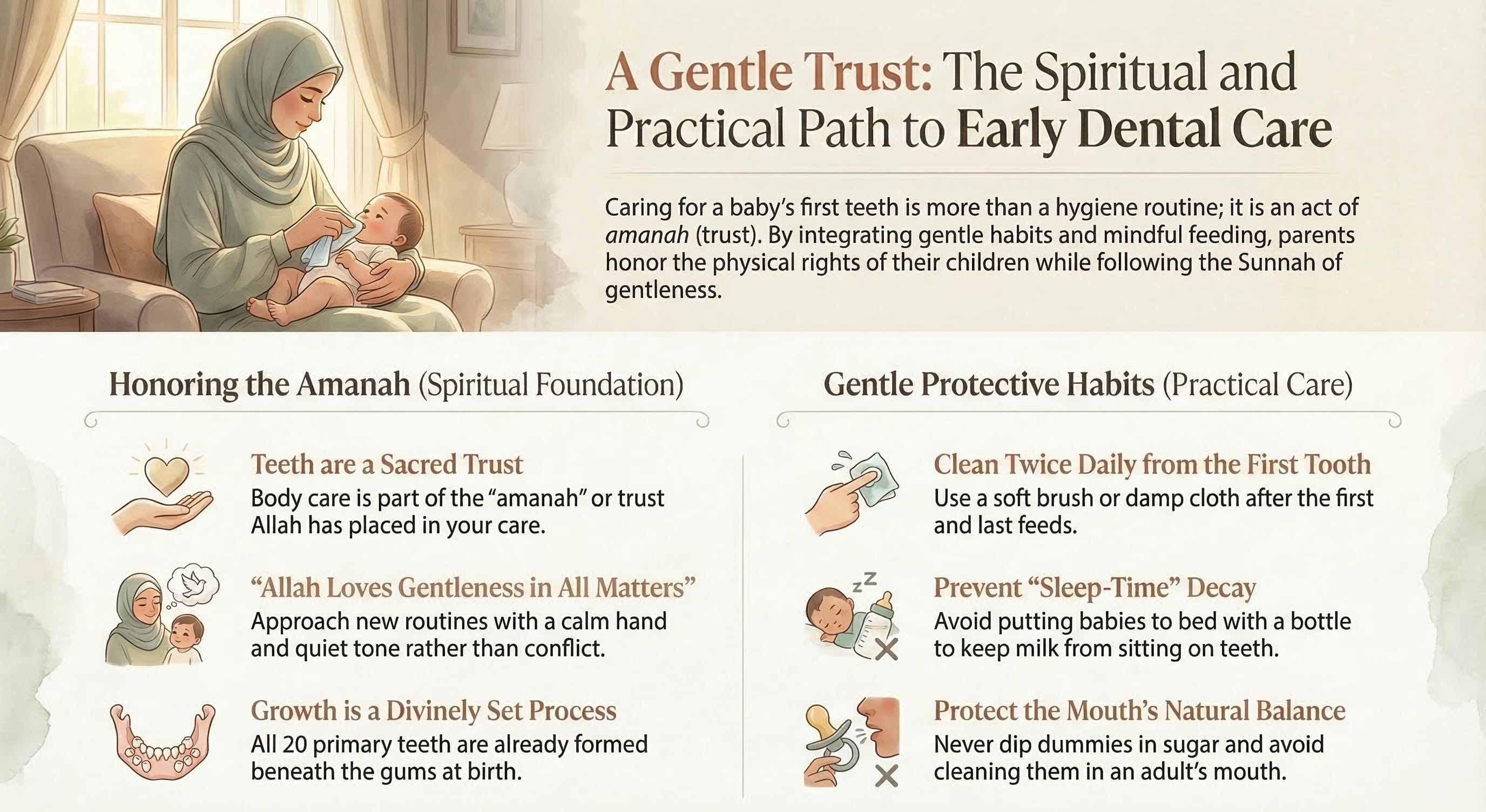
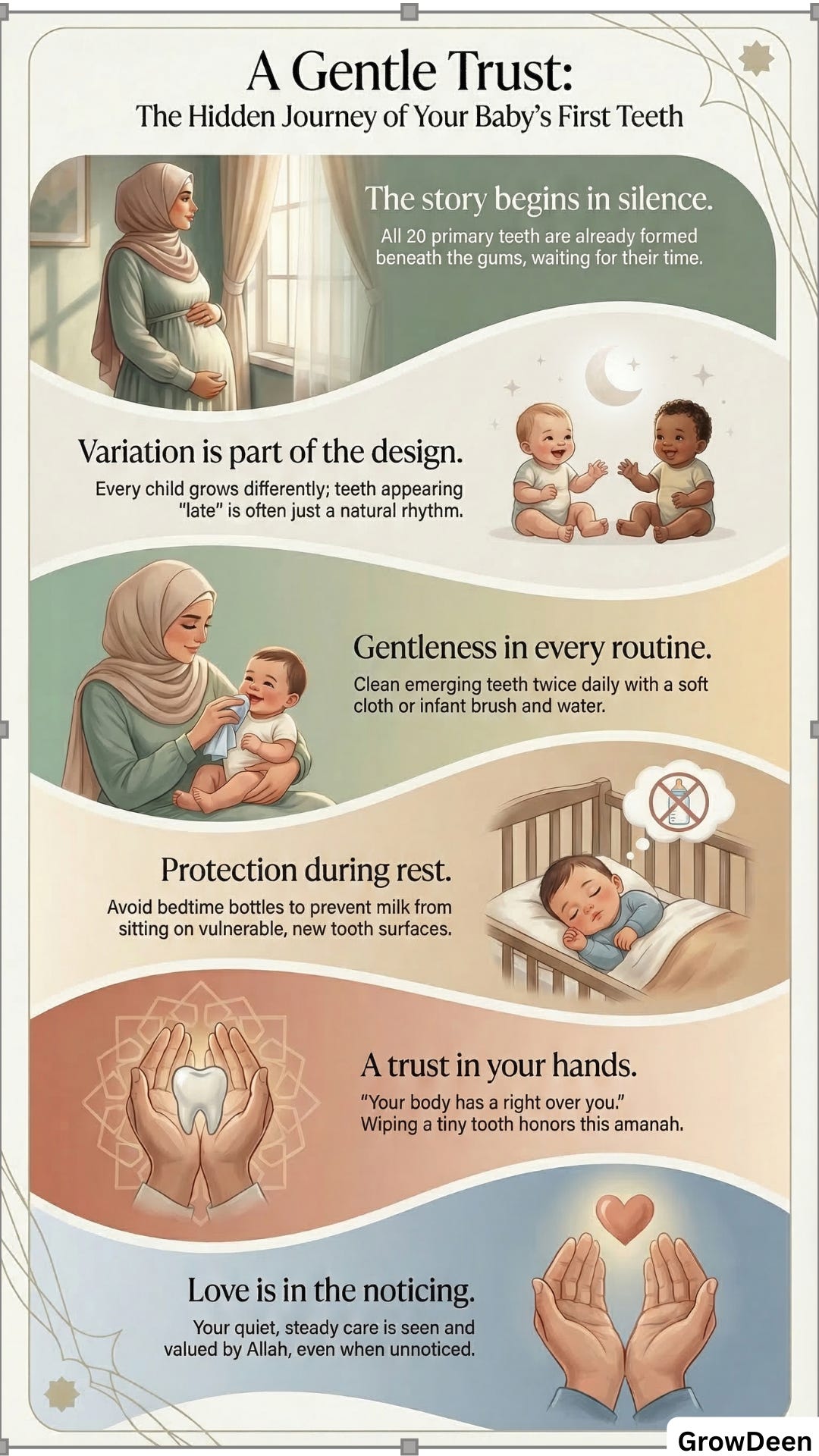
Your baby is born with all 20 primary teeth already formed beneath the gums, waiting for their own time to come through. [1] [2] That alone settles something in the heart. What you are seeing unfold is not random. It is part of a process Allah already set in motion long before you held your baby in your arms.
And that process does not look identical in every child. One baby gets a tooth early. Another stays beautifully gummy for much longer. That variation, by itself, is not a sign that something has gone wrong. [1]
The timeline is not as rigid as tired parents fear
Many babies get their first tooth somewhere between 6 and 10 months.
Some start much earlier. Some much later. Some follow the usual order. Some do not seem to care about the usual order at all. [1] [2]
That can be hard for a parent, because we are always quietly checking. Is this normal? Is this too soon? Too late? Am I missing something?
Sometimes the most soothing answer is simply this: children grow with variation built into them.
Allah says, “Allah does not burden a soul beyond that it can bear.” [16]
Even that verse can meet a parent here. Not because teething is a huge trial compared to life’s bigger tests, but because these small uncertainties add up in the newborn months. And Allah knows that too.
Allah’s gentleness belongs in mouth care too
Once the first tooth appears, care begins.
Not harsh care. Not complicated care. Just a gentle beginning.
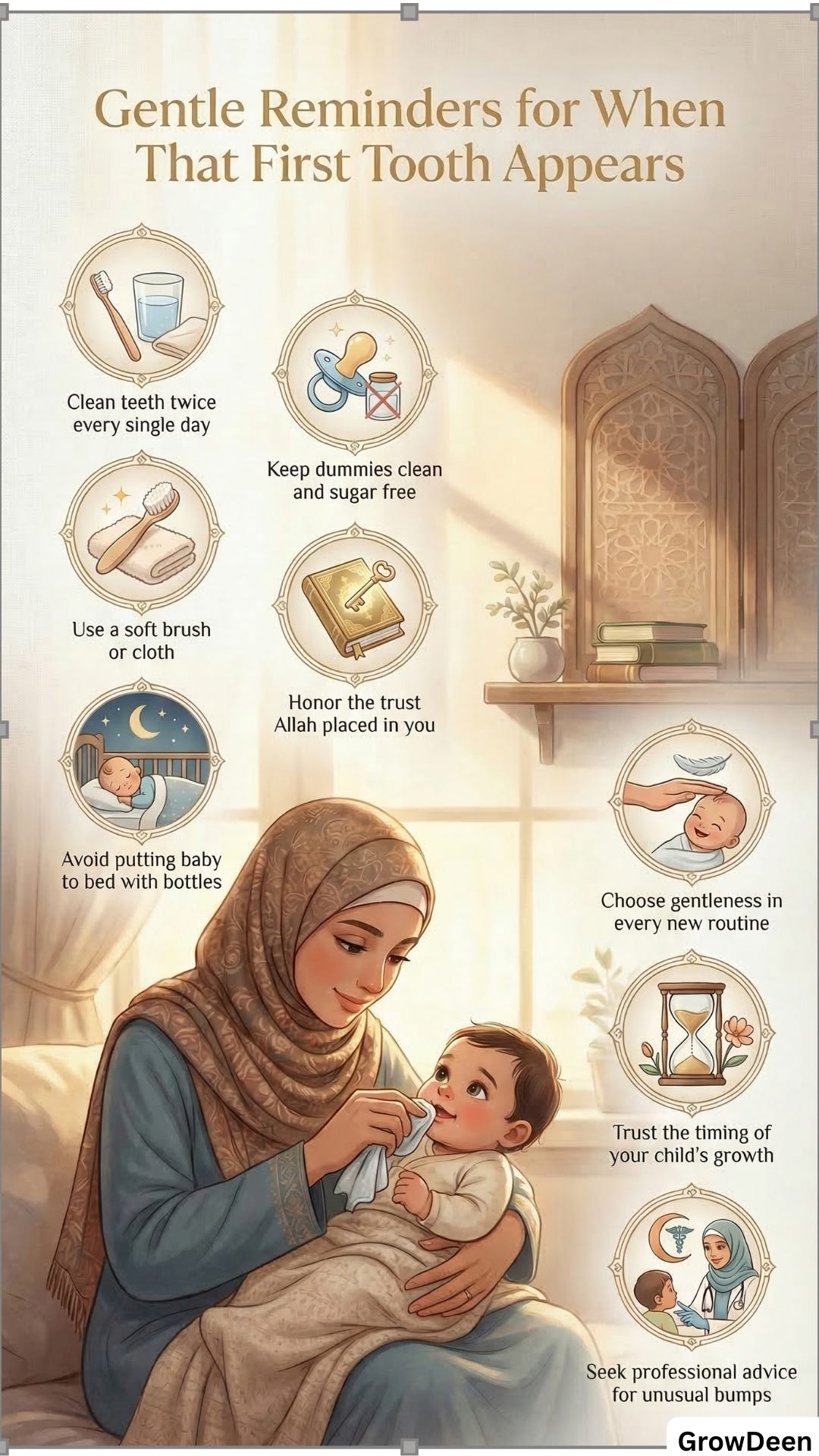
A soft infant toothbrush for children under two, used with water, is usually enough. If your baby hates the brush, a clean damp face washer or a piece of gauze can be an easier starting point. The aim is simply to clean the tooth surface twice a day, especially after the first and last feeds. [2] [7]
There is something tender about this stage. You are not scrubbing. You are introducing care.
The Prophet ﷺ said, “Allah is gentle and loves gentleness in all matters.” [12]
That gentleness matters here more than people realize. A calm hand. A quiet tone. Not turning every new routine into a battle. Your baby may resist at first. That does not mean you are doing it wrong. It just means you are both learning.
A trust hidden inside ordinary routines
For Muslim parents, body care is never just mechanical.
It is part of amanah.
Allah says, “Indeed, Allah commands you to render trusts to whom they are due...” [11]
And the Prophet ﷺ said, “Your body has a right over you.” [13]
When I think about early dental care through that lens, it changes the feeling of it. Wiping a tiny tooth after a feed does not look impressive from the outside. No one applauds it. But it is still part of honoring a trust.
You are protecting what Allah placed in your care.
You are noticing before neglect has a chance to settle in.
If gentle, Islamically grounded support for these early parenting moments would help you, subscribe for free so each new article and life gift reaches you without adding one more thing to search for later.
Some feeding habits feel loving but quietly cause harm
One of the hardest parts of parenting is that something soothing in the short term is not always kind in the long term.
Baby teeth are vulnerable as soon as they appear. [5] [6] That is why feeding habits begin to matter early. Before solids, babies should be fed only breastmilk or infant formula. [3] And breastfeeding itself carries both health benefit and deep dignity in Islam.
Allah says, “Mothers may breastfeed their children for two complete years for whoever wishes to complete the nursing period.” [9]
And He says, “His mother carried him in weakness upon weakness, and his weaning is in two years.” [10]
But even milk, when it sits around the teeth repeatedly, especially during sleep, can contribute to tooth decay. During sleep there is less saliva in the mouth to help protect the teeth. [4] [5] [6] That is one reason putting a baby to bed with a bottle is discouraged. It increases the risk of early tooth decay and also brings a choking risk. [5] [6]
This is not about guilt. It is about noticing the quiet places where protection begins.
The little things people sometimes overlook
If your baby uses a dummy, it should not be dipped in honey, sugar, or anything sweet. [7] It also should not be cleaned in an adult’s mouth. It needs proper washing and sterilising instead. [7]
That may seem small, but mouths are full of bacteria, and newborn mouths are delicate places.
Allah says, “Do not pursue that of which you have no knowledge.” [15]
There is wisdom in that for parenting too. We do not just go by habit, family sayings, or whatever someone once did. We pause. We learn. We choose what is sound.
And there are other little surprises that may appear in the mouth too. Some babies have tiny pale bumps on the gums that look alarming at first. These may be harmless findings such as Bohn’s nodules or Epstein pearls, which often disappear on their own in the first months. [8]
When reassurance is enough and when a professional should look
Not every unusual thing needs treatment.
But some things do deserve a proper look.
If a baby is born with teeth, or if you notice a bump or mouth finding that makes you hesitate, it is sensible to let a dentist, family doctor, or pediatrician examine it. [2] [8] A natal tooth may be stable and harmless, or it may need attention if it is loose, affects feeding, or creates risk. [8]
That is part of responsible care, not overreaction.
The Prophet ﷺ said, “Each of you is a shepherd and each of you is responsible for his flock.” [14]
There is no panic in that hadith. Only steadiness. Responsibility. Presence.
And really, that is what early parenting asks for again and again. Not perfection. Just steady noticing.
Protection often looks quiet
So much of newborn care is made of things no one celebrates.
A clean dummy.
A soft brush.
A wiped tooth after a feed.
A parent choosing not to hand over a bedtime bottle because they now understand what it could lead to.
These are quiet acts. But quiet acts shape a child’s future more than we think.
If you are trying to care well for your baby in these small hidden ways, that effort matters. It is seen by Allah even when no one else notices it.
And if you are still learning, still unsure, still pausing over every new little change in your baby’s mouth, that too is part of caring. A careful parent often looks uncertain from the outside.
But uncertainty that leads to attention is not weakness.
It is love doing its work.
GIFTS FOR YOU, DEAR PARENT
If you’ve reached this part of the page, it tells me something meaningful about you.
You weren’t just skimming or passing time. You stayed because something here felt relevant to your real life.
Because you care.
Because you want to do things with more awareness.
Because you’re trying, even when it feels overwhelming.
That is not small.
So I didn’t want this article to remain just words on a page. I wanted it to gently step into your daily life in practical ways. That’s why we prepared these Life Gifts for you.
Not as extras.
Not as decorations.
But as simple tools to help you hold onto what mattered most in what you just read.
Here’s what you’ll find inside:
Gentle Understanding Card
A clear and simplified summary of the core concept from this article, so you can revisit the main idea anytime without rereading everything.
Heartfelt Dua Card
A carefully chosen dua connected to this stage of life, because we know that real strength and ease ultimately come from Allah’s help.
Gentle Actions Card
Practical examples to help you translate knowledge into action, so what you learned becomes part of your daily rhythm.
Gentle Reminders Card
Short, steady reminders drawn from the key points, designed to be printed or saved and placed somewhere you’ll see often.
These were designed slowly and thoughtfully, with time, care, and sincere dua. We created them because we genuinely want to walk alongside you, not just through one article, but through every stage of this lifelong journey.
If these gifts support you even in a small way, I would love for you to continue receiving them.
Subscribe so that each new Gift arrives directly in your inbox whenever we release the next stage. That way, you won’t miss the tools designed to support you right where you are.
May Allah place barakah in your effort, accept your intention, and make this path easier and more rewarding than it feels right now.
Please share it with a family/friend who may benefit from this knowledge.
What is one moment with your child that feels hardest lately, and what kind of support would make it feel lighter?
Subscribe for free to keep receiving gentle, research rooted, Islamically grounded support for the real moments of parenting.
References
[1] Christian, P., & Evans, C. (2024). Infancy, childhood, and adolescence. In C. Geissler & H. Powers (Eds), Human nutrition (14th edn, Chapter 14). Oxford University Press.
[2] American Academy of Pediatric Dentistry (AAPD). (2024). Periodicity of examination, preventive dental services, anticipatory guidance/counseling, and oral treatment for infants, children, and adolescents. The Reference Manual of Pediatric Dentistry (pp. 293-305). AAPD.
[3] National Health and Medical Research Council (NHMRC). (2012, updated 2015). Infant feeding guidelines: Information for health workers. NHMRC.
[4] Peres, K.G., Chaffee, B.W., Feldens, C.A., Flores-Mir, C., Moynihan, P., & Rugg-Gunn, A. (2018). Breastfeeding and oral health: Evidence and methodological challenges. Journal of Dental Research, 97(3), 251-258.
[5] American Academy of Pediatric Dentistry (AAPD). (2020). Policy on early childhood caries (ECC): Classifications, consequences, and preventive strategies. The Reference Manual of Pediatric Dentistry (pp. 79-81). AAPD.
[6] Tinanoff, N., Baez, R.J., Diaz Guillory, C., Donly, K.J., Alberto Feldens, C., McGrath, C., Phantumvanit, P., Pitts, N.B., Kim Seow, W., Sharkov, N., Songpaisan, Y., & Twetman, S. (2019). Early childhood caries epidemiology, aetiology, risk assessment, societal burden, management, education, and policy: Global perspective. International Journal of Paediatric Dentistry, 29(3), 238-248.
[7] Welti, R., Chinotti, M., Walsh, O., Arcus, M., Asgari, J., Phillips, K., Wallace, J., Do, L., Moynihan, P., & Silva, M. (2023). Oral health messages for Australia: A national consensus statement. Australian Dental Journal, 68(4), 247-254.
[8] Zen, I., Soares, M., Sakuma, R., Inagaki, L.T., Pinto, L.M.C.P., & Dezan-Garbelini, C.C. (2020). Identification of oral cavity abnormalities in pre-term and full-term newborns: A cross-sectional and comparative study. European Archives of Paediatric Dentistry, 21, 581-586.
[9] Qur’an, Surah Al-Baqarah 2:233
[10] Qur’an, Surah Luqman 31:14
[11] Qur’an, Surah An-Nisa 4:58
[12] Sahih Muslim 2593
[13] Sahih al-Bukhari 1968
[14] Sahih al-Bukhari 7138; Sahih Muslim 1829