
The Quiet Danger in the Bathroom Most Parents Underestimate
What Parents Need to Remember Before Running the Bath

Free gift for you! A practical companion resource is waiting for you near the end of this article to help you remember, apply, and benefit from what you read. Don’t forget to download!
Bath-time drowning prevention depends on constant close supervision, reduced distractions, simple water-safety habits, and a calm sense of responsibility that treats a child’s safety as both a practical duty and a trust before Allah.
Bath time can feel so ordinary that the danger almost disappears inside the routine.
A little water.
A warm room.
A tired child.
A parent already thinking about pajamas, tomorrow’s clothes, the cup still sitting in the sink, the message they forgot to answer, the towel they meant to bring in before turning on the tap.
That is part of what makes bath-time drowning so frightening. Not because it usually begins with chaos. But because it usually begins with a very normal evening.
And that is exactly why this subject needs plainness.
Bath-time drowning is a serious risk for babies and young children, and they must never be left alone in the bath. [1][4][5][7][8]
It happens faster, quieter, and in less water than people expect
Many adults still carry the wrong picture of drowning in their minds.
They imagine noise.
Thrashing.
A cry for help.
A dramatic scene that would be impossible to miss.
But often it does not look like that at all.
Very young children are especially vulnerable because their bodies and judgment are not ready to protect them. They are top-heavy. They slip easily. They do not understand the hazard. And once they are in difficulty, they do not know how to rescue themselves. [1][4]
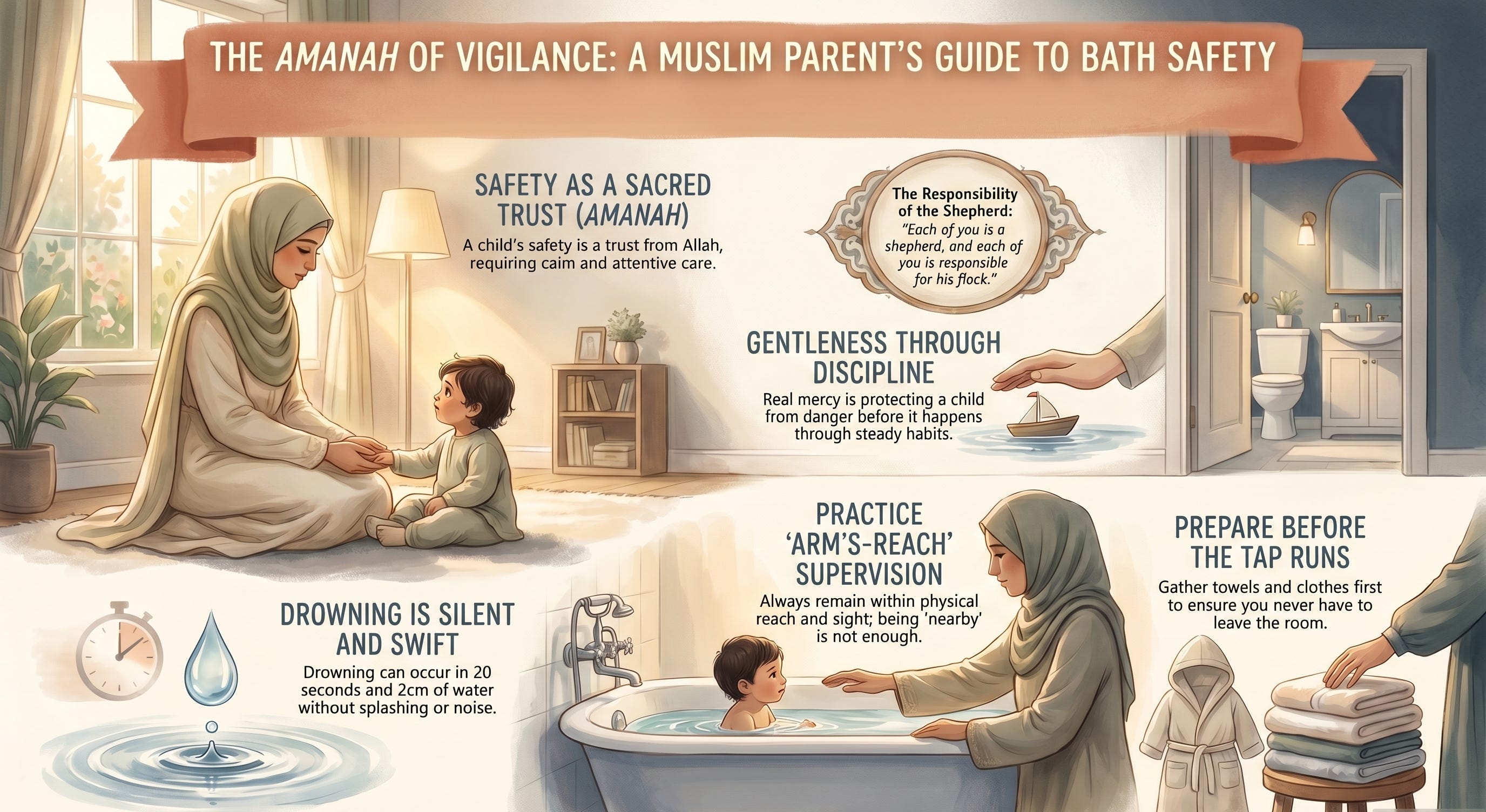
A child can slide under suddenly, even in very shallow water. Drowning can happen in only a few centimetres of water and in about 20 seconds, silently, without the splashing adults expect. [1] The American Academy of Pediatrics makes the same point in slightly different words: infants can drown in as little as 1 or 2 inches of water. [8]
That is what catches people.
The bathroom can sound quiet.
The room can feel calm.
And danger can still be unfolding.
Drowning remains one of the major causes of death for children under five. The World Health Organization says children under 5 account for nearly a quarter of all drowning deaths worldwide, and the CDC says drowning is the leading cause of death for children aged 1 to 4 in the United States. Bath-time drowning is not a bizarre, freak accident. It belongs to a pattern of preventable child injury that families need to take seriously. [7][8]
Nearby is not the same as present
This may be one of the hardest truths for tired parents, because many of us have learned to live in divided attention.
You are in the room, but half-thinking about the laundry.
You are one step away, but reaching for the towel.
You are listening for the baby, but glancing at the phone.
You are “basically there.”
For bath safety, that is not enough.
A child should be within arm’s reach and sight at all times. [1] That is the standard because drowning happens quickly and quietly enough that “I was just nearby” does not offer the protection people imagine it does.
Bath time often comes at the end of the day, when everyone is already tired and trying to do several things at once. [1] Research on fatal drowning cases in children aged 0 to 4 has shown that caregiver distraction and supervision lapses are a major part of what goes wrong. [2] It is not always reckless neglect. Sometimes it is divided attention. Another child calls out. The phone rings. Someone knocks at the door. A parent suddenly remembers the clean nappy is in the other room.
That is why the safest bath routine is the one that is already simplified before the water runs.
The safest bath usually starts before the child goes in
A lot of prevention lives in preparation.
Not dramatic preparation.
Just ordinary preparation done every time.
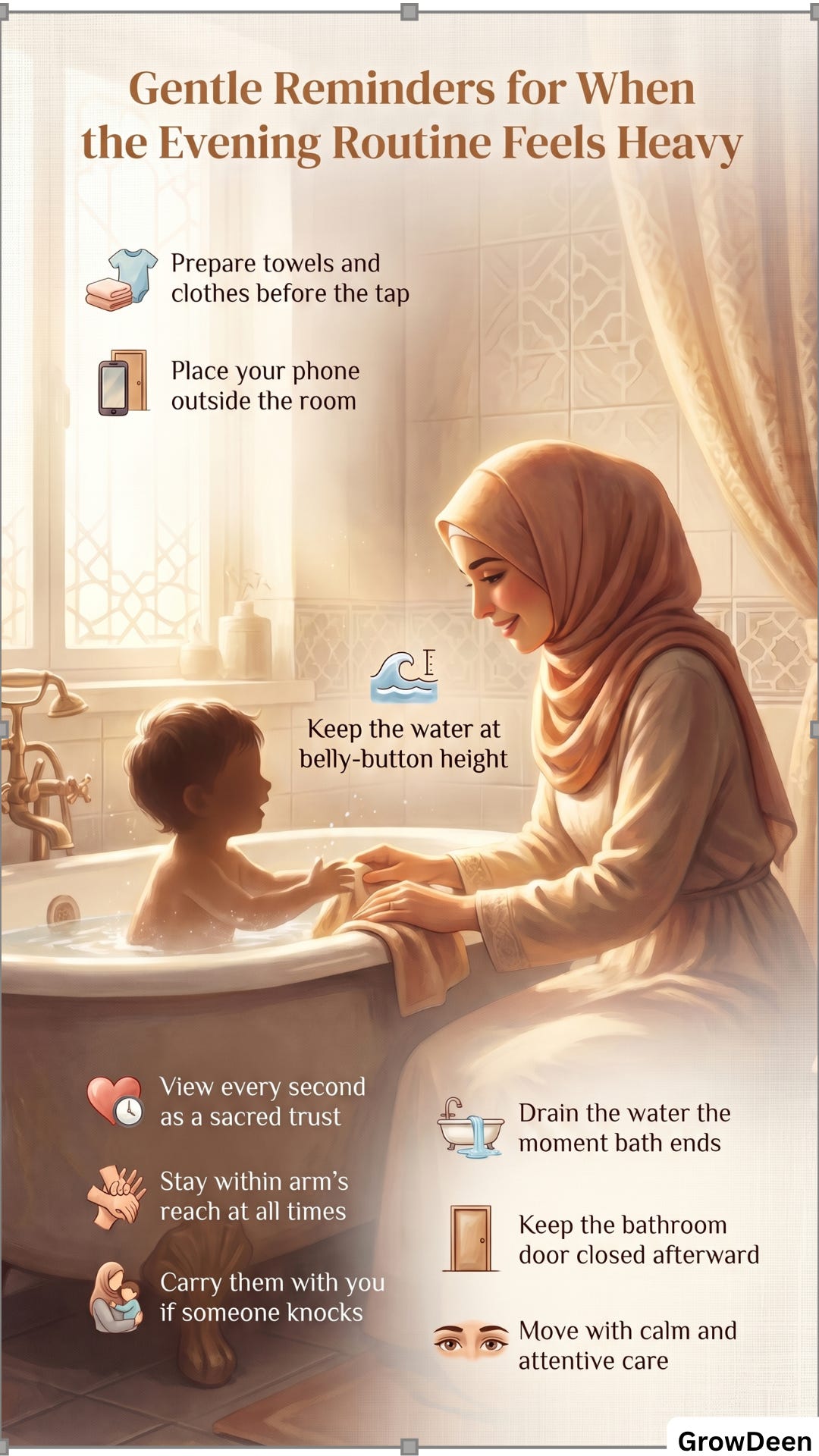
Get the towel ready first.
Get the clean nappy ready first.
Get the clean clothes ready first.
Have the washcloth there.
Have whatever else you know you will need already within reach. [1]
If your phone is likely to distract you, silence it and leave it outside the bathroom. [1][2]
If someone knocks at the door, wrap the child in a towel and take them with you. [1]
These habits may seem almost too simple to matter. But simple habits are often exactly what make supervision real. They remove the moment where a parent tells themselves, I’ll only be gone for a second.
And honestly, that sentence is where a lot of risk begins.
There is also wisdom in making bath time smaller than many people imagine it needs to be. Children do not need deep water for washing or play. Belly-button height is enough for a child who can sit up independently. [1] A non-slip mat can help if the surface is slippery. [1] Once bath time is over, let the water out immediately. Keep bathroom and laundry doors shut when they are not in use. Keep plugs out of reach so young children cannot refill baths or sinks themselves. [1][6][8]
These are not grand safety systems.
They are just the little doors through which danger usually enters, closed one by one.
[PLACE FIRST INLINE VISUAL HERE — Gentle Understanding Card]
Some of the things people trust most are not actually safety devices
Bath seats and bath cradles need this kind of honesty.
They can help support a child physically, but they are not safety devices and they cannot keep a child safe without active adult supervision. [1][5] Royal Life Saving guidance says the same thing clearly: bath aids can support the child, but they do not replace hands-on adult supervision. [5]
That matters because products often create a false sense of reassurance.
The child looks supported.
The setup looks stable.
The parent feels they have made things safer.
But if that confidence leads to divided attention, then the aid has quietly made the situation more dangerous, not less.
Older siblings are not substitutes either. They should never be left to supervise younger children in the bath because they do not have the skills to spot an emergency and respond properly. [1] Families can be tempted by this, especially when life is busy and an older child seems sensible or caring.
But loving is not the same as being able to rescue.
Layers of protection matter because one habit can fail
The broader drowning literature supports layered prevention.
The idea is simple. Safety is stronger when several protections sit together: active supervision, restricting unsupervised access to water, creating safer environments, and having adults who know what to do if something goes wrong. [5][7]
In bath time, that looks like this:
Eyes on the child.
Water kept shallow.
Everything prepared in advance.
Doors closed afterward.
Plugs out of reach.
Bath emptied immediately.
Attention not wandering.
That is what real prevention looks like in an ordinary bathroom.
Not fear.
Not a long speech.
Just several quiet protections sitting together.
And first aid belongs in that same picture. Learning first aid, refreshing first-aid training every few years, and updating CPR skills yearly are sensible steps. [1] This is not because parents are supposed to live with dread in their chests. It is because they should not be helpless if something goes wrong. Readiness is part of care. [6]
If writing like this helps you feel steadier in the real work of parenting, subscribe for free so the next article arrives in your inbox when it’s ready.
Allah’s gentleness is present in careful supervision
From an Islamic point of view, bath-time safety sits naturally under amanah.
A child in the bath is fully dependent on the adult nearby. Allah says, “Indeed, Allah commands you to render trusts to whom they are due.” [9]
A child’s life and safety are among the clearest trusts a parent or carer will ever hold.
And Allah says, “And do not throw yourselves with your own hands into destruction.” [10]
Preventable carelessness belongs under that warning. Not because Islam wants a parent to become harsh or anxious. But because responsibility in Islam is real, concrete, and often found in very ordinary details.
The Prophet ﷺ said, “Each of you is a shepherd, and each of you is responsible for his flock.” [11]
That hadith reaches directly into daily parenting. Not only the big decisions. The little ones too. Bath time. Feeding time. Fastening the car seat. Staying in the room. Putting the phone away. Taking the child with you instead of gambling on “one second.”
And yet the tone here is still gentleness.
The Prophet ﷺ also said, “Allah is gentle and loves gentleness in all matters.” [12]
Gentleness does not mean carelessness. It means calm, attentive care. It means not rushing through bath time with your mind split across three other tasks. It means slowing down enough to protect what has been entrusted to you.
There is mercy in prevention.
The Prophet ﷺ showed tenderness toward children openly. [13] Real mercy is not only comforting a child after danger. It is protecting them before danger happens. It is the quiet discipline of preparing first, staying close, and refusing the little shortcuts that adults take when routine starts to feel too familiar.
The safest habit is the one you repeat every single time
Parents are not being asked to control everything.
Children are lively.
Bath time can be messy.
Even a calm routine can unravel if the day has been long enough.
But bath safety is one of those areas where the protective steps are not actually complicated.
Stay close.
Stay focused.
Use little water.
Empty it right away.
Shut the doors.
Learn CPR.
Repeat the same safe habits every time. [1][5][6][7][8]
Allah says, “Allah does not burden a soul beyond what it can bear.” [14]
There is relief in that.
Because this is not a topic that asks for perfection in everything. It asks for seriousness in something very specific. An ordinary room. A little water. A small child who trusts you completely.
That is the real shape of bath-time drowning prevention.
Not a dramatic warning.
Just steady habits in an ordinary room, done faithfully enough that an ordinary room stays safe.
GIFTS FOR YOU, DEAR PARENT
If you’ve reached this part of the page, it tells me something meaningful about you.
You weren’t just skimming or passing time. You stayed because something here felt relevant to your real life.
Because you care.
Because you want to do things with more awareness.
Because you’re trying, even when it feels overwhelming.
That is not small.
So I didn’t want this article to remain just words on a page. I wanted it to gently step into your daily life in practical ways. That’s why we prepared these Life Gifts for you.
Not as extras.
Not as decorations.
But as simple tools to help you hold onto what mattered most in what you just read.
Here’s what you’ll find inside:
Gentle Understanding Card
A clear and simplified summary of the core concept from this article, so you can revisit the main idea anytime without rereading everything.
Heartfelt Dua Card
A carefully chosen dua connected to this stage of life, because we know that real strength and ease ultimately come from Allah’s help.
Gentle Actions Card
Practical examples to help you translate knowledge into action, so what you learned becomes part of your daily rhythm.
Gentle Reminders Card
Short, steady reminders drawn from the key points, designed to be printed or saved and placed somewhere you’ll see often.
These were designed slowly and thoughtfully, with time, care, and sincere dua. We created them because we genuinely want to walk alongside you, not just through one article, but through every stage of this lifelong journey.
If these gifts support you even in a small way, I would love for you to continue receiving them.
Subscribe so that each new Gift arrives directly in your inbox whenever we release the next stage. That way, you won’t miss the tools designed to support you right where you are.
May Allah place barakah in your effort, accept your intention, and make this path easier and more rewarding than it feels right now.
Please share it with a family/friend who may benefit from this knowledge.
What is one moment with your child that feels hardest lately, and what kind of support would make it feel lighter?
You do not need to approach bath time with panic.
You do not need to become frightened of every splash.
You just need habits simple enough, and serious enough, to hold steady even on a tired evening.
May Allah place barakah in your care, steadiness in your hands, and protection around the child entrusted to you. May He make your home safer, your attention calmer, and your parenting heavier with mercy than with fear.
Subscribe for free if you’d like more warm, evidence-based, Islamically grounded support for the real work of raising children.
References
[1] Chang, S.S.M., & Ozanne-Smith, J. (2020). Drowning mortality in children aged 0–14 years in Victoria, Australia: Detailed epidemiological study 2001–2016
[2] Peden, A.E., & Franklin, R.C. (2020). Causes of distraction leading to supervision lapses in cases of fatal drowning of children 0–4 years in Australia: A 15-year review
[3] Peden, A.E., Franklin, R.C., & Pearn, J.H. (2020). The prevention of child drowning: The causal factors and social determinants impacting fatalities in portable pools
[4] Peden, A.E., Franklin, R.C., & Pearn, J.H. (2018). Unintentional fatal child drowning in the bath: A 12-year Australian review (2002-2014)
[5] Royal Life Saving Australia. Royal Life Saving National Drowning Report 2022, Royal Life Saving Society Australia bath-time safety guidance
[6] Simpson, J.C., & Nicholls, J. (2012). Preventing unintentional childhood injury at home: Injury circumstances and interventions
[7] World Health Organization. Drowning fact sheet and drowning prevention guidance
[8] American Academy of Pediatrics / HealthyChildren.org, CDC drowning prevention guidance
[9] Qur’an, Surah An-Nisa 4:58
[10] Qur’an, Surah Al-Baqarah 2:195
[11] Sahih al-Bukhari 7138
[12] Sahih Muslim 2593
[13] Sahih al-Bukhari 5998