
The Quiet Constipation Cycle Many Parents Miss
A Gentle Way Through Constipation in Babies and Children

When a child starts fearing the toilet because passing stool hurts, early gentle care, calm routines, and timely medical support can help break the cycle before constipation becomes a bigger burden.
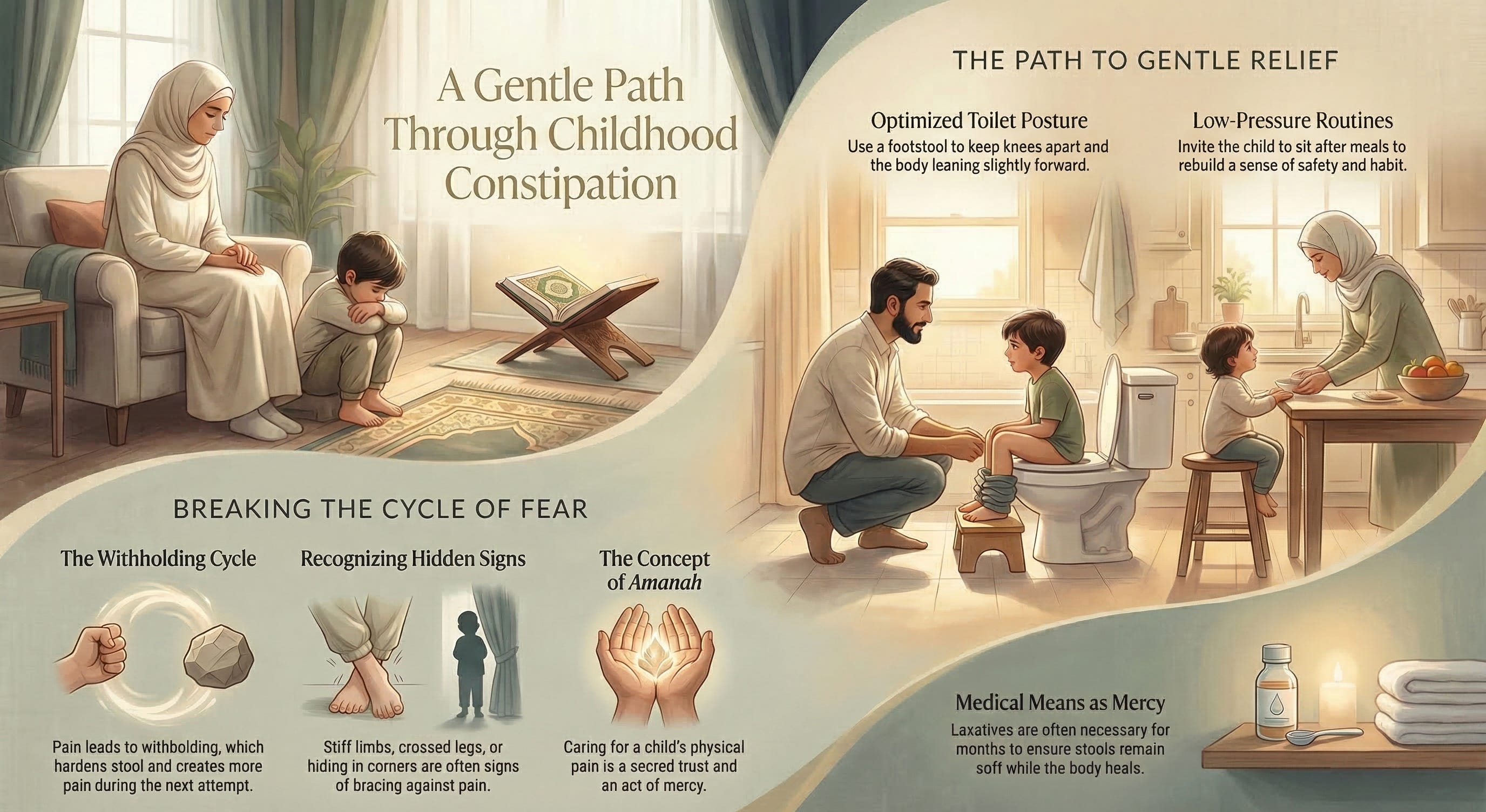
You see it before your child says a word.
The stiff little body. The crossed legs. The fidgeting. That strange half panic on their face when you gently say, “Do you need the toilet?”
Maybe yesterday there was crying. Maybe there was one hard poo that hurt more than usual. Maybe now they are trying not to go at all.
And suddenly something that should have been ordinary has become a daily tension in your home.
If you have been watching this happen, feeling worried, unsure, maybe even a little helpless, you are not overreacting. Constipation can quietly grow into a real source of pain for a child, and for a parent, it can feel surprisingly heavy too. [1] [2] [4] [5] [6] [8] [9] [10]
When the body starts remembering pain
One of the hardest parts of constipation is that it often feeds itself.
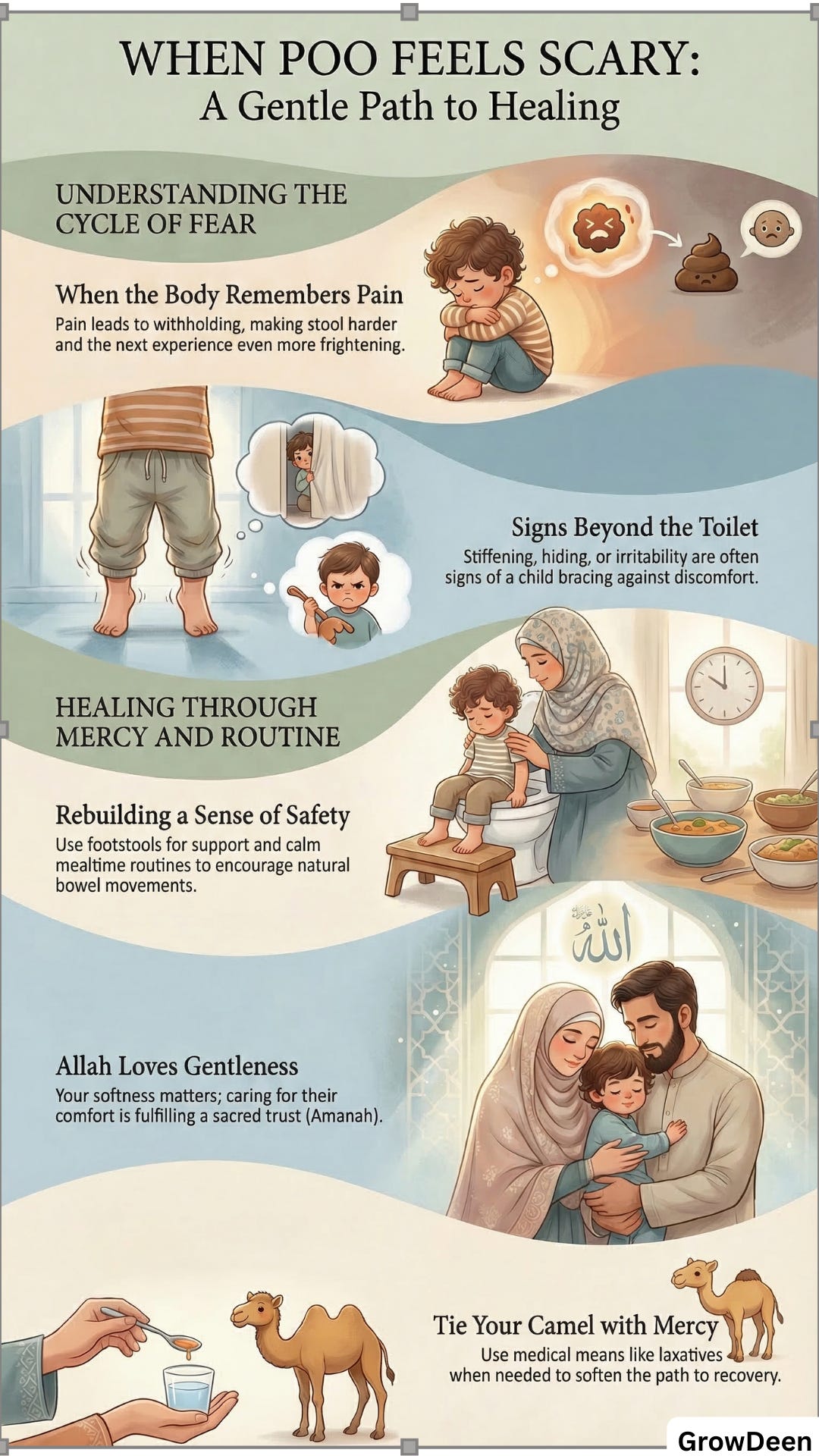
A child passes one hard stool. It hurts. So next time, they hold it in. The stool stays inside longer, more water gets pulled out of it, and it becomes even harder to pass. Then the next experience hurts even more. [1] [2] [4] [5] [6] [8] [9] [10]
That is why some children begin rocking, crossing their legs, hiding in corners, refusing the toilet, or acting restless in ways that do not make sense at first. They are not always being difficult. Sometimes they are bracing themselves.
And constipation is not only about how often a child poos. Some children go a few times a day. Others go far less often and are still fine if the stool is soft and easy to pass. What matters is the full picture: pain, difficulty, hard stool, large stool, fear, withholding. [2] [6] [8] [9] [10]
The signs can look smaller than they really are
Sometimes constipation shows up in ways that do not immediately seem connected.
A child may complain of tummy pain on and off. They may become irritable. They may not want to sit on the toilet. Some develop tiny tears around the anus from passing hard stool, and then a little blood appears. That can make the next bowel motion feel even more frightening. [4] [5] [8] [10]
In longer standing cases, some children soil their underwear without meaning to. This can be deeply upsetting for them and confusing for parents. But it is often a sign that stool has been building up and softer stool is leaking around it. It is not laziness. It is not carelessness. [3] [4] [8] [10]
This is one of those moments when your child needs dignity more than frustration.
Allah says, And speak to people good words. [13]
Even when you are tired, your softness matters.
What may be sitting underneath it
A lot of constipation begins with holding.
Sometimes a child does not want to stop playing. Sometimes school toilets feel uncomfortable or embarrassing. Sometimes they are simply trying to avoid repeating a painful experience. [1] [4] [6] [8] [9] [10]
Food and fluids matter too. If a child is not getting enough fibre, or has been eating and drinking less because of illness or routine changes, stools can become firmer and harder to move. [1] [5] [6] [8] [9] [10]
Most constipation in children is functional. That means it is usually not caused by a rare disease, but by a mix of bowel habits, stool withholding, and daily patterns. [4] [5] [6] [7] [10]
There is a quiet relief in knowing that. Not because it is trivial. It is not. But because it means many children can improve with steady, practical support.
Allah’s gentleness reaches into ordinary caregiving
For Muslim parents, this is not a small or awkward issue to ignore.
A child’s body is an amanah. Their pain matters. Their fear matters. Helping them early is part of care, part of mercy, part of fulfilling trust.
The Prophet ﷺ said, Your body has a right over you. [11]
He also said, There should be neither harming nor reciprocating harm. [12]
And there is something so beautiful here: constipation care is not only about bowel habits. It is also about how we respond to a child who is uncomfortable, ashamed, or afraid. We do not mock. We do not expose. We do not make them feel small.
The Prophet ﷺ said, Allah is gentle and loves gentleness in all matters. [16]
That includes this.
If this kind of grounded, Islamic, practical support helps you feel less alone in everyday parenting moments, subscribe for free so new articles and gentle life gifts come straight to your inbox.
Small things that often help more than we expect
Most of the time, support begins with very ordinary things.
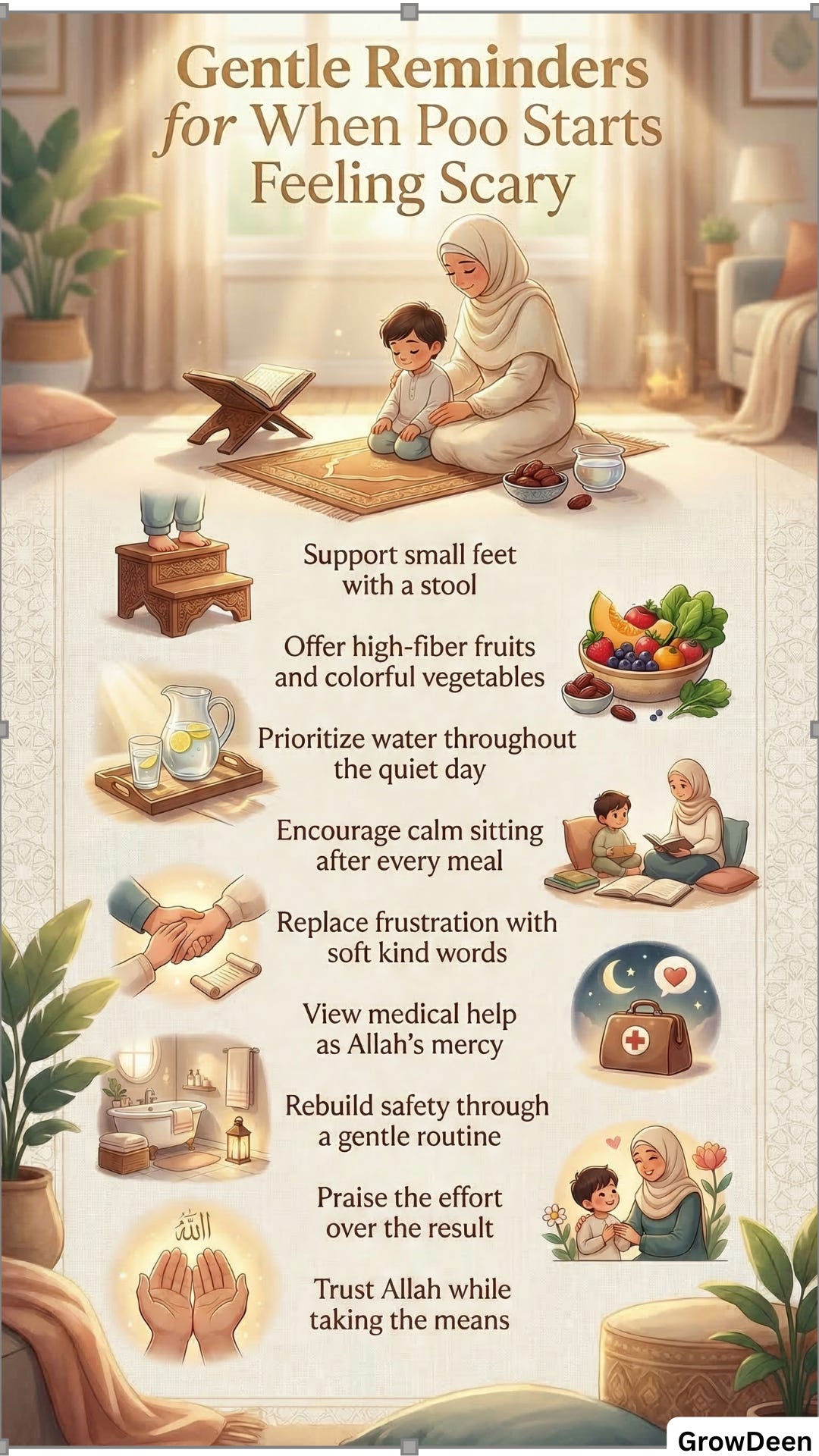
A little more fibre through fruit, vegetables, and wholegrains. A little more attention to drinking. A calmer toilet rhythm. [5] [6] [8] [9] [10]
Some children find it much easier to pass stool when their feet are supported, knees apart, and body leaning slightly forward. A small footstool under their feet can help more than many parents realize. Some little ones also feel more secure on a potty than on a large toilet. [5] [6] [8] [9] [10]
There is also benefit in inviting them to sit on the toilet for a few minutes after meals, especially after breakfast or dinner, because that is when the body naturally tries to move the bowel. [5] [6] [8] [9] [10]
Not with pressure. Not with a battle.
Just gentle routine.
Praise can help too, even if nothing happens that time. What you are trying to rebuild is not only bowel movement. You are rebuilding safety.
When medicine becomes part of mercy
Sometimes diet and routine are not enough on their own.
If stool has already become hard and the child has started fearing the toilet, laxatives are often an important part of treatment. They help soften stool or help the bowel move it along, which can begin to break that painful cycle. [5] [6] [8] [9] [10]
Some children need this support for longer than families expect, sometimes for months rather than days. That can feel surprising, but it is part of properly settling the problem instead of only getting one quick result. [7] [8] [10]
The goal is not just to make a child poo once.
The goal is to help poo become soft, regular, and no longer something they dread.
And if you are hesitating to seek help because it feels embarrassing or you keep hoping it will pass on its own, remember the teaching of the Prophet ﷺ: Tie it and trust in Allah. [15]
You take the means. Then you place your trust in Allah.
Babies can struggle too
Constipation in babies can look a little different.
You may notice dry, pellet like stool, visible straining, or clear discomfort when they try to poo. If that is happening, it is wise to speak with a GP or child and family health nurse. [1] [4] [5] [8] [9] [10]
Breastfed babies are rarely constipated, though their patterns can change a lot. Some go very often at first and then much less later on, while still being completely normal if the stool stays soft and they are growing well. [4] [5] [8] [9]
Formula fed babies can also have a wide range of normal, but hard stool may sometimes point to constipation or formula preparation issues. Babies starting solids may pass firmer stools at first too. [1] [4] [5] [8] [9]
And just like with older children, early care matters. A painful stool can create the same cycle of fear and holding back. [4] [5] [8] [10]
When not to wait it out
Some situations need medical advice sooner.
If a child is under 12 months, has fever, vomiting, blood in the stool, poor weight gain, severe tummy pain, or is simply not improving with simple home support, it is time to get them checked. [5] [6] [8] [9] [10]
This is not being dramatic. It is being careful.
And if you are walking through this slowly, patiently, one bathroom trip at a time, hold onto this:
Indeed, Allah is with the patient. [17]
Improvement often comes quietly. Bit by bit. Through calm repetition, wise support, and a child who slowly stops being afraid.
You are not failing because this takes time.
You are caring for your child in a hard, hidden moment. That matters more than you know.
GIFTS FOR YOU, DEAR PARENT
If you’ve reached this part of the page, it tells me something meaningful about you.
You weren’t just skimming or passing time. You stayed because something here felt relevant to your real life.
Because you care.
Because you want to do things with more awareness.
Because you’re trying, even when it feels overwhelming.
That is not small.
So I didn’t want this article to remain just words on a page. I wanted it to gently step into your daily life in practical ways. That’s why we prepared these Life Gifts for you.
Not as extras.
Not as decorations.
But as simple tools to help you hold onto what mattered most in what you just read.
Here’s what you’ll find inside:
Gentle Understanding Card
A clear and simplified summary of the core concept from this article, so you can revisit the main idea anytime without rereading everything.
Heartfelt Dua Card
A carefully chosen dua connected to this stage of life, because we know that real strength and ease ultimately come from Allah’s help.
Gentle Actions Card
Practical examples to help you translate knowledge into action, so what you learned becomes part of your daily rhythm.
Gentle Reminders Card
Short, steady reminders drawn from the key points, designed to be printed or saved and placed somewhere you’ll see often.
These were designed slowly and thoughtfully, with time, care, and sincere dua. We created them because we genuinely want to walk alongside you, not just through one article, but through every stage of this lifelong journey.
If these gifts support you even in a small way, I would love for you to continue receiving them.
Subscribe so that each new Gift arrives directly in your inbox whenever we release the next stage. That way, you won’t miss the tools designed to support you right where you are.
May Allah place barakah in your effort, accept your intention, and make this path easier and more rewarding than it feels right now.
Please share it with a family/friend who may benefit from this knowledge.
What is one moment with your child that feels hardest lately, and what kind of support would make it feel lighter?
Subscribe for free to keep receiving gentle, research grounded, Islamically rooted support for the real moments of parenting.
References
[1] Alex, G., Gibb, S., Hardikar, W., & Nightingale, M. (2015). Gastrointestinal conditions. In A. Gwee, R. Rimer & M. Marks (Eds), Paediatric handbook (9th edn, pp. 90 to 106). Wiley Blackwell.
[2] Benninga, M., Candy, D.C., Catto-Smith, A.G., Clayden, G., Loening-Baucke, V., Di Lorenzo, C., Nurko, S., & Staiano, A. (2005). The Paris Consensus on Childhood Constipation Terminology (PACCT) Group. Journal of Pediatric Gastroenterology & Nutrition, 40(3), 273 to 275.
[3] Brazzelli, M., Griffiths, P.V., Cody, J.D., & Tappin, D. (2011). Behavioural and cognitive interventions with or without other treatments for the management of faecal incontinence in children. Cochrane Database of Systematic Reviews, 2011(12), CD002240.
[4] Fiorino, K.N., & Liacouras, C.A. (2016). Encopresis and functional constipation. In R. Kliegman, B. Stanton, N. Schor, J. St Geme & R. Behrman (Eds), Nelson textbook of paediatrics (20th edn, pp. 1807 to 1809). Saunders Elsevier.
[5] Hoffenberg, E., Brumbough, D., Futura, G.T., Kobak, G., Liu, E., Soden, J., & Kramer, R. (2014). Gastrointestinal tract. In W. Hay, M. Levin, J. Sondheimer, R. Deterding & M. Abzug (Eds), Current diagnosis and treatment: Pediatrics (22nd edn, pp. 651 to 695). McGraw Hill.
[6] National Institute for Health and Clinical Excellence (NICE). (2010). Constipation in children and young people: Diagnosis and management [Clinical guideline CG99]. NICE.
[7] Pijpers, M.A., Bongers, M.E., Benninga, M.A., & Berger, M.Y. (2010). Functional constipation in children: A systematic review on prognosis and predictive factors. Journal of Pediatric Gastroenterology and Nutrition, 50(3), 256 to 268.
[8] Royal Children’s Hospital (RCH). (2020). Clinical practice guidelines: Constipation.
[9] Royal Children’s Hospital (RCH). (2020). Kids health information: Constipation.
[10] Tabbers, M.M., DiLorenzo, C., Berger, M.Y., Faure, C., Langendam, M.W., Nurko, S., Staiano, A., Vandenplas, Y., & Benninga, M.A. (2014). Evaluation and treatment of functional constipation in infants and children: Evidence-based recommendations from ESPGHAN and NASPGHAN. Journal of Pediatric Gastroenterology and Nutrition, 58(2), 265 to 281.
[11] Hadith: Sahih al-Bukhari 5199
[12] Hadith: Sunan Ibn Majah 2340
[13] Qur’an: Surah Al-Baqarah 2:83
[14] Hadith: Sahih al-Bukhari 6464; Sahih Muslim 782
[15] Hadith: Jami at-Tirmidhi 2517
[16] Hadith: Sahih Muslim 2593