
The Quiet Airway Risks Many Babies Face in Ordinary Moments
What Parents Need to Notice About a Baby’s Breathing

Free gift for you! A practical companion resource is waiting for you near the end of this article to help you remember, apply, and benefit from what you read. Don’t forget to download!
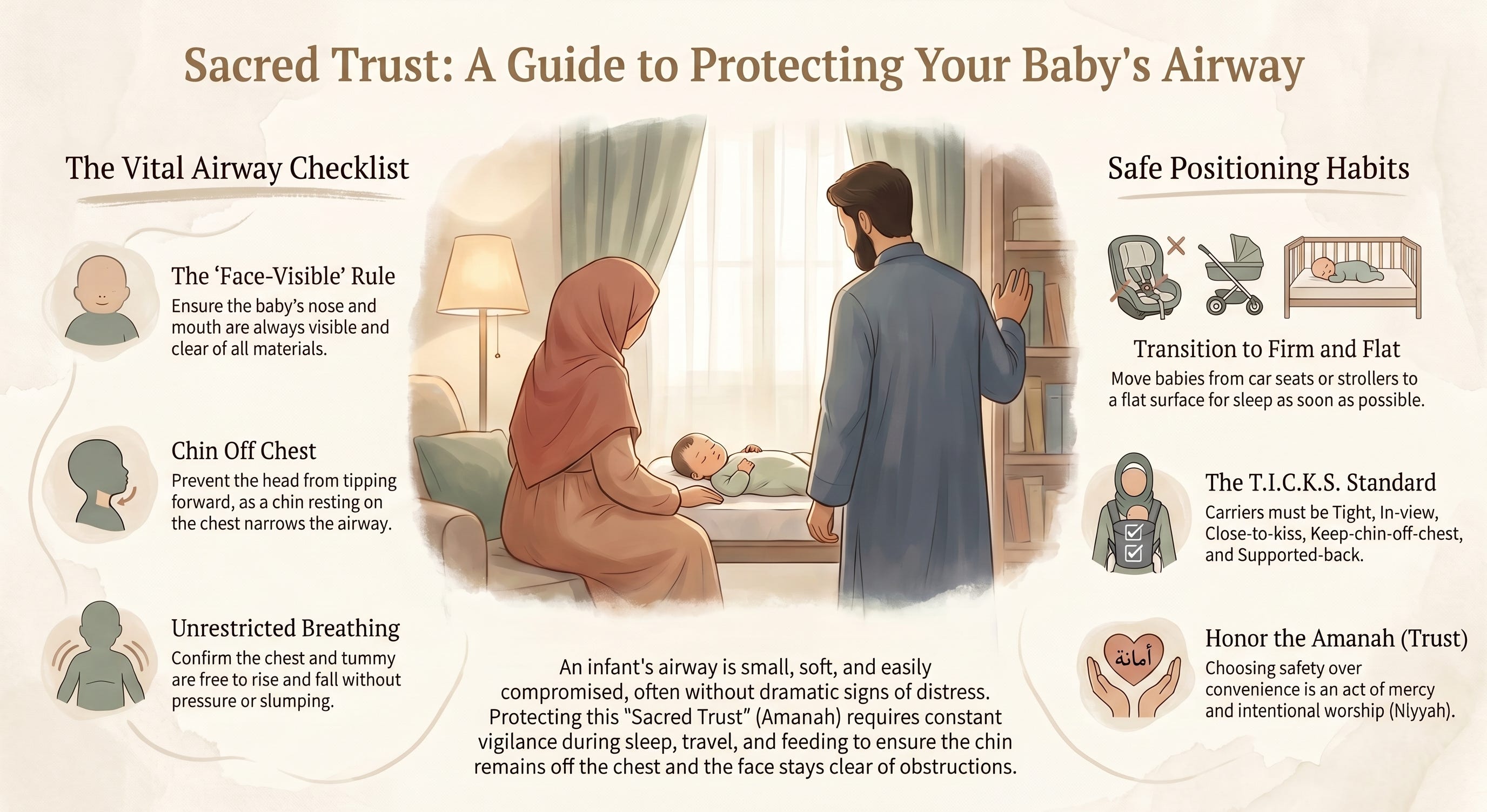
Protecting a baby’s airway means keeping the nose and mouth clear, the chin off the chest, the body well supported, and the baby in positions that allow easy breathing during sleep, travel, play, and feeding.
Sometimes the most serious danger does not look like danger at all.
A baby asleep in a car seat after a long drive.
A sling that feels soft and cozy.
A pram shaded with a blanket.
A night feed when everyone is half-awake and just trying to get through the hour quietly.
These are ordinary moments. That is exactly why they matter.
A baby’s airway is small, soft, and easy to compromise. Breathing can be affected by position, pressure, poor support, overheating, and blocked air around the nose and mouth. And babies do not always announce airway trouble dramatically. The danger can be quiet. [1][2][3][4][5][6][7]
Their smallness is part of their vulnerability
This is one of those truths that can feel uncomfortable because it asks us to look more closely at things we usually want to treat as normal.
Babies rely on protective reflexes such as swallowing, coughing, gagging, and arousal from sleep, but those systems are still developing in early infancy. Their airways are narrower than those of older children and adults. Their head and neck control is immature. If the chin drops toward the chest, if the neck folds awkwardly, or if the face presses into soft material, a baby may not be able to correct the position effectively.
Some babies need even more caution.
Babies under four months.
Babies born premature.
Babies with low birth weight.
Babies who are unwell.
Babies exposed to smoke or sedating substances.
The risk is not theoretical for them. Their vulnerability is simply greater, and that means the adult’s awareness has to be greater too. [3][4][5][6]
The first question is simpler than it sounds
Can this baby breathe easily right now?
That is really where airway protection begins.
Not with a product label.
Not with a guess.
Not with “it should be fine.”
Just that question, asked honestly.
Is the face visible?
Is the nose clear?
Is the mouth clear?
Is the chin resting on the chest?
Is the neck trapped?
Is the chest and tummy free to rise and fall?
Is there fresh air around the face, or is the baby rebreathing trapped exhaled air?
That is not a question to ask once and move on from. It has to be revisited whenever a baby is asleep, strapped in, carried, feeding, or propped in equipment. The safest parents are often not the most confident ones. They are the ones who keep checking. [3][4][5][7]
Sleep is where people assume safety too quickly
This is one of the hardest places, maybe because tired families are always hoping not to disturb a sleeping baby.
But “fell asleep there” and “safe to stay sleeping there” are not the same thing.
A safer sleep setup is firm, flat, level, clear, smoke-free, and not overheated, with the baby placed on the back. The American Academy of Pediatrics and CDC continue to advise that the safest place for a baby to sleep is on a separate, firm, flat sleep surface, on the back, with no soft bedding, pillows, or loose items in the sleep space. [1][2][7][8]
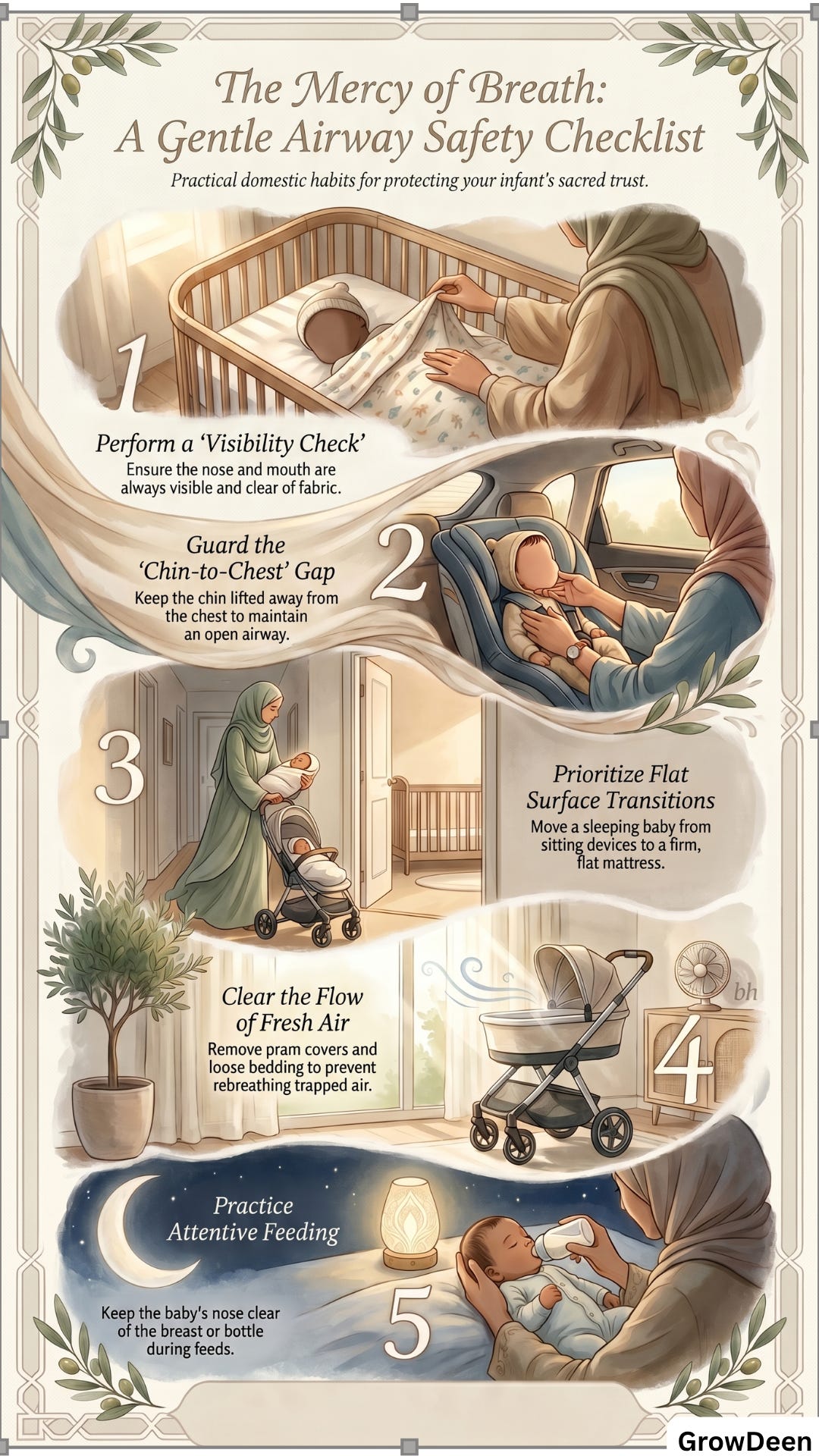
And if a baby falls asleep in a sitting device such as a car seat, stroller, swing, infant carrier, or sling, the baby should be moved to a firm, flat sleep surface as soon as possible. [1][2][7]
That point matters because inclined or semi-upright sleep can allow a baby to slump forward and narrow the airway. Tiredness makes adults more likely to blur that line. The baby looks peaceful. The room is finally quiet. Nobody wants to wake them.
I understand that instinct.
Still, a sleeping baby’s comfort is not the only question. Safe breathing matters more.
Travel and outings have their own hidden risks
Car travel creates one version of this problem.
Rear-facing seats are safest for crash protection, but the reclined sitting position can still allow a baby’s head to tip forward if the seat is not installed or fitted properly. A baby’s chin should not tip onto the chest, the buckle should not press into the tummy, and the baby should not slouch. Regular breaks on long drives matter. Unsupervised sleep in the car seat should not become routine. Travel seats are for transport, not for ordinary unsupervised sleep. [2][3][4][7]
Prams and strollers need the same realism.
For babies under six months, a stroller that keeps the baby too upright can put the airway at risk, especially once the baby falls asleep and the head folds forward. Younger babies need a pram or stroller that allows them to lie flat on a level surface. And covering the pram with a blanket is not a harmless little trick for shade. Air flow can be restricted. Overheating can follow. Poor ventilation around a baby’s face is not a small thing. [3][4][5][7]
Carriers and slings can be deeply useful, but only when the baby is positioned well. The T.I.C.K.S. check remains excellent guidance: the carrier should be tight, the face should stay in view, the baby should be close enough to kiss, the chin should stay off the chest, and the back should be supported. Loose fabric, slumped posture, and fetal-style curling are not signs of comfort. They are warning signs. [3][4][5]
Play and feeding need airway awareness too
Playtime is easy to underestimate because it looks active rather than restful.
But airway problems are not limited to sleep.
Tummy time should happen on a firm, flat surface with supervision, giving babies room to lift and turn the head safely. Sitting supports, rockers, bouncinettes, and inclined props can become unsafe if the baby falls asleep in them or slumps into a compromised position. Equipment does not replace airway awareness. It never does. [1][3][4][6]
Feeding brings a different kind of vulnerability.
Night feeds happen when adults are exhausted, and exhaustion opens the door to unsafe positioning. If an adult is falling asleep while feeding, they need to think ahead about how to stay awake. During breastfeeding, the baby’s nose should remain clear of the breast. That can sound almost too obvious when written down. In real life, it is exactly the kind of detail tired people miss. [3][6][8]
Smoke exposure belongs in this conversation too. Second-hand and third-hand smoke, including vaping residues, can irritate babies’ lungs. Safe-sleep guidance continues to recommend a smoke-free environment because smoke exposure is linked with increased risk of sleep-related infant death. [1][2][6][7]
If this kind of careful, grounded writing helps you feel steadier in the real work of caring for a baby, subscribe for free so the next article and companion resources arrive quietly in your inbox.
Allah’s mercy is in these small acts of attention
From an Islamic perspective, airway protection fits naturally under amanah.
A baby cannot explain distress clearly. A baby cannot reposition independently. A baby cannot protect themselves from poor adult decisions. That helplessness should soften us.
Allah says, “O you who believe, protect yourselves and your families…” [8]
The verse speaks first to ultimate safety, but it also teaches a habit of protective responsibility. And Allah says, “Mothers bore their children in weakness upon weakness.” [9]
The early months of care are physically demanding. Islam does not dismiss that. It names it. Which means the tiredness is real, but so is the responsibility carried inside it.
The Prophet ﷺ said, “He is not one of us who does not show mercy to our young.” [10]
Mercy here is not abstract affection. It is checking the baby’s face again. It is moving a sleeping baby from a stroller to a flat sleep surface even though you do not want to wake them. It is adjusting the sling. It is refusing convenience when convenience puts breathing at risk.
And the Prophet ﷺ said, “Allah is gentle and loves gentleness in all matters.” [11]
Gentle care is attentive care.
It is not rushed.
It is not careless.
It does not guess where knowledge is needed.
And then there is niyyah. “Actions are only by intentions.” [12]
A parent who learns these habits, checks breathing, keeps the environment smoke-free, and arranges ordinary routines around safety is not just being cautious. They are honoring a trust with intention. Allah also says, “Do not pursue that of which you have no knowledge.” [13]
In practice, that means do not guess your way through products and positions that affect breathing. Learn. Ask. Check. Use what is known to be safer.
In the end, airway protection is a way of looking
It is not one special trick.
It is not one perfect product.
It is not one rule you remember once and never revisit.
It is a way of looking.
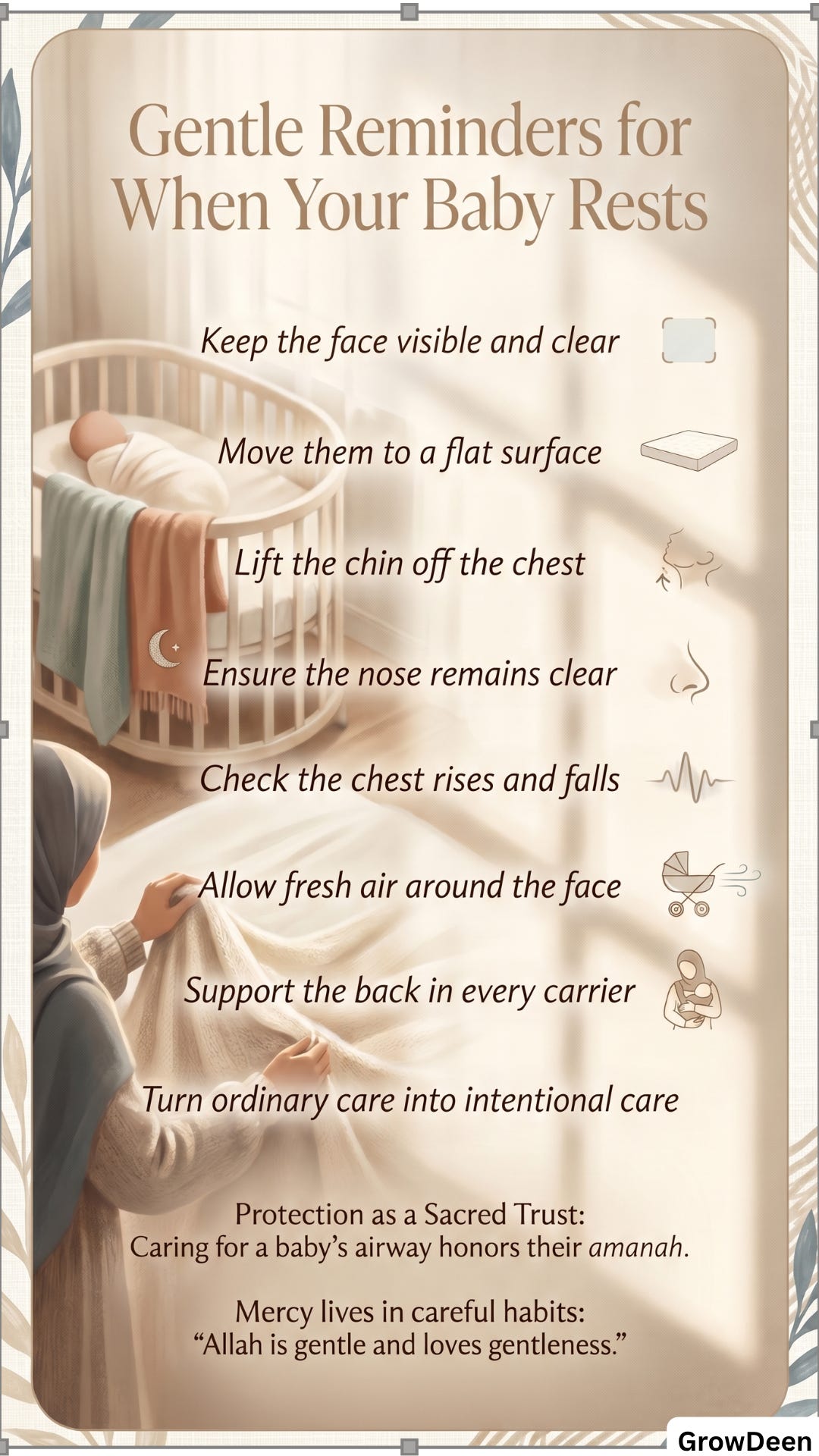
Is the face visible?
Is the nose clear?
Is the chin free?
Is the chest moving easily?
Is the baby on a surface or in a position that supports breathing rather than narrowing it?
Those questions belong in sleep, in the car, in the pram, in the sling, at play, and during feeding. Asked often enough, they become habit.
And that habit can save a life.
GIFTS FOR YOU, DEAR READER
If you’ve reached this part of the page, that tells me something meaningful about you.
You stayed with this.
You did not just pass through it.
And usually that means something here touched real life. Maybe it named a quiet worry you have carried. Maybe it put words to something you have been trying to notice without knowing how to explain it. Maybe it simply made you want to care more carefully for a baby entrusted to you.
That matters.
Your effort to read with attention matters too. It says something about the kind of care you are trying to offer, even in the tired and ordinary parts of life that no one claps for.
I did not want this article to remain only words on a page.
I wanted it to stay with you a little longer than that.
To reach into the practical moments.
To be easier to remember when you are tired.
To be easier to act on when a baby falls asleep in a place that feels convenient, or when you are moving quickly through a routine and need something simple to bring you back to what matters.
So we prepared a small companion pack for you.
Not as decoration.
Not as pressure.
But as a few thoughtful resources designed to help this stay close to real life. Something you can save, revisit, print, reflect on, or keep nearby when you want the heart of this guidance in a form that is easier to carry into the day.
The hope is not just that you read.
The hope is that what you read becomes easier to remember, easier to apply, and easier to return to when you need it again.
These companion resources were made slowly, thoughtfully, with care and sincere du’a. They were prepared because some things are too important to leave as a passing impression. They deserve something steadier.
So please do download the companion pack.
And if it supports you, subscribe for free so future articles and companion resources arrive directly in your inbox. That way, the next time we publish something meant to help in a real stage of care, it reaches you without extra effort from you.
And if someone comes to mind while you are reading, a parent, a grandparent, a caregiver, a new mother, someone exhausted and trying their best, share it with them too.
May Allah place barakah in your effort, accept your intention, and make the care you give more protective, more merciful, and more rewarded than it feels in the moment.
What is one ordinary moment with a baby that you think people underestimate most when it comes to breathing and positioning?
Subscribe for free if you’d like future articles and companion resources that help Islamic wisdom and practical care stay close to real life.
References
[1] American Academy of Pediatrics. Safe Sleep guidance for infants
[2] Centers for Disease Control and Prevention. Providing Care for Babies to Sleep Safely
[3] Red Nose Australia. Guidance on infant airway protection in slings, baby carriers, and prams, and broader safe-sleep recommendations
[4] The Lullaby Trust. Baby’s airway guidance on keeping the airway clear and avoiding products or positions that narrow or fold it
[5] NHS. Safe infant sleep and infant resuscitation guidance relevant to positioning and observing breathing
[6] Sleep Health Foundation. Safe Sleeping and Babies guidance
[7] HealthyChildren.org. How to Keep Your Sleeping Baby Safe: AAP Policy Explained
[8] Qur’an, Surah At-Tahrim 66:6
[9] Qur’an, Surah Luqman 31:14
[10] Jami‘ at-Tirmidhi 1921
[11] Sahih Muslim 2593
[12] Sahih al-Bukhari 1, Sahih Muslim 1907