
The Parenting Shift That Makes Hard Days Softer
When You Stop Fighting Temperament, You Start Finding Peace

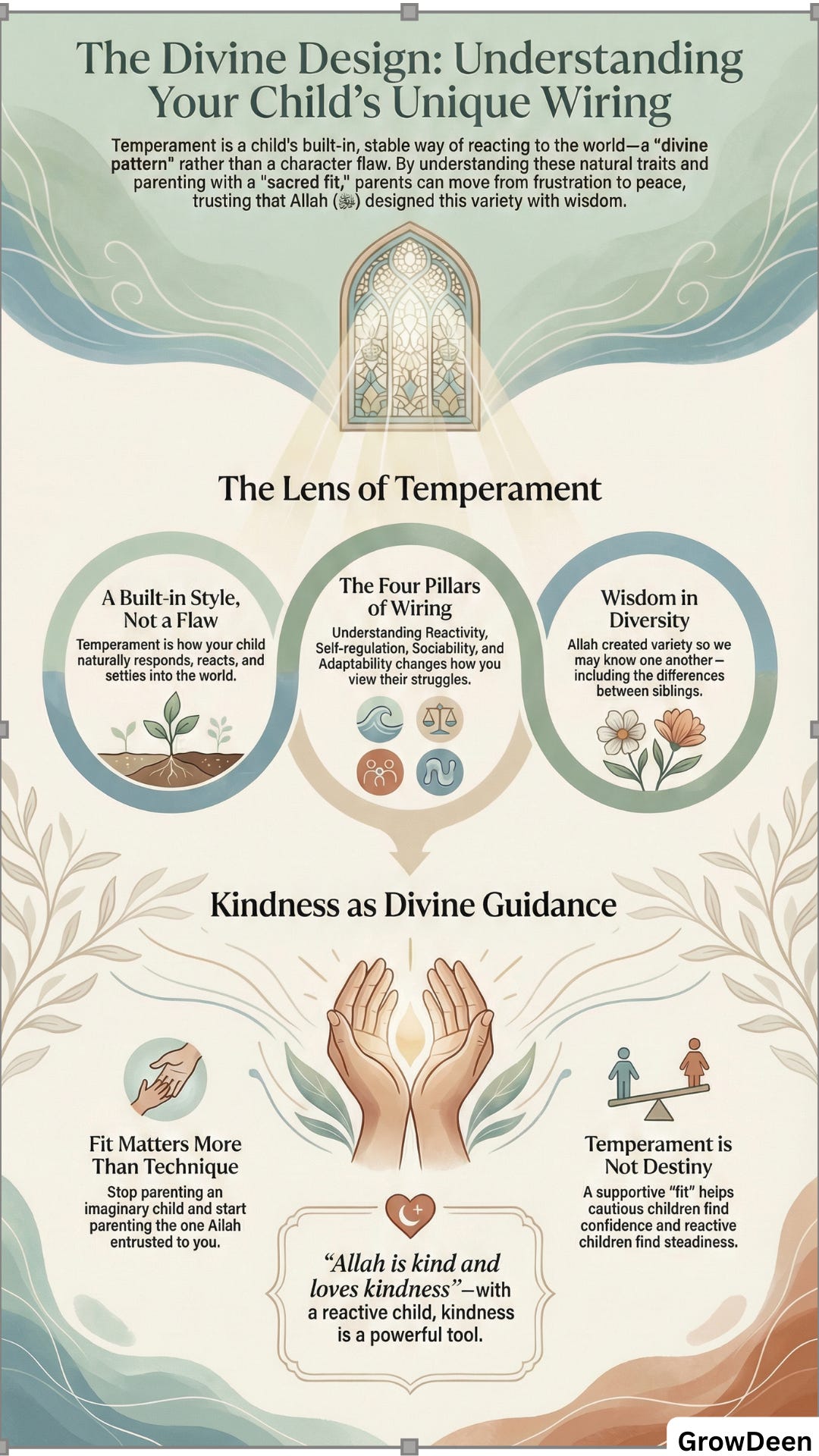
Temperament is your child’s built in way of reacting and settling, and when your parenting fits that wiring, everyday life becomes calmer and emotional growth becomes easier for both of you.
You walk into a family gathering.
One child runs ahead like they have been waiting all week to see everyone.
The other child stays close to you, fingers gripping your sleeve, eyes scanning the room like it is too much.
Same parents. Same home. Same love.
And still, two completely different reactions.
If you have ever whispered to yourself, “What am I doing wrong,” I want you to breathe for a second.
A lot of what you are seeing is temperament.
Not a character flaw. Not a parenting failure.
A built in style.
Your child is not a mystery, they are patterned
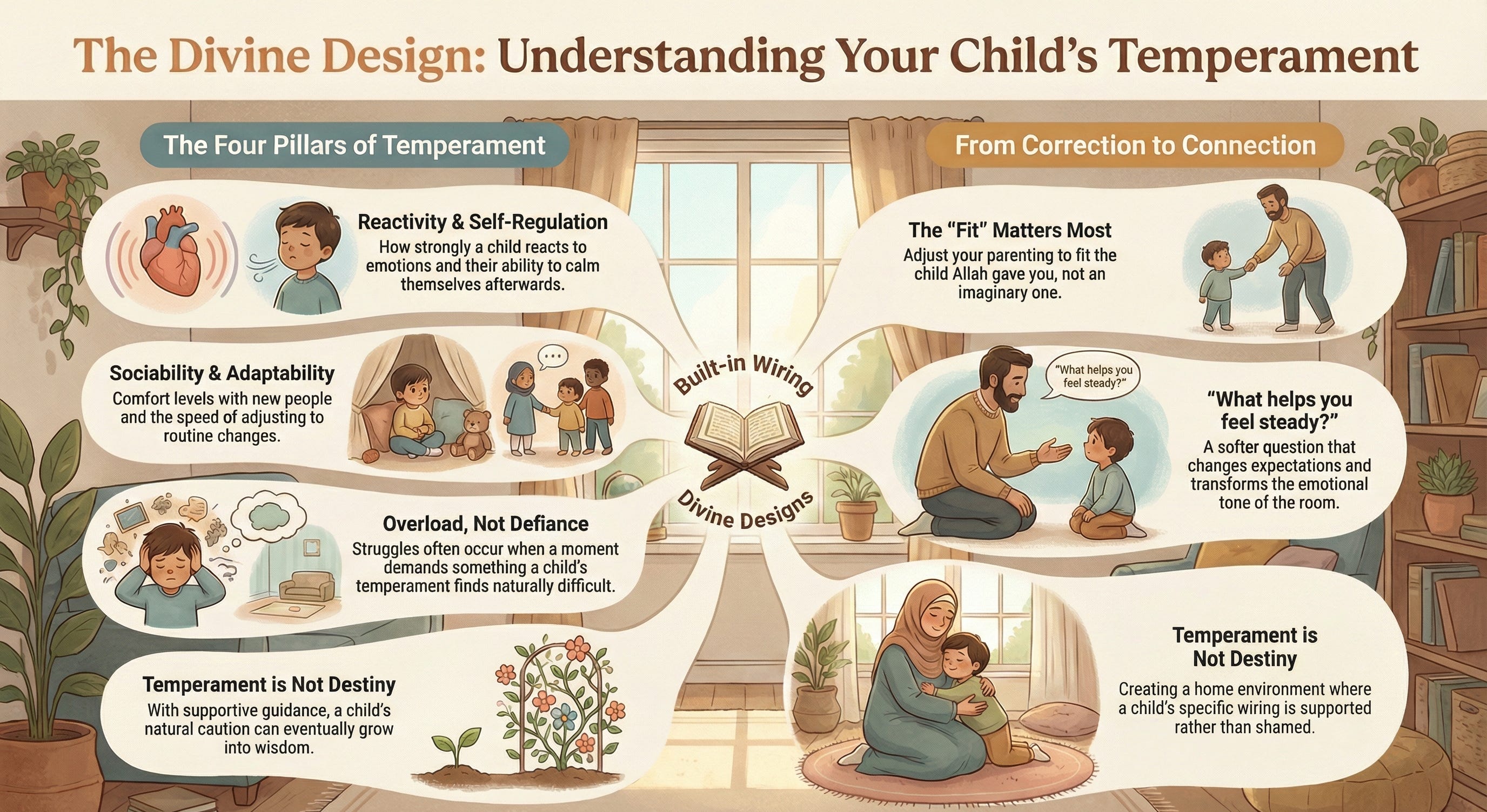
Temperament is the way your child naturally responds to the world around them. How strongly they react. How easily they settle. How they feel with new people. How they handle change over time [1].
It tends to be fairly stable early on, even as children grow and learn skills that shape how it shows up in daily life [1]. That is why you can often see hints of it from babyhood.
You probably already use temperament language without realizing it.
Easygoing.
Slow to warm.
Feels everything.
Needs routine.
That is not you labeling your child. That is you noticing their design.
Four small traits that explain a lot of your daily life
Here is a simple way to hold temperament in your mind. Not as a test. Just as a lens.
Reactivity is how strongly your child reacts to things like excitement, disappointment, frustration.
Self regulation is how much your child can manage behaviour and attention, and how well they can calm themselves when emotions rise [1].
Sociability is how comfortable your child feels meeting new people or being in groups.
Adaptability is how quickly your child adjusts to changes, transitions, new routines, surprises.
When you see your child struggle, it is often because the moment is asking them to do something their temperament finds hard.
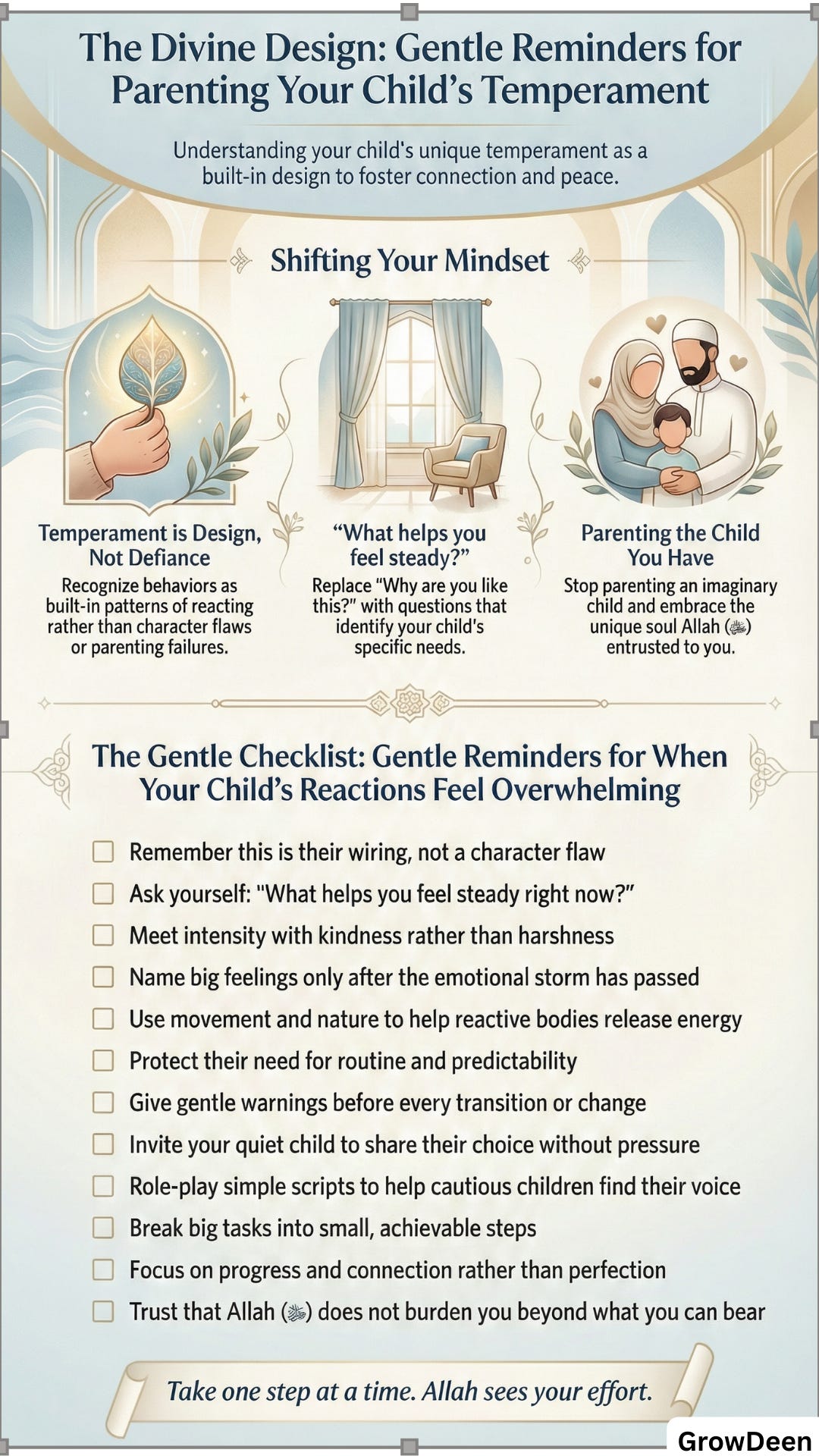
That is not defiance every time. Sometimes it is overload.
Sometimes it is simply a poor fit.
Al Hakim is in the differences inside your home
Allah created variety with wisdom.
He tells us that He made people diverse so we may come to know one another [2]. That includes the tiny differences between siblings too.
So when your child does not react the way you would, or the way their sibling does, try a softer question.
Not, “Why are you like this.”
But, “What helps you feel steady.”
That question changes your tone. It changes your expectations. It changes the whole room.
The fit matters more than the technique
You cannot swap out your child’s temperament. It is part of who they are.
But you can parent in a way that fits them, so their strengths grow and their rough edges soften with time.
Research across childhood shows that early temperament patterns are linked with later social and emotional adjustment, and the way children are supported and guided plays a big role in how things unfold [3]. In other words, temperament is not destiny.
It is a starting point.
A child who feels everything can learn steadiness.
A child who is cautious can learn confidence.
A child who struggles with self regulation can learn tools and rhythms that make life easier.
Often, the biggest shift happens when we stop trying to parent an imaginary child and start parenting the one Allah entrusted to us.
When emotions hit like a wave
If your child is more reactive, you likely see how quickly things rise.
The joy is loud. The anger is loud. The disappointment can feel like a full body experience.
These children often need help naming feelings, but not in the middle of the storm.
Later.
When they are calm again.
Try a gentle debrief that feels like connection, not correction.
What happened
What did it feel like in your body
What could we try next time
Keep it short. Keep your voice low.
This is how you build self regulation skills that do not come automatically for every child [1].
If your child also seems physically restless, movement helps. Outdoor time. Carrying groceries. Racing to the mailbox. Anything that lets the body release the intensity.
And when you feel tempted to meet intensity with intensity, hold onto the Prophet’s words.
Allah is kind and loves kindness, and He gives for kindness what He does not give for harshness [4].
Kindness is not weakness.
With a reactive child, it is guidance.
The quiet child still needs you to notice them
A less reactive child can look easy.
They do not protest much. They do not demand space. They might quietly accept what is decided.
Sometimes these children get overlooked without anyone meaning to.
So invite them in.
Not with pressure. With warmth.
Do you want this plan, or would you pick something else
Give them time to answer. Do not rush the moment. Some children need a longer pause to find their words.
If they struggle to speak up, role play simple scripts.
Can I have a turn
I do not like that
I want to choose
You are not trying to change their nature. You are giving them tools.
When change feels like pain
A less adaptable child often needs routine like they need air.
Transitions can be hard even when nothing bad is happening. Surprises can feel unpleasant. A new plan can bring tears.
Predictability is mercy for these children.
Give warnings before transitions.
Tell them what is coming next.
Keep routines steady where you can.
And when change is unavoidable, do not treat their discomfort like stubbornness. Many times they are trying to cope, not trying to control.
Research on inhibited temperament in toddlers suggests these cautious patterns can be stable, and parenting behaviours influence how social and behavioural outcomes develop over time [5]. A slow to warm child is not broken.
With the right support, caution can become wisdom, not fear.
When you are tired of repeating yourself
Some children struggle with attention and persistence. They bounce quickly. They act fast. They find it hard to settle.
These children usually need structure that feels supportive, not controlling.
Break tasks into smaller steps.
Add a playful element.
Reward effort.
Make focus feel possible.
Relationships matter too. Research in preschool settings links temperament with the quality of child teacher relationships, and those relationships connect to children’s emotional functioning [6]. One steady adult can shape a child’s emotional life in a powerful way.
You can be that steady adult at home, even if you are imperfect.
And on the days you feel like you have nothing left, remember this verse.
Allah does not burden a soul beyond what it can bear [7]. Not you. Not your child.
Gifts for You, Dear Parent
If you’ve reached this part of the page, it tells me something meaningful about you.
You weren’t just skimming or passing time. You stayed because something here felt relevant to your real life.
Because you care.
Because you want to do things with more awareness.
Because you’re trying, even when it feels overwhelming.
That is not small.
So I didn’t want this article to remain just words on a page. I wanted it to gently step into your daily life in practical ways. That’s why we prepared these Life Gifts for you.
Not as extras.
Not as decorations.
But as simple tools to help you hold onto what mattered most in what you just read.
Here’s what you’ll find inside:
Gentle Understanding Card
A clear and simplified summary of the core concept from this article, so you can revisit the main idea anytime without rereading everything.
Heartfelt Dua Card
A carefully chosen dua connected to this stage of life, because we know that real strength and ease ultimately come from Allah’s help.
Gentle Actions Card
Practical examples to help you translate knowledge into action, so what you learned becomes part of your daily rhythm.
Gentle Reminders Card
Short, steady reminders drawn from the key points, designed to be printed or saved and placed somewhere you’ll see often.
These were designed slowly and thoughtfully, with time, care, and sincere dua. We created them because we genuinely want to walk alongside you, not just through one article, but through every stage of this lifelong journey.
If these gifts support you even in a small way, I would love for you to continue receiving them.
Subscribe so that each new Gift arrives directly in your inbox whenever we release the next stage. That way, you won’t miss the tools designed to support you right where you are.
May Allah place barakah in your effort, accept your intention, and make this path easier and more rewarding than it feels right now.
Please share it with a family/friend who may benefit from this knowledge.
What is one moment with your child that feels hardest lately, and what kind of support would make it feel lighter?
References
[1] Zentner, M., & Bates, J. E. (2008). Child Temperament: An integrative review of concepts, research programs, and measures. International Journal of Developmental Science, 2, 7–37. https://psycnet.apa.org/record/2008-09493-002
[2] Qur’an 49:13. https://quran.com/49/13
[3] Sanson, A., Letcher, P., Smart, D., Prior, M., Toumbourou, J. W., & Oberklaid, F. (2009). Associations between early childhood temperament clusters and later psychosocial adjustment. Merrill Palmer Quarterly, 55, 26–54. https://psycnet.apa.org/record/2009-02213-002
[4] Sahih Muslim 2593. https://sunnah.com/muslim:2593
[5] Rubin, K. H., Burgess, K. B., & Hastings, P. D. (2002). Stability and social behavioral consequences of toddlers’ inhibited temperament and parenting behaviors. Child Development, 73, 483–495. https://doi.org/10.1111/1467-8624.00419
[6] Erdogan, G. S., Benga, O., Albu Răduleț, M., & Macovei, T. (2022). Child temperament and child teacher relationship quality: Implications for children’s emotional functioning during preschool period. Frontiers in Psychology, 13, 992292. https://doi.org/10.3389/fpsyg.2022.992292
[7] Qur’an 2:286. https://quran.com/2/286