
The Ordinary Moments That Start House Fires
And the Safety Habits That Stop Them

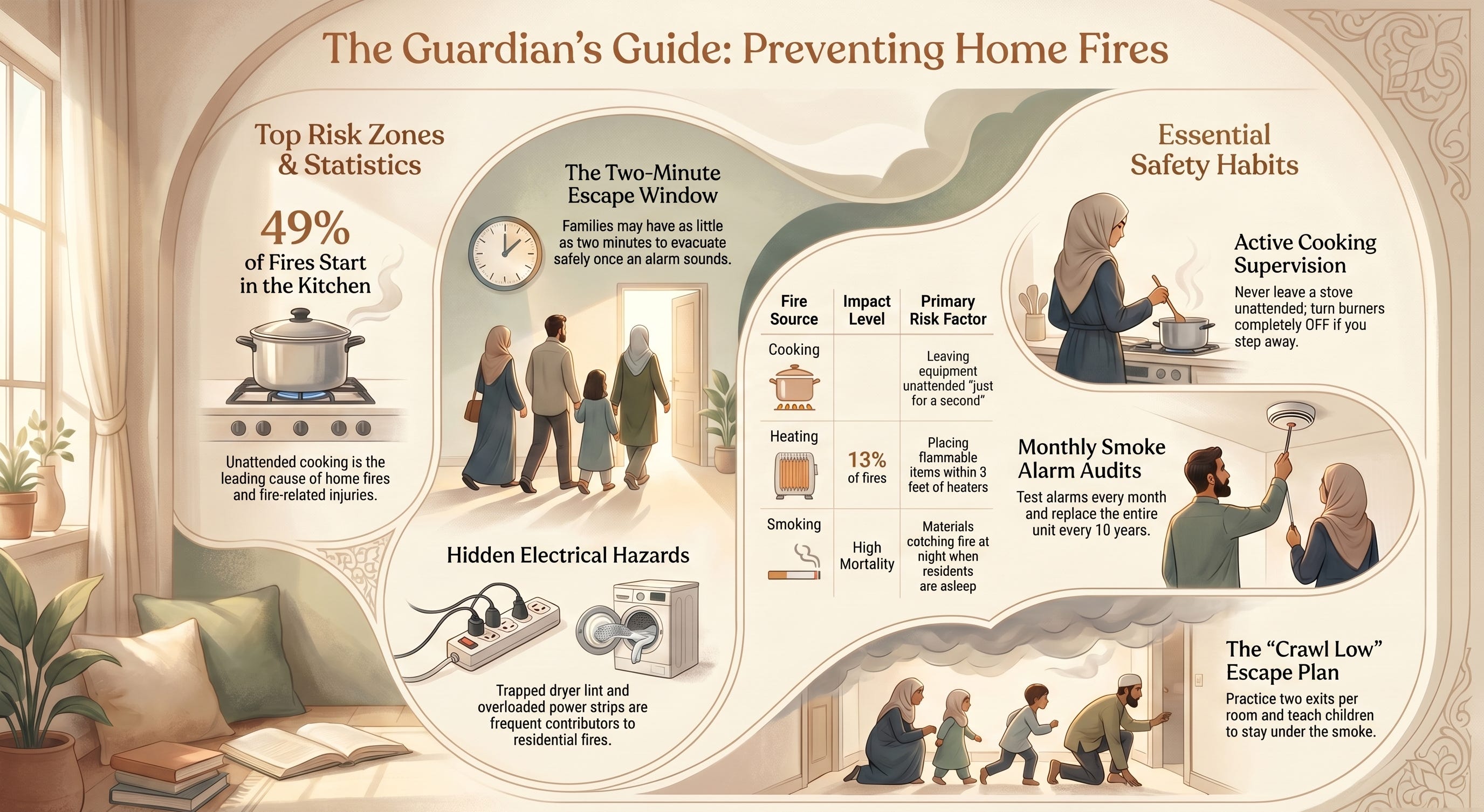
NFPA data shows cooking causes 49% of reported home fires and 20% of home fire deaths, with unattended cooking as the leading cause. [2][4] This guide shows you the 5 safety habits that protect your family, starting with the one room where most fires begin.
A pot left unattended for “just a minute.”
A phone charger plugged in overnight, every night.
A space heater placed a little too close to the curtains.
A cigarette that looked completely out.
You think you’re careful. But here’s what I didn’t realize until I studied fire safety data: most home fires don’t start with dramatic disasters. They start with ordinary things we do every single day — things that felt too familiar to fear.
When I looked at NFPA’s home fire reports, one pattern emerged clearly: faulty appliances, unattended cooking, heaters, cigarettes, and open flames are among the most common causes. [1][2][4][5][6] And here’s what stopped me: smoke alarms are one of the most powerful protections a family can have — but only if they’re working when the fire starts.
Let me walk you through what I learned.
Why This Guide Is Different From Generic Fire Safety Lists
1. Evidence-Based + Current Data — Every recommendation is backed by NFPA, fire safety research, and systematic reviews on residential fire prevention from 2004-2023. [1][2][4][5][6]
2. Islamic Framework Integrated — This isn’t just a checklist — it’s about taking precautions (as Allah commands) and protecting your family from preventable harm with both action and intention.
3. Actionable Resources Included — You’ll get a free Home Fire Safety Quick Reference Kit — a printable checklist, escape plan template, and du’as you can keep where your family will actually use them.
The Kitchen: Where 49% of Home Fires Begin
Here’s why I’m starting with the kitchen:
NFPA data shows cooking is the number one cause of home fires and home fire injuries. Unattended cooking is the leading cause of kitchen fires. [2][4][5]
Not grease fires from deep-frying (though those are dangerous).
Not oven malfunctions.
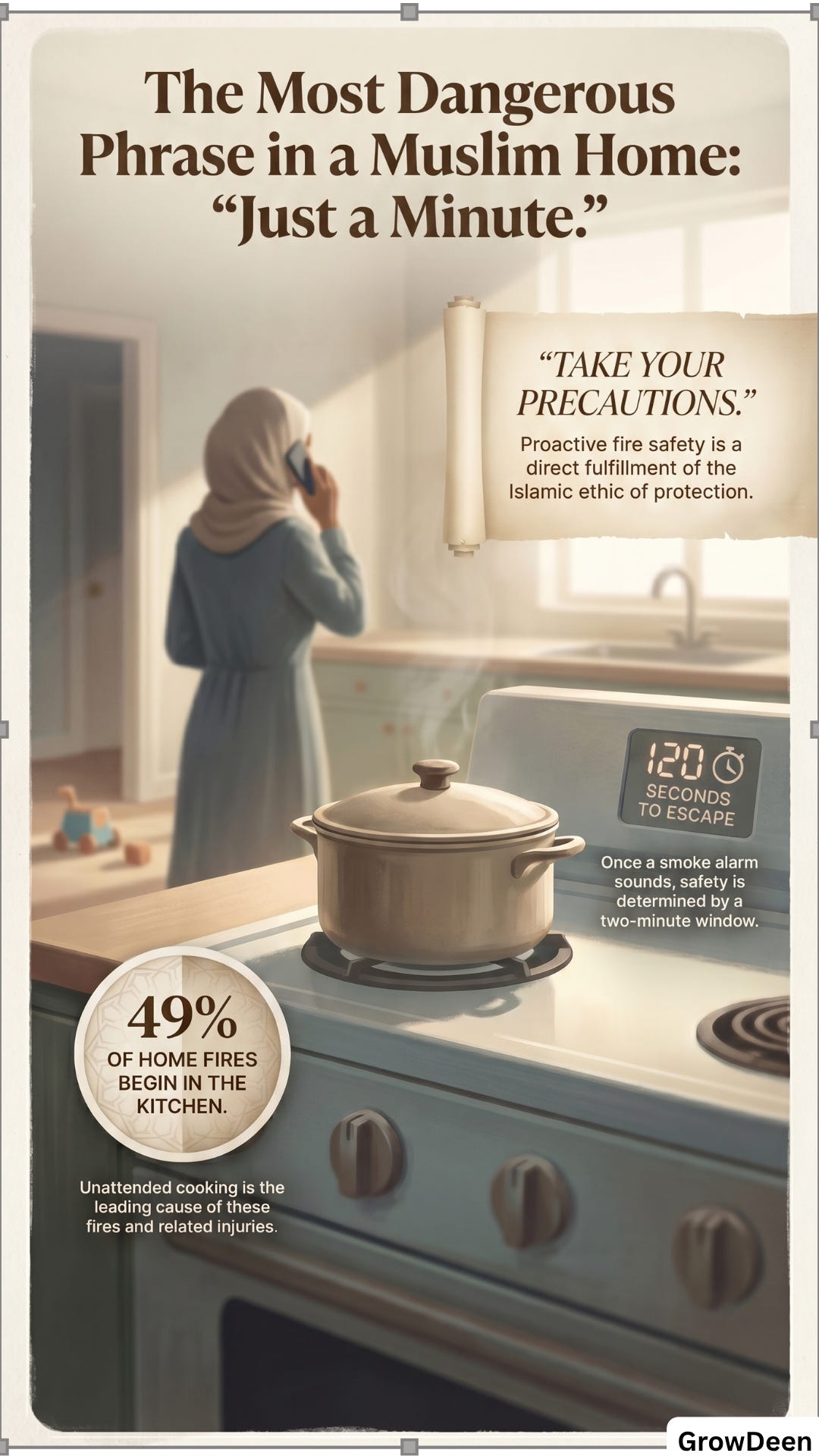
Unattended cooking. Someone stepped away. The phone rang. A child needed something. The pot was left alone for “just a second.”
That’s how most kitchen fires start.
Here’s what works:
Never leave cooking unattended on the stove. If you must leave the kitchen, turn off the burner. Not down. Off.
Be especially careful with deep-frying and hot oil — oil fires spread fast and water makes them worse.
Keep children supervised in the kitchen or out of the cooking area entirely when you’re using heat. [2][4][5]
I know this sounds simple. Almost too simple to matter.
But that’s exactly why it matters. The most preventable fires begin in moments that felt completely ordinary five seconds earlier.
The Silent Fire Risks Hiding in Your Electrical Outlets
Now here’s something most people don’t think about:
Electrical equipment doesn’t look dangerous when it’s just sitting there. But residential fire-prevention reviews repeatedly identify unsafe electrical conditions, overloaded circuits, damaged cords, and poor appliance maintenance as recurring contributors to home fires. [4]
The habits that prevent electrical fires:
Unplug appliances when not in use (especially heat-producing ones: toasters, irons, hair tools, phone chargers left overnight)
Replace frayed or faulty appliances immediately — don’t wait
Avoid overloading outlets (if you’re using power strips for everything, you’re overloading)
Keep airflow around clothes dryers
Clean the dryer lint filter every single time you use it [4]
Let me tell you why that last one matters:
A dryer lint filter may not look like a fire hazard. But trapped lint is exactly the kind of thing that turns heat into ignition.
Heaters and Fireplaces: The Danger That Stays After the Flame Is Gone
Here’s what surprised me when I studied heater safety:
Heaters and fireplaces remain dangerous even after the obvious flame is gone.
The source guidance is clear: heaters and fireplaces should be guarded, flammable items should stay at least one meter (about 3 feet) away, and heaters should be turned off when not in use. [1][4]
That spacing matters.
Curtains, blankets, toys, and clothing are often what catch next. Children also need to be taught, early and often, that heaters and fireplaces are not safe to approach “just for a second,” even when they look inactive. [1]
I know this is a lot to keep in mind, especially when you’re managing a household with children, work, and a thousand other responsibilities.
That’s why I’ve created a Home Fire Safety Quick Reference Kit, a printable guide with a room-by-room fire hazard checklist, a family escape plan template, and the exact steps to take if a fire starts.
Keep reading to download it at the end of this article, it’s designed to stay on your fridge or in your emergency folder where you’ll actually see it.
Smoking and Vaping: The Fires That Start at Night
Smoking and vaping require just as much seriousness as cooking and heating.
Here’s why this matters:
Fires that begin from smoking materials often happen at night, when escape is slower and smoke exposure becomes deadlier. [4]
The habits that prevent smoking-related fires:
Never leave lit cigarettes unattended
Never smoke in bed
Dispose of cigarette ends carefully (fully extinguished, in appropriate containers)
Never charge vaping devices unsupervised overnight [4]
And here’s something most people don’t realize:
Smoke inhalation, not flames alone, is one of the main reasons home fires kill.
That’s why working smoke alarms matter so much. Which brings me to the most important safety device in your home.
Smoke Alarms: The 2 Minutes That Could Save Your Family
Let me tell you the statistic that changed how I think about smoke alarms:
NFPA says people may have as little as two minutes to escape safely once a smoke alarm sounds. [1][4]
Two minutes.
Not ten. Not five. Two.
That’s why working smoke alarms are not optional extras. They’re the device most likely to give your family the time you need to escape.
Where smoke alarms should be installed:
Inside every bedroom
Outside each separate sleeping area
On every level of the home, including the basement [1][4]
The maintenance habits that keep them working:
Test alarms monthly (it takes 10 seconds)
Keep them dust-free
Replace batteries on a regular schedule according to manufacturer directions
Replace the entire alarm when it reaches the end of its service life — often around 10 years for many models [1][4]
Where possible, use interconnected alarms. When one sounds, they all sound. This gives sleeping households more warning time — especially in larger homes where a fire in the basement might not wake someone upstairs until it’s too late.
And here’s something I wish more parents knew:
Children under five do not always wake to smoke alarms. [1]
That means you cannot assume “the alarm will wake everyone.” It may not.
Extra thought is needed for where children sleep, who assists them, and how quickly they can be reached in the dark.
Fire Extinguishers and Fire Blankets: When They Help (And When They Don’t)
A fire extinguisher and fire blanket can help — but only if three things are true:
The fire is still small
You know what you’re doing
Escape remains possible
Use a home extinguisher only if the fire can be put out quickly, you are not placing yourself in danger, everyone else has already left, and you know the extinguisher is suitable for that type of fire. [1]
Critical warning:
Never use water on oil, fat, or electrical fires. [1] If cooking oil is burning, smothering is safer than splashing.
Fire blankets have a narrower but useful role. They can smother cooking-fat fires or wrap around a person whose clothes have caught fire. If a pot is burning, place the blanket carefully over it and leave it there with the heat turned off. [1]
Even then, emergency services should still be called. A fire that looks finished may not truly be finished.
The Escape Plan Your Family Needs to Practice (Before Fire Happens)
This is the part families postpone.
And it’s often the part they need most.
Here’s what an escape plan includes:
Two exits from every room where possible
An outside meeting place everyone knows
Practice with everyone in the home
Teaching children what smoke alarms sound like and what to do when they hear one [1]
USFA recommends drawing a home map, marking two ways out of every room, choosing an outside meeting place, and practicing the plan with everyone. People may have less than two minutes to get out once the alarm sounds. [7]
The escape rules everyone needs to know:
“Stop, drop, cover and roll” if clothes catch fire
“Crawl low and go” to get under smoke [1]
Once outside, no one goes back in — not for pets, not for belongings, not to “just check one room”
Smoke inhalation is a major cause of death in home fires. Fast escape matters more than gathering anything inside.
One more thing that helps:
Closed doors can slow the spread of heat, smoke, and toxic gases. NFPA and USFA both mention the protective effect of closed doors during escape planning. [7]
Sleeping with bedroom doors closed and knowing which doors may buy extra time, can make a difference when seconds matter.
The Islamic Framework: Why Fire Safety Is Taking Precautions
When I reflect on home fire safety from an Islamic perspective, it sits naturally under the command to take precautions.
Allah says, “O you who believe, take your precautions.” [11]
That verse is concise, but it carries a mindset: don’t wait until the danger is already in front of you.
The fire alarm is installed beforehand. The escape plan is practiced beforehand. The lighter is locked away beforehand.
That’s what taking precautions looks like in a family home.
Allah also says, “Protect yourselves and your families from a Fire.” [12] The verse’s deepest meaning reaches beyond household safety, but the ethic of protection runs through both worldly and spiritual care.
A parent who reduces obvious dangers, teaches children what smoke alarms sound like, and plans how to get everyone out is living inside that ethic of protection in an ordinary, necessary way.
Another verse says, “And whoever saves one life, it is as if he had saved all mankind.” [13]
That doesn’t only apply to heroic rescues after disaster. It also speaks to the quieter work of prevention.
The spark that never catches because the dryer lint was cleared. The pan that never ignites because cooking was not left unattended. The child who gets out because the family practiced the route.
These things matter enormously — even if no one sees them.
The Prophet ﷺ said, “Each of you is a shepherd, and each of you is responsible for his flock.” [14]
Home fire safety fits this hadith almost exactly. It’s about guardianship. It’s about not assuming that the home is automatically safe just because it’s familiar.
He also said, “There should be neither harming nor reciprocating harm.” [15]
This principle reaches naturally into child safety, appliance safety, cigarette safety, and escape planning. Where harm is foreseeable and preventable, neglect is not neutral.
And there is still room for mercy and calm. The Prophet ﷺ said, “Allah is gentle and loves gentleness in all matters.” [16]
In a fire, panic can injure people almost as much as flames. Training, preparation, and calm habits are forms of gentleness too. They lower chaos. They help adults think. They help children trust instructions when seconds matter.
The 5 Safety Habits That Protect Your Family
Let me give you the summary you can remember:
1. Never leave cooking unattended. Turn off the burner if you must leave the kitchen.
2. Maintain electrical safety. Unplug heat-producing appliances, replace frayed cords, clean dryer lint every time.
3. Guard heaters and fireplaces. Keep flammable items at least one meter away, turn heaters off when not in use.
4. Install and maintain smoke alarms. Inside every bedroom, outside sleeping areas, on every level. Test monthly, replace batteries, replace units after 10 years.
5. Practice your escape plan. Two exits per room, outside meeting place, crawl low under smoke, never go back in.
These aren’t dramatic solutions.
They’re the kind that save lives precisely because they’re repeated so often. [1][2][4][5][6]
Most fire safety feels ordinary on quiet days. That’s exactly why it saves families on terrible ones.
Your Home Fire Safety Quick Reference Kit
If you’ve read this far, you’re the kind of parent who takes ordinary risks seriously — not as paranoia, but as protective vigilance.
That tells me something beautiful about you.
I didn’t want this article to remain only words. I wanted it to stay with you — in your kitchen, near your bedrooms, in the places where fires actually start and where calm, practiced habits can stop them.
So I’ve prepared a Home Fire Safety Quick Reference Kit for you.
Inside the Home Fire Safety Quick Reference Kit (one comprehensive PDF, 3 pages):
Page 1: Room-by-Room Fire Hazard Checklist
Kitchen safety check (5 yes/no questions: cooking supervision, appliance maintenance, flammable items)
Bedroom safety check (3 questions: smoke alarms, closed doors, escape routes)
Living areas safety check (4 questions: heater spacing, electrical outlets, extension cords)
Complete in 10 minutes, check monthly
Page 2: Emergency Response Guide
Emergency contact numbers template
What to do if fire starts (step-by-step)
When to use fire extinguisher vs when to evacuate
Page 3: Du’as
Du’a for family protection from fire
Du’a before sleep (includes safety)
This isn’t just a PDF to download and forget. It’s a tool designed to stay on your fridge, in your emergency folder, or inside your home binder — where you’ll actually use it when you need it most.
This Home Fire Safety Quick Reference Kit is what every GrowDeen subscriber receives with each article. We cover the full journey of raising Muslim children from safety and health to character development and daily Islamic routines, all backed by research and rooted in wisdom.
If you’re a Muslim parent who wants both evidence-based guidance AND Islamic perspective, subscribe for free so future resources arrive in your inbox before you need them.
You’ll receive useful emails, no spam, just guidance that matters when it matters.
May Allah place barakah in your effort, accept your intention, and make the care you give more protective, more merciful, and more rewarded than it feels in the moment.
Share This With Someone Who Needs It
Think of one person right now: a friend with young children who leaves candles burning, a sister whose dryer lint filter hasn’t been cleaned in months, someone whose smoke alarm batteries have been beeping “low” for weeks.
This article could protect their family. Share it with them today — not because you’re being preachy, but because you care.
Sometimes the most loving thing we can do is pass along knowledge that prevents tragedy.
Frequently Asked Questions
Q: How often should I test my smoke alarms?
Test them monthly, it only takes 10 seconds. When I learned that smoke alarms should be tested every month, I set a phone reminder for the first Sunday of each month. The test button is usually right on the front. If it doesn’t beep loudly, replace the batteries immediately. [1][4]
Q: What’s the most common cause of home fires?
Cooking, specifically, unattended cooking. NFPA data shows cooking causes 49% of reported home fires and 20% of home fire deaths. [2][4] The prevention is simple but requires discipline: never leave cooking unattended. If you must leave the kitchen, turn off the burner completely.
Q: Can I use water on a grease fire?
Never. Water on a grease fire causes the burning oil to splatter and spread, making the fire much worse. [1] If cooking oil catches fire, smother it with a fire blanket or a pot lid (if safe to approach), turn off the heat, and call emergency services. Don’t try to carry the burning pot outside.
Q: Do children actually wake up to smoke alarms?
Not always, especially children under five. [1] This surprised me too. That’s why you can’t rely on the alarm alone to wake your children. Your escape plan needs to account for who will get them, how quickly you can reach them in the dark, and whether they know what to do if they wake up to the alarm before you reach them.
Q: How far should furniture be from space heaters?
At least one meter (about 3 feet) from anything flammable, curtains, blankets, furniture, toys, clothing. [1][4] And here’s what I learned: even when heaters are turned off, they can stay hot for a while. Never leave children unsupervised around heaters, even if they look “off.”
Q: What should I do if my clothes catch fire?
Stop, drop, cover your face with your hands, and roll until the flames are out. [1] Don’t run, running feeds oxygen to the flames and makes them worse. This is one of those things that feels awkward to practice, but practicing it means your children will remember it when panic hits.
Q: How do I know if my electrical outlets are overloaded?
If you’re using multiple power strips to plug in everything in one area, you’re probably overloading. Signs include: outlets that feel warm to touch, flickering lights when you plug something in, frequent circuit breaker trips, or a burning smell near outlets. [4] If you notice any of these, reduce the load immediately and have an electrician evaluate your electrical system.
References
[1] Source article provided: “Home fire safety.”
[2] NFPA. (2023). Home cooking fires. National Fire Protection Association. https://www.nfpa.org/education-and-research/research/nfpa-research/fire-statistical-reports/home-cooking-fires
[3] Cassell, E., Clapperton, A., & Ashby, K. (2004). Unintentional burns and scalds in vulnerable populations. Hazard, 57, 1-17.
[4] Shokouhi, M., Nasiriani, K., Cheraghi, Z., Ardalan, A., Khankeh, H., Fallahzadeh, H., & Khorasani-Zavareh, D. (2019). Preventive measures for fire-related injuries and their risk factors in residential buildings: A systematic review. Journal of Injury and Violence Research, 11(1), 1-14.
[5] Turner, C., Spinks, A., McClure, R., & Nixon, J. (2004). Community-based interventions for the prevention of burns and scalds in children. Cochrane Database of Systematic Reviews, 2004(2), CD004335.
[6] Country Fire Authority (CFA). (2023). Smoke alarms.
https://www.cfa.vic.gov.au/
[7] U.S. Fire Administration. (2024). Home fire escape plans.
https://www.usfa.fema.gov/
[8] Seah, R., Holland, A.J.A., Curtis, K., & Mitchell, R. (2019). Hospitalised burns in children up to 16 years old: A 10-year population-based study in Australia. Journal of Paediatrics and Child Health, 55(9), 1084-1090.
[9] U.S. Consumer Product Safety Commission. (2023). Window covering safety.
https://www.cpsc.gov/
[10] NFPA. (2024). Installing and maintaining smoke alarms. National Fire Protection Association.
https://www.nfpa.org/
[11] Qur’an, Surah An-Nisa 4:71
[12] Qur’an, Surah At-Tahrim 66:6
[13] Qur’an, Surah Al-Ma’idah 5:32
[14] Sahih al-Bukhari 7138
[15] Sunan Ibn Majah 2340
[16] Sahih Muslim 2593