
The Ordinary Household Items That Can Put a Baby’s Breathing at Risk
What Parents Need to Notice About Strangulation and Suffocation Risks

Free gift for you! A practical companion resource is waiting for you near the end of this article to help you remember, apply, and benefit from what you read. Don’t forget to download!
Preventing strangulation and suffocation in babies and young children depends on safer sleep, safer equipment, fewer cords and loose items, and steady adult attention to the ordinary objects that can quietly become dangerous.
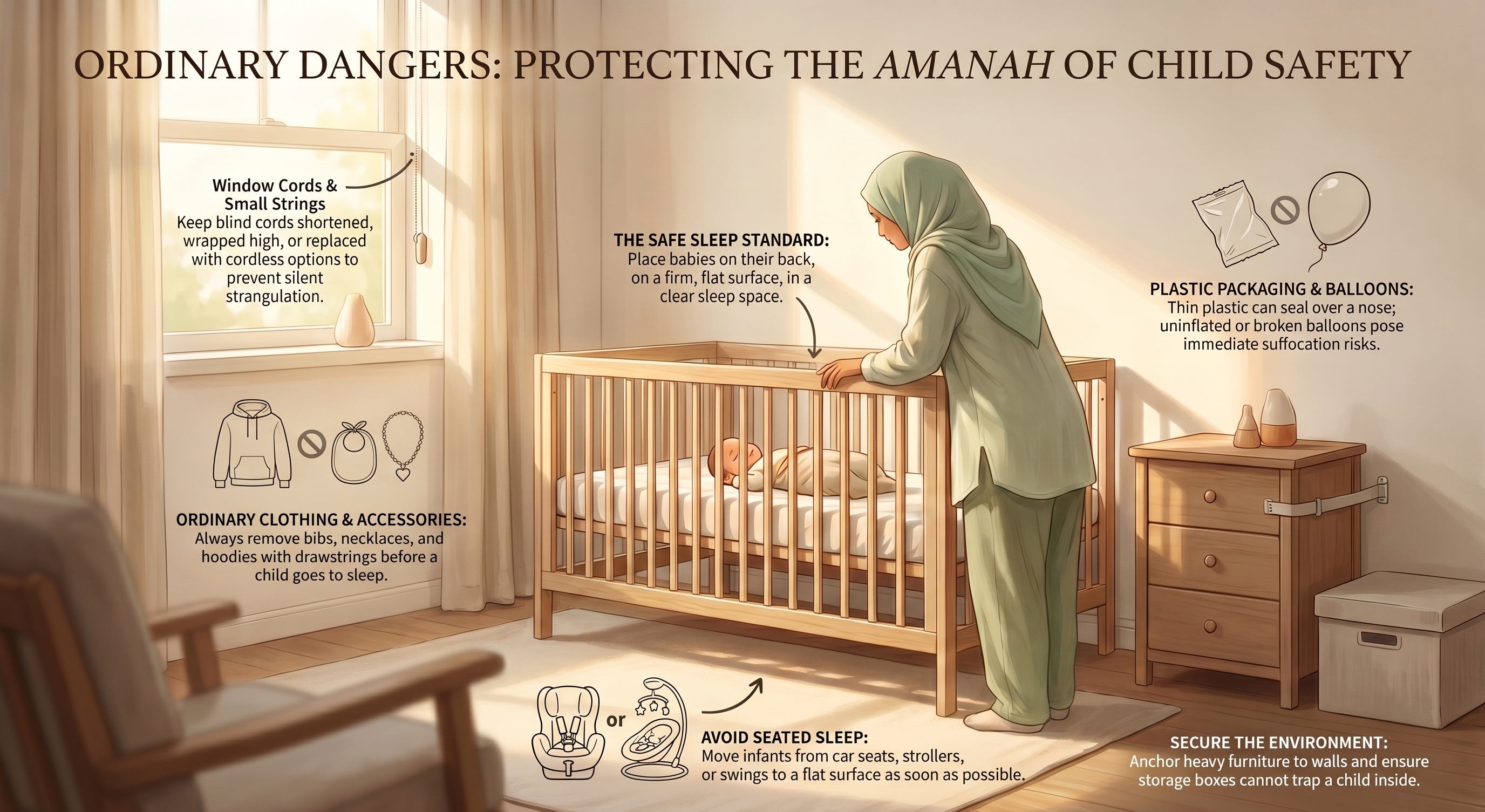
Some dangers do not arrive with noise.
They sit quietly in a room and wait to be overlooked.
A cord by the window.
A bib left on after a feed.
A plastic bag tucked inside a drawer but not really out of reach.
A baby slipping lower in a stroller.
A child climbing into a storage box and pulling the lid down behind them.
That is part of what makes strangulation and suffocation so frightening. They often do not look dramatic at first. They look ordinary. Familiar. Easy to dismiss. [1][2][6][7]
And for very young children, that ordinary shape is exactly what makes the risk so serious.
The danger is easier to see when you know what kind of danger it is
It helps to name things clearly.
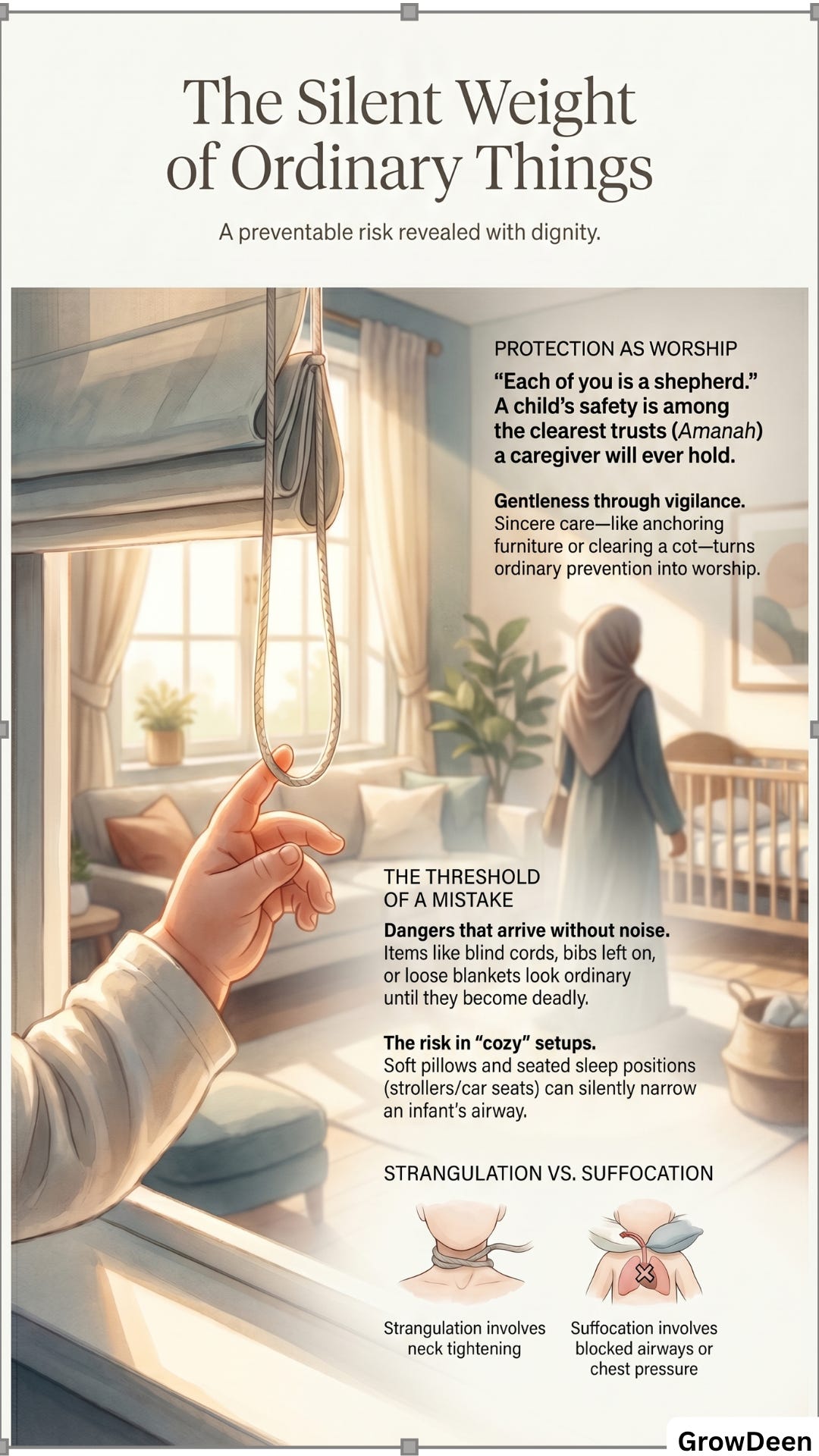
Strangulation happens when something tightens around the neck and prevents breathing.
Suffocation happens when the nose, mouth, throat, or windpipe is blocked, or when pressure on the chest prevents proper breathing. [1][2][6][7]
Families may not use those words precisely in daily life, and that is understandable. But the distinction still matters, because it helps you notice risk sooner.
A blind cord hanging too low is not the same hazard as a soft pillow near a baby’s face.
A necklace on a toddler is not the same hazard as a stroller covered too tightly with a blanket.
The mechanisms differ.
The urgency does not.
Tired adults often reach for shortcuts that babies cannot survive
A lot of this comes back to equipment and the quiet habits that form around it.
A dummy should never be tied to clothing, the hand, the neck, or the cot with ribbon, string, or cord. A bottle should never be propped in a child’s mouth. [1][2] These are exactly the kinds of shortcuts adults are tempted to take when they are tired and trying to manage too many things at once.
But a baby cannot free themselves from what an adult sets up around them.
That is the part worth holding onto.
The advice about prams, strollers, car seats, and bouncinettes matters for the same reason. Babies under six months should be in a pram that allows them to lie flat if they fall asleep. Harnesses should be used properly. Airflow should never be blocked by a cloth or blanket. Car seats and bouncinettes should not become regular sleep places. [1][4][8][9]
This lines up with current safe-sleep guidance: infants who fall asleep in seated products such as car seats, strollers, swings, infant carriers, or slings should be moved to a firm, flat sleep surface as soon as possible. [4][8][9]
There is something painfully ordinary about that risk. A baby falls asleep. The room becomes quiet. The adult does not want to wake them. The moment feels harmless.
And still, the airway can narrow. The position can become unsafe. The ordinary moment can turn.
Sleep should feel simple, and that is part of what keeps it safe
Beds and bedding need more caution than many people realize, because sleep-related suffocation remains one of the most serious forms of preventable infant harm.
A safer sleep environment means baby on the back, on a firm, flat, level surface, with the head and face uncovered, in a clear sleep space that is not overheated and is smoke free. [4][8][9]
That is consistent with the AAP’s 2022 recommendations, which continue to advise back sleeping, a firm flat non-inclined surface, and no soft bedding, pillows, blankets, or toys in the infant sleep space. [4][8][9]
This is also where people often want a softer, prettier, cozier setup than safety allows.
A pillow.
A folded blanket.
Something plush near the baby’s head.
A nest-like sleep space that feels warm and lovely.
I understand that instinct. But with babies, cozy-looking and safe are not always the same thing.
The same carefulness applies to co-sleeping. The point is not to write in panic. The point is to be medically honest. Adult beds, couches, soft sleep surfaces, loose bedding, and sleeping next to smokers or deeply exhausted adults can all increase the risk of accidental suffocation or strangulation in bed. [4][8][9]
Some of the most dangerous things in the house were never meant as toys
Plastic bags, packaging, mattress wrap, and balloons are one category people keep underestimating.
A thin plastic layer can seal over the nose and mouth.
A piece of packaging can cling to a child’s face before they know how to pull it away.
An uninflated balloon or broken balloon piece can become deadly very quickly. [1][2]
That is why the practical advice matters so much. Keep plastic bags and wraps out of reach. Tie knots in them before disposal. Remove plastic packaging from cot and bassinet mattresses. Never give uninflated balloons to young children. [1][2]
There is also a whole category of strangulation hazards that feel soft and harmless because they are part of clothing or daily life.
Ropes.
Scarf-like clothing.
Hood strings.
Necklaces.
Helmet straps.
Bibs left on too long.
These are not dramatic objects. But that does not make them gentle in their effects. Remove bibs and hoods before sleep. Avoid jewelry on children. Be cautious with drawstrings and scarves. Remove helmets after riding or skating. [1][2][3]
These are the kinds of small decisions that protect children before anything ever looks urgent.
Cords, furniture, and closed spaces become dangerous faster than people think
Window blind cords deserve a firmer tone because the danger is quick and silent.
Cords should be kept out of reach, shortened, wrapped on a cleat or safety device high on the wall, and replaced with safer options where possible. [2][5] Current CPSC guidance goes further and says the safest option, when young children are present, is cordless window coverings. It also notes that children have strangled on window covering cords in mere moments, even with an adult nearby. [10]
That matters because being nearby is not the same as intervening in time.
Furniture and large household objects create a different suffocation pattern: entrapment and crushing. Sturdy furniture should be anchored. Children should be supervised around unstable household items, wood piles, sand tunnels, storage chests, and anything that can trap or crush. [6][7][11] The CPSC’s Anchor It campaign continues to warn that dressers, bookcases, and televisions can tip over and crush children when climbed, pulled, or used for support. [11]
Children do not need obviously dangerous objects to get into serious trouble.
They need access.
Curiosity.
A few unsupervised moments.
That is all.
And that is why prevention works best in layers: safer products, safer sleep, fewer cords, fewer loose items, anchored furniture, and adults who do not assume that being “somewhere nearby” is enough.
If writing like this helps you feel steadier in the real work of protecting children, subscribe for free so the next article and companion resources arrive quietly in your inbox.
Allah’s care in these small precautions
From an Islamic perspective, this kind of layered care fits naturally into amanah.
Allah says, “And let those fear Allah who, if they left behind weak offspring, would be concerned for them.” [12]
There is a strong sense of responsibility in that verse toward vulnerable children. It speaks to the heart of child safety. Do not be careless with those who cannot protect themselves.
And Allah says, “Indeed, Allah commands you to render trusts to whom they are due.” [13]
A child’s breathing, sleep, and safety are among the clearest trusts a parent or caregiver will ever hold. He also says, “Do not pursue that of which you have no knowledge.” [14]
In practice, that means do not guess your way through sleep safety, cords, car-seat sleep, or unsafe equipment. Learn what is known to protect children, then act on it.
The Prophet ﷺ said, “Each of you is a shepherd, and each of you is responsible for his flock.” [15]
That hadith fits this topic almost line for line. The flock here includes the baby in the cot, the toddler near the blind cord, the child climbing furniture, the infant drifting to sleep in a stroller. Safety is not outside spiritual duty. It is one of its most ordinary expressions.
And the Prophet ﷺ said, “Allah is gentle and loves gentleness in all matters.” [16]
Gentleness here is not vague softness. It is carefulness. It is removing the bib before sleep. It is cutting the cord shorter. It is not leaving a child with a bottle propped in the mouth because the adult wants two free hands. It is the slow, thoughtful kind of care that protects without making a show of itself.
And intention deepens it all. “Actions are only by intentions.” [17]
A parent who anchors a dresser, clears the cot, shortens a blind cord, and chooses a safer sleep setup out of sincere care for the child and obedience to Allah is turning ordinary prevention into worship.
That may not look grand from the outside.
But it is weighty with Allah.
In the end, most prevention happens long before anything feels urgent
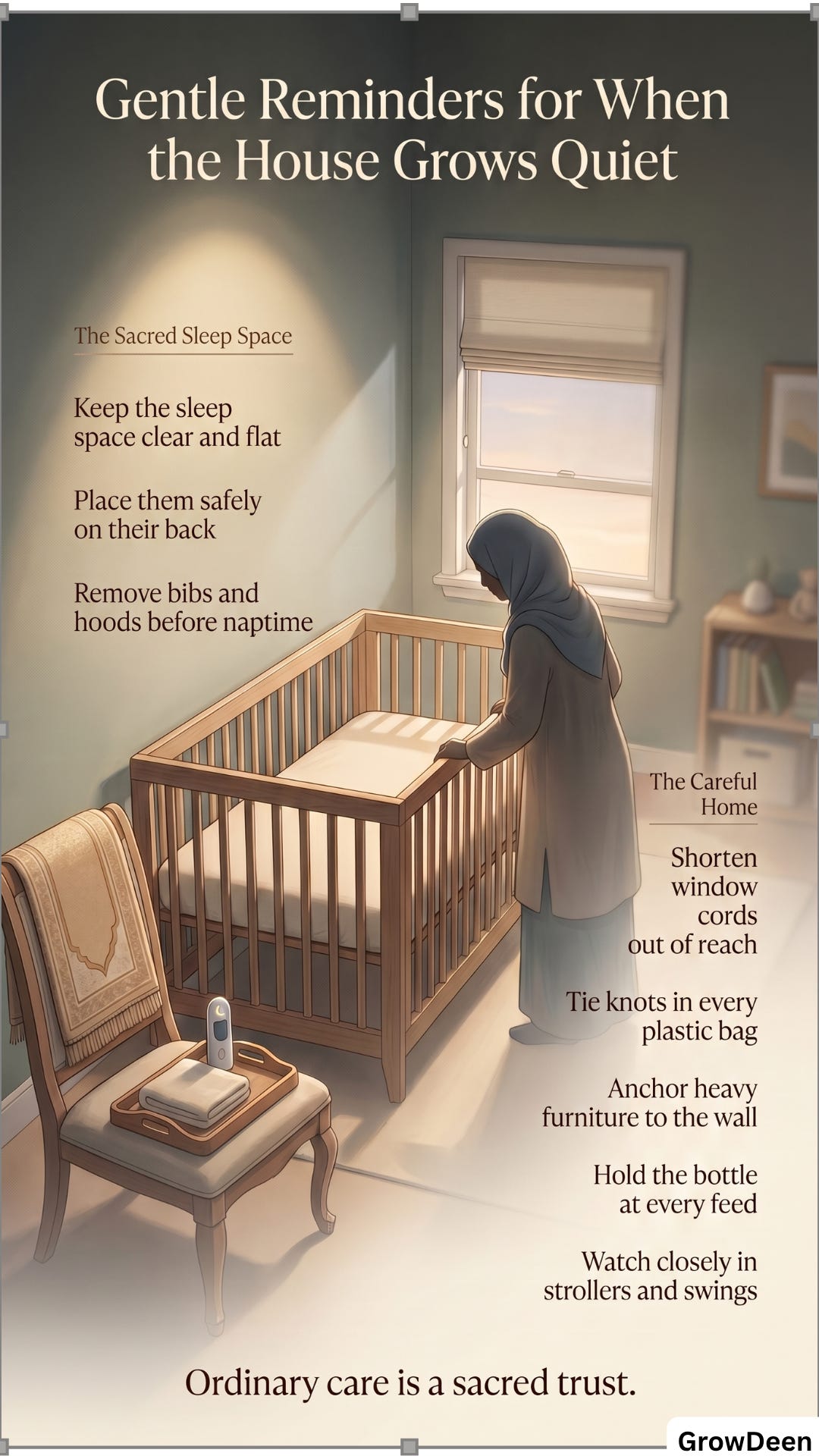
Preventing strangulation and suffocation is rarely about one big decision.
It is about dozens of small ones made early enough.
No loose cords.
No unsafe sleep clutter.
No propped bottles.
No bags within reach.
No assuming a child will “probably be fine.”
Those choices feel minor until the day they are not.
And that is why they matter so much.
GIFTS FOR YOU, DEAR READER
If you’ve reached this part of the page, that tells me something meaningful about you.
You stayed with this.
You did not just skim it and move on.
And usually that means something here felt close to real life. Maybe it made you think about something in your own home that had faded into the background. Maybe it sharpened your attention to the quiet risks that hide inside ordinary caregiving. Maybe it simply reminded you how much love lives inside the small precautions no one else ever notices.
That effort matters.
Your willingness to read carefully, reflect honestly, and take ordinary safety seriously is not small. It says something beautiful about the kind of care you are trying to give.
I did not want this article to remain only words on a page.
I wanted it to stay with you a little longer than that.
To follow you into the nursery.
Into bedtime.
Into tidying up.
Into the unnoticed corners of the house where prevention is often decided long before danger appears.
So we prepared a small companion pack for you.
Not as decoration.
Not as pressure.
But as a few thoughtful resources designed to help this stay close to daily life. Something you can save, revisit, print, reflect on, or keep nearby when you want the heart of this guidance in a form that is easier to carry into the day.
The hope is simple.
Not just that you read.
But that what you read becomes easier to remember, easier to apply, and easier to return to when you need it.
These companion resources were made slowly, thoughtfully, with care and sincere du’a. They were prepared because some kinds of guidance are too important to leave as a passing impression. They deserve something steadier. Something that helps bridge the gap between knowing and doing.
So please do download the companion pack.
And if it supports you, subscribe for free so future articles and companion resources arrive directly in your inbox. That way, the next time something is published for a real stage of care and responsibility, it reaches you without extra effort from you.
And if someone comes to mind while you are reading, a parent, grandparent, teacher, caregiver, or anyone responsible for small children, share it with them too.
May Allah place barakah in your effort, accept your intention, and make the care you give more protective, more merciful, and more rewarded than it feels in the moment.
What is one ordinary object in a child’s world that you think adults most often stop really seeing?
Subscribe for free if you’d like future articles and companion resources that help Islamic wisdom and practical care stay close to real life.
References
[1] Congiu, M., Cassell, E., & Clapperton, A. (2005). Unintentional asphyxia (choking, suffocation and strangulation) in children aged 0-14 years
[2] Datta, M., & Cyriac, J. (2013). Window blind cords and accidental strangulation
[3] Kumral, B., Ozdes, T., Avsar, A., & Buyuk, Y. (2014). Accidental deaths by hanging among children in Istanbul, Turkey: Retrospective analysis of medicolegal autopsies in 33 years
[4] Moon, R.Y., Carlin, R.F., Hand, I., The Task Force On Sudden Infant Death Syndrome & The Committee On Fetus And Newborn. (2022). Sleep-related infant deaths: Updated 2022 recommendations for reducing infant deaths in the sleep environment
[5] Rauchschwalbe, R., & Mann, N.C. (1997). Pediatric window-cord strangulations in the United States, 1981-1995
[6] Sasso, R., Bachir, R., & El Sayed, M. (2018). Suffocation injuries in the United States: Patient characteristics and factors associated with mortality
[7] Zarroug, A.E., Stavlo, P.L., Kays, G.A., Rodeberg, D.A., & Moir, C.R. (2004). Accidental burials in sand: A potentially fatal summertime hazard
[8] American Academy of Pediatrics. 2022 safe-sleep recommendations and related parent guidance
[9] U.S. Consumer Product Safety Commission. Window covering cord guidance, the recommendation to choose cordless coverings where young children are present, and updated hazard rules for accessible cords
[10] U.S. Consumer Product Safety Commission. Anchor It! campaign and childproofing guidance
[11] Qur’an, Surah An-Nisa 4:9
[12] Qur’an, Surah An-Nisa 4:58
[13] Qur’an, Surah Al-Isra 17:36
[14] Sahih al-Bukhari 7138
[15] Sahih Muslim 2593
[16] Sahih al-Bukhari 1, Sahih Muslim 1907