
The One Car Safety Mistake That Puts Children at Risk Every Day
The Car Safety Mistake Most Parents Make Before Every Journey

In 2024 alone, Australian roads claimed 1,172 lives, with children among the most vulnerable passengers. [1] This guide shows you the often-overlooked ways to keep your child safe, calm, and comfortable during every car journey—from the temperature settings most parents miss to the breaks that protect your baby’s breathing.
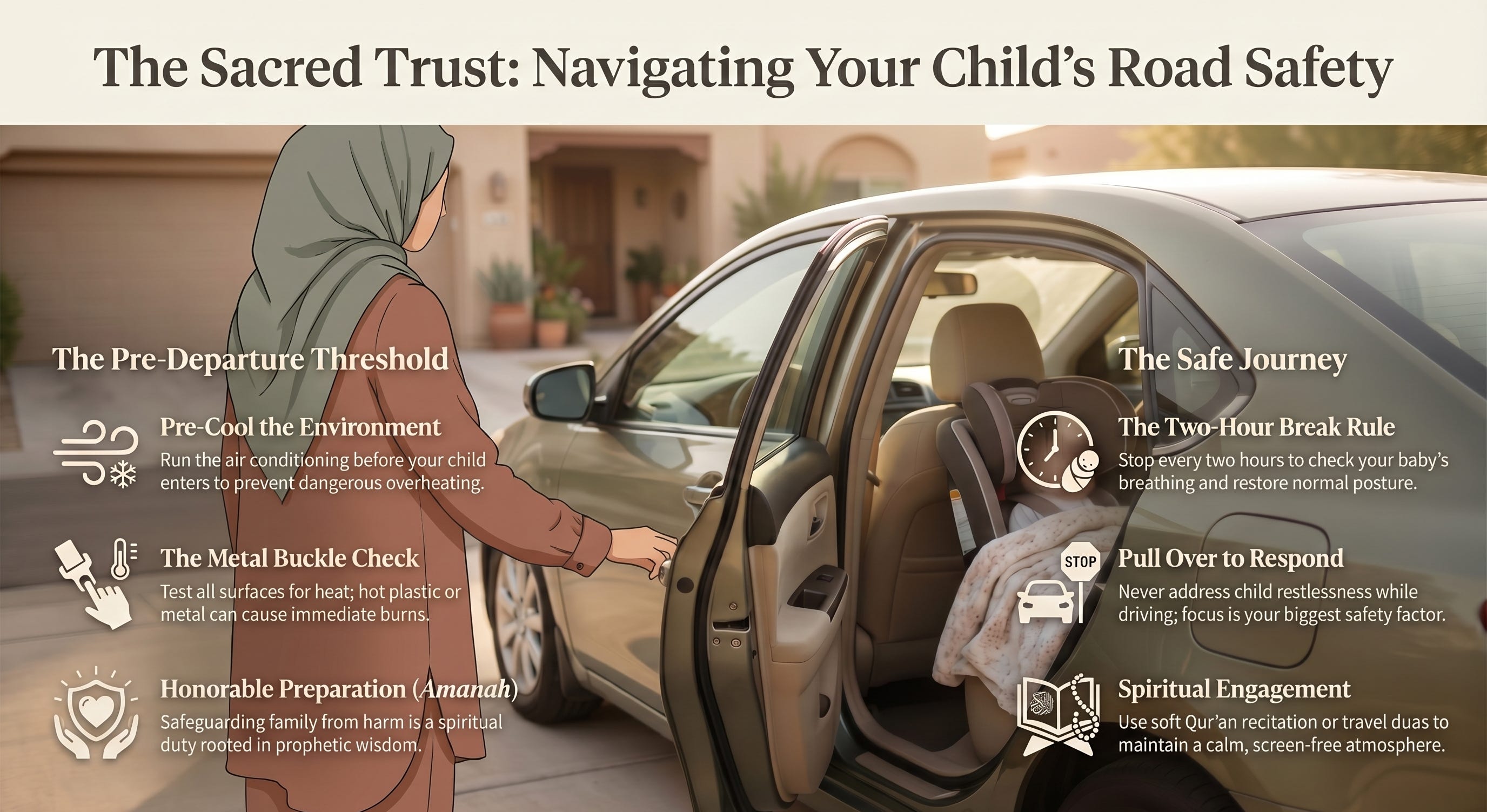
You buckle your child into the car seat. Check the straps. Start the engine.
The car has been sitting in the sun for an hour, and the interior feels warm, but you’ll turn on the air conditioning once you start driving. Your toddler is already fidgeting. You’ve got a long drive ahead.
Here’s what I wish someone had told me earlier: what happens in the first five minutes before you pull out of the driveway can make the difference between a safe, calm journey and one where your child becomes dangerously overheated, distressed, or unsafe.
When I studied the BITRE’s 2024 road trauma report, the number stopped me: 1,172 road deaths in Australia that year. [1] And while not all involved children, it made me realize how much we control through small, preventable choices. The decisions we make before, during, and after a car journey shape whether our children arrive safely.
Why This Guide Is Different From Generic Safety Lists
Scientific Research + Current Data — Every recommendation is backed by peer-reviewed research from Australian transport authorities, child safety organizations, and medical institutions (2021-2025).
Islamic Framework Integrated — This isn’t just safety tips. It’s about honoring the amanah (sacred trust) of protecting your child through practical action grounded in spiritual awareness.
Actionable Resources Included — You’ll get a free Safe Car Journey Companion Pack to print and keep in your car—not just information, but tools you’ll actually use when you need them most.
Why Calm Children Make Safer Journeys
Here’s what surprised me when I started researching this: a distracted driver is the single biggest controllable risk factor in car safety. [2]
When your child is uncomfortable—too hot, restless, or upset—they become a distraction. You glance back. You reach for a toy. You twist around to soothe them while driving.
Those seconds matter.
But here’s the thing: when children feel physically comfortable and mentally engaged, they settle. And when they settle, you can focus on the road. This isn’t just about convenience. It’s about creating the conditions for you to drive safely.
When I reflect on the hadith where the Prophet ﷺ said, “Each of you is a shepherd, and each of you is responsible for his flock,” [3] I think about how this applies to every car journey. Our children are entrusted to us. The temperature we set, the breaks we take, the way we respond to their needs while driving—all of it falls under that responsibility.
How to Keep Your Child Cool in the Car (Even on Hot Days)
Children’s bodies don’t regulate temperature the way ours do. They heat up faster. They sweat less efficiently. And what feels warm to you can become dangerously hot for them within minutes. [4]
Before You Get in the Car
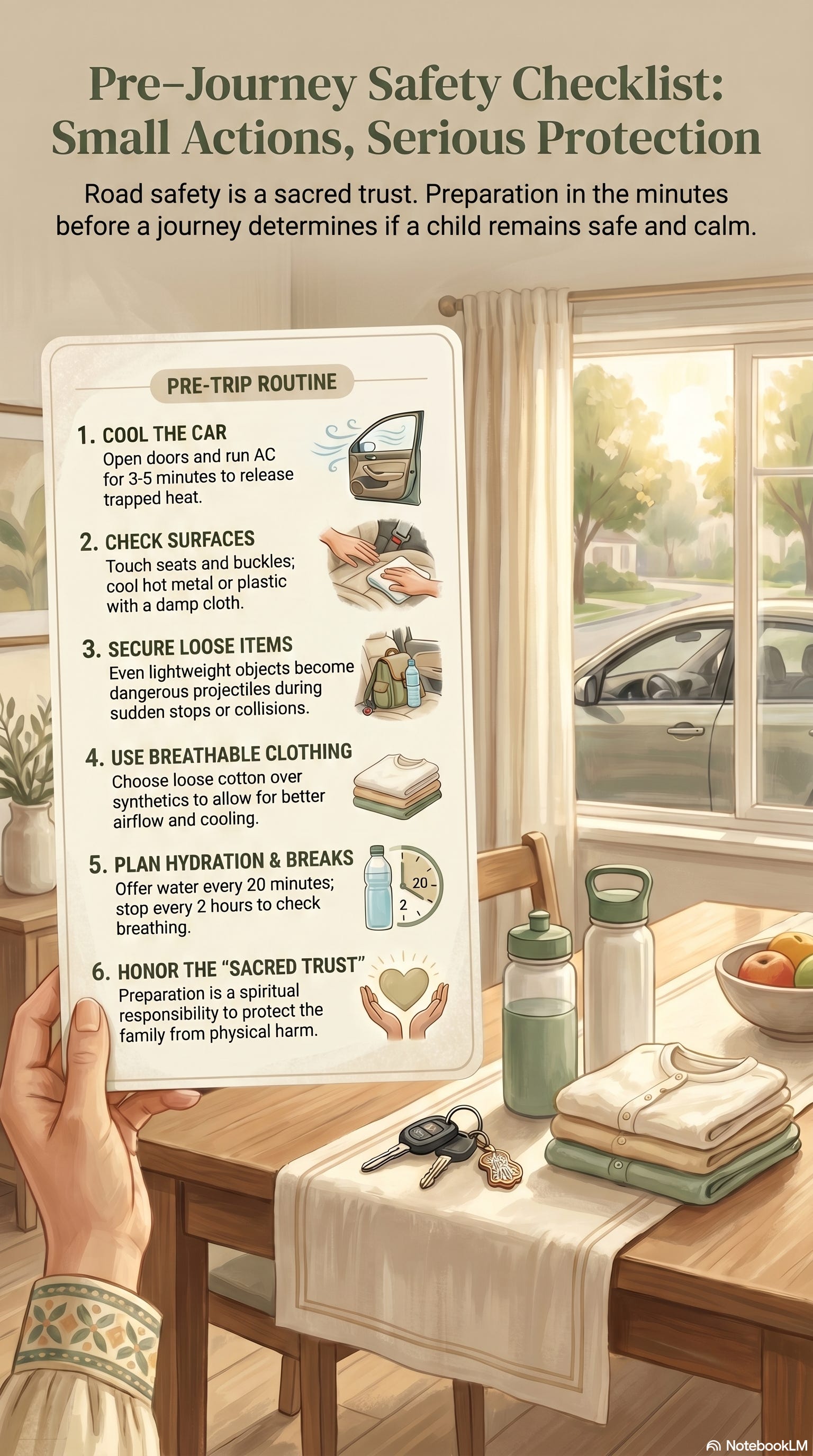
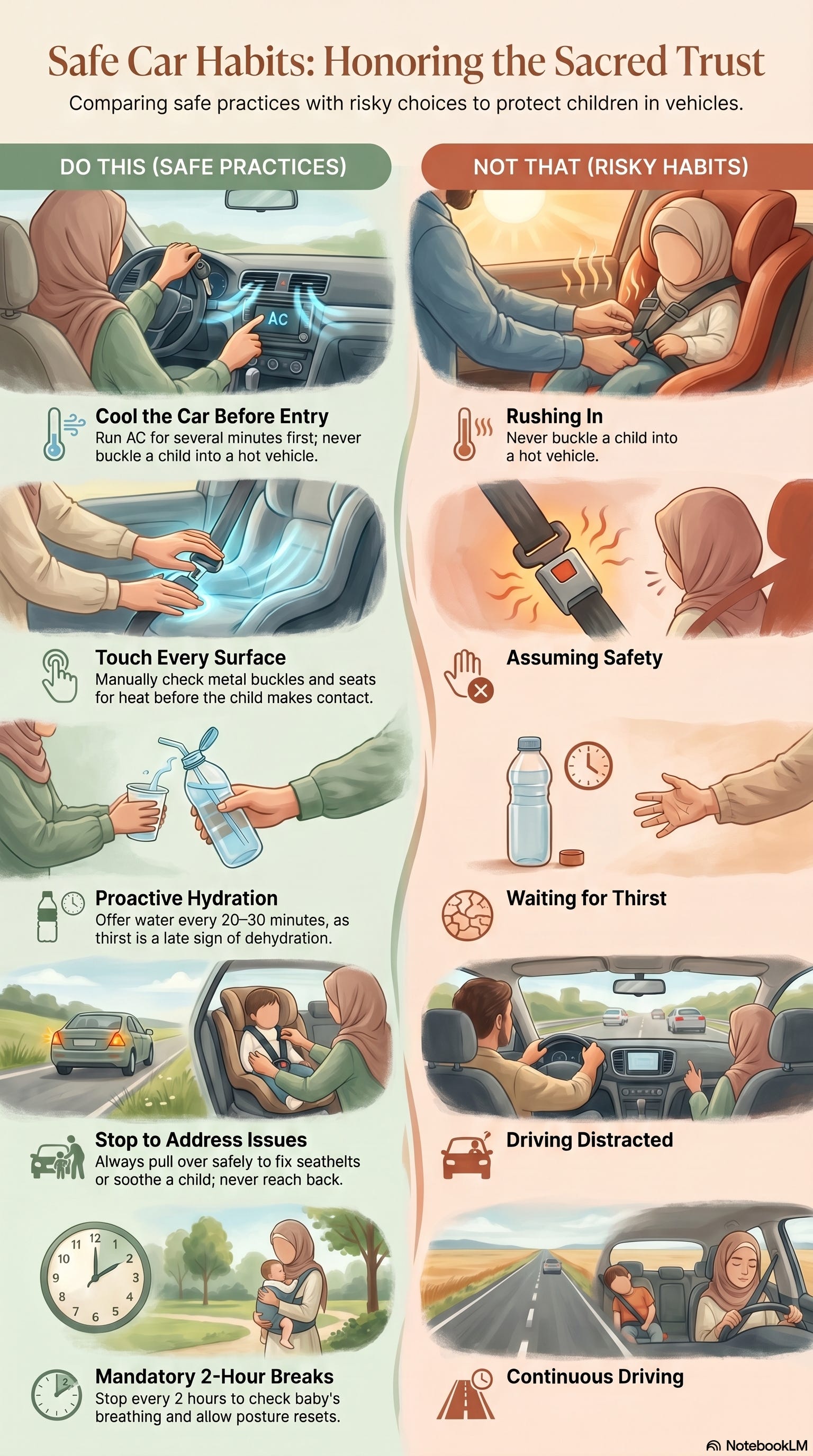
Cool the car before your child enters. If it has been parked in the sun, open the doors and run the air conditioning for several minutes first. I learned this the hard way after my daughter’s car seat buckle burned her leg—metal and plastic surfaces absorb heat and can cause burns even when the air temperature seems fine. [5]
Check every surface your child will touch. If the seat or buckle feels too hot, drape a damp cloth over it briefly to cool it down.
Dress your child in light, loose, breathable clothing. Cotton works better than synthetic fabrics because it allows airflow.
Plan longer trips during cooler times if possible. Early morning or evening travel reduces heat exposure significantly.
Carry extra water. Traffic happens. Delays happen. Having more water than you think you need isn’t paranoia—it’s preparation.
During the Journey
Use air conditioning if you have it. If not, open windows to create airflow, but make sure your child’s arms, legs, and head stay inside the vehicle.
Offer water regularly, even if they don’t ask. Thirst is a late sign of dehydration—small, frequent sips work better than large amounts given infrequently.
Never cover baby capsules or car seats with blankets to block the sun. This traps heat and restricts airflow, creating a dangerous microenvironment around your child. [6] Use proper window sunshades instead, and make sure they don’t obstruct your view.
Never leave a child unattended in a parked car. Temperatures inside vehicles rise rapidly to life-threatening levels. [7] What seems like a quick errand can become a tragedy.
Why Children Need Breaks on Long Journeys (Yes, Even If They’re Asleep)
This is something I didn’t understand until I read the research: car seats are designed for crash protection, not extended sitting.
For babies especially, the semi-reclined position can affect breathing if maintained too long. [8] Their airways are still developing, and sitting in that position for hours without breaks compromises airflow.
But here’s what you can do: stop every two hours during long trips. Even if your child is asleep, you can check on them without waking them.
Regular breaks allow you to:
Check that your baby is breathing easily
Adjust their position
Give them time out of the seat to restore normal posture
For older children, breaks provide movement. Stretching improves circulation. Fresh air resets mood. Even a brief stop can make the difference between a cooperative child and one who becomes increasingly distressed.
I know this is a lot to remember, especially when you’re managing the mental load of packing, planning routes, and keeping everyone on schedule. That’s why I’ve created a free Safe Car Journey Companion Pack—a printable 3-page guide with pre-trip checklists, break reminders, and calm engagement ideas you can keep in your car. Keep reading to download it at the end of this article—it’s designed to stay with you in the spaces where this actually happens.
What to Do When Your Child Becomes Uncomfortable or Behaves Unsafely
Restlessness is normal. You might notice fidgeting, trying to undo seatbelts, or becoming upset.
Respond gently. Remind them calmly why staying secured matters. Praise cooperation when you see it.
But if your child unfastens their seatbelt, needs urgent attention, or behaves in a way that compromises safety, you must pull over safely and stop before responding.
Never try to fix the situation while driving. Those few seconds reaching back to refasten a buckle are seconds when your attention isn’t on the road.
After stopping:
Secure the seatbelt properly
Explain calmly why this matters
Resume driving only when everything is safe
Children learn from repetition. If you consistently stop to address safety issues rather than handling them while driving, they learn that safety is non-negotiable.
How to Keep Children Engaged Without Screens or Noise
Here’s what worked for me: meaningful engagement, not just distraction.
Talk with your child. Describe what you see outside. Explain where you’re going and what you’ll do when you arrive. Even young children benefit from being included in the journey’s story.
Play simple observation games—finding colors, counting vehicles, spotting landmarks.
Play Qur’an recitation in a calm, gentle tone. For young children, this soothes. For older children, it creates a peaceful environment connected to something deeper than entertainment.
Encourage listening to simple adhkar or softly reciting together. The Prophet ﷺ taught specific travel supplications, including “SubhanAllahi wa bihamdihi” (Glory and praise be to Allah). [9] Teaching children these phrases—even in simplified form—roots them in awareness of Allah’s protection during travel.
For older children, introduce short duas or reflections appropriate to their age. Ask them what they’re grateful for during the journey.
Provide safe, lightweight toys or books. Avoid hard objects that could become dangerous in sudden stops—weight and speed turn harmless items into hazards. [10]
Offer healthy snacks and drinks when safe to do so. Hunger and thirst fuel irritability.
The Islamic Perspective: Why Car Safety Is a Trust Issue
Allah says in the Qur’an: “O you who have believed, protect yourselves and your families from a Fire.” [11]
While this speaks to spiritual protection, it reminds me that our duty includes safeguarding our children from physical harm through vigilance and preparation. Every decision about car safety—cooling the vehicle, taking breaks, responding safely to distress—is part of that trust.
Another verse says: “And do not throw yourselves into destruction with your own hands.” [12] Rushing, neglecting precautions, or treating responsibility lightly is a form of self-harm. When we cut corners on safety, we’re not just being careless—we’re failing the trust placed in our hands.
Your Safe Car Journey Companion Pack
If you’ve read this far, you’re the kind of parent who takes safety seriously—not as paranoia, but as protective care. That tells me something important about you.
Inside the Safe Car Journey Companion Pack (one comprehensive PDF, 3 pages):
Page 1: Pre-Journey Safety Checklist — Everything to check before you start the engine, from car temperature to water supplies, designed like a laminated card you can keep clipped to your sun visor.
Page 2: Break Schedule & Engagement Ideas — When to stop, what to check, and 7 meaningful ways to keep children calm without screens—so you can reference it quickly during longer trips.
Page 3: Travel Du’as & Spiritual Reminders — Authentic supplications for travel safety organized by moment (before departure, during journey, upon arrival) so you can teach them naturally to your children.
This isn’t just a PDF to download and forget. It’s a tool designed to stay in your car—where you’ll actually use it when you need it most.
This Companion Pack is what every GrowDeen subscriber receives with each article. We cover the full journey of raising Muslim children, all backed by research and rooted in Islamic wisdom.
If you’re a Muslim parent who wants both evidence-based guidance and Islamic perspective, subscribe for free so future resources arrive in your inbox before you need them.
You’ll receive guidance when it’s ready, no clutter, just guidance when there’s something worth sharing.
Do This Right Now
Before you keep reading: check your car’s air conditioning settings. Make sure you know how to cool the car quickly. Note where your water bottles are stored.
Right now.
These small checks take less than two minutes and can prevent dangerous heat exposure on your next journey.
May Allah place barakah in your careful preparation, accept your intention to protect what He has entrusted to you, and make every journey safe, peaceful, and blessed.
Share This With One Parent Who Needs It
Think of one person right now: a friend with young children who just bought their first car, a sister preparing for a long road trip with her toddler, a new mother at the masjid who mentioned she’s nervous about her first solo drive with the baby.
This article could protect their child. Share it with them today—not because you’re being preachy, but because you care. Sometimes the most loving thing we can do is pass along knowledge that prevents harm.
Frequently Asked Questions
Q: How often should I offer my child water during a car journey? A: Offer small amounts every 20-30 minutes, even if they don’t ask. Thirst is a late indicator of dehydration, especially in children. For more on managing heat and hydration, see “How to Keep Your Child Cool in the Car” above.
Q: Can I leave my child in the car if I’m just running into the shop for two minutes? A: No. Car temperatures rise dangerously fast—within minutes, not hours. [7] What seems like a quick errand creates a life-threatening situation. Always take your child with you.
Q: My baby falls asleep in the car. Is it safe to let them sleep for the whole journey? A: Car seats aren’t designed for extended sleep. Stop every two hours to check your baby’s breathing, adjust their position, and give them time out of the seat. [8] You don’t have to wake them, but the break protects their airway.
Q: What’s the safest temperature setting for the car when traveling with children? A: Aim for a comfortable temperature that doesn’t require your child to wear heavy clothing while secured in their seat. Cool the car before they enter, and adjust gradually during the journey. Touch metal buckles and seat surfaces regularly—they heat up faster than the air.
Q: How can I keep my toddler calm without using a tablet or screen? A: Talk with them, play observation games, or play Qur’an recitation softly. Engage them in the journey’s narrative—what they see, where you’re going, what you’ll do. For more ideas, see “How to Keep Children Engaged Without Screens or Noise” above.
Q: What should I do if my child unfastens their seatbelt while I’m driving? A: Safely pull over and stop the vehicle immediately. Never try to refasten it while driving. Once stopped, secure the belt properly, explain why it matters, and resume only when safe. Consistency teaches that safety is non-negotiable.
References
[1] Australian Bureau of Infrastructure and Transport Research Economics (BITRE). (2025). Road trauma Australia 2024: Statistical report on fatalities and hospitalised injuries from road crashes in Australia. BITRE. Retrieved from https://www.bitre.gov.au/sites/default/files/documents/road-trauma-australia-2024.pdf
[2] Australian Bureau of Statistics (ABS). (2024). Causes of death, Australia. ABS. Retrieved from https://www.abs.gov.au/statistics/health/causes-death/causes-death-australia/latest-release
[3] Sahih al-Bukhari 893, Sahih Muslim 1829
[4] Australian Institute of Health and Welfare (AIHW). (2022). Australia’s children: Injuries. AIHW. Retrieved from https://www.aihw.gov.au/reports/children-youth/australias-children/contents/health/injuries
[5] Neuroscience Research Australia (NeuRA) and Kidsafe Australia. (2013). Keeping children as safe as possible while travelling in motor vehicles: A guide for parents, carers and road safety practitioners. NeuRA & Kidsafe Australia. Retrieved from https://kidsafe.com.au/wp-content/uploads/2017/10/DetailedConsumerGuide-1.pdf
[6] Neuroscience Research Australia (NeuRA). (2021). National child restraint best practice guidelines. NeuRA. Retrieved from https://www.neura.edu.au/crs-guidelines
[7] KidSafe Victoria. (n.d.). Children left unattended in cars. Kidsafe Victoria. Retrieved from https://www.kidsafevic.com.au/road-safety/hot-cars/?no_frame=1
[8] Bilston, L.E., Yuen, M., & Brown, J. (2007). Reconstruction of crashes involving injured child occupants: The risk of serious injuries associated with sub-optimal restraint use may be reduced by better controlling occupant kinematics. Traffic Injury Prevention, 8(1), 47-61. https://doi.org/10.1080/15389580600990352
[9] Sahih Muslim 2731
[10] Brown, J., Bilston, L., McCaskill, M., & Henderson, M. (2005). Identification of injury mechanisms for child occupants aged 2-8 in motor vehicle accidents. Motor Accidents Authority of NSW. Retrieved from http://pandora.nla.gov.au/pan/108965/20091023-1911/www.maa.nsw.gov.au/getfile8ba1.pdf
[11] Qur’an, Surah At-Tahrim 66:6
[12] Qur’an, Surah Al-Baqarah 2:195