
The Living Room Moments That Build a Child’s Confidence
Play Is Not A Break From Learning, It Is The Learning

Play is one of the main ways children learn how their body works, how emotions feel, how relationships respond, and when play fades in a noticeable way it can be a gentle signal to check in and seek support.
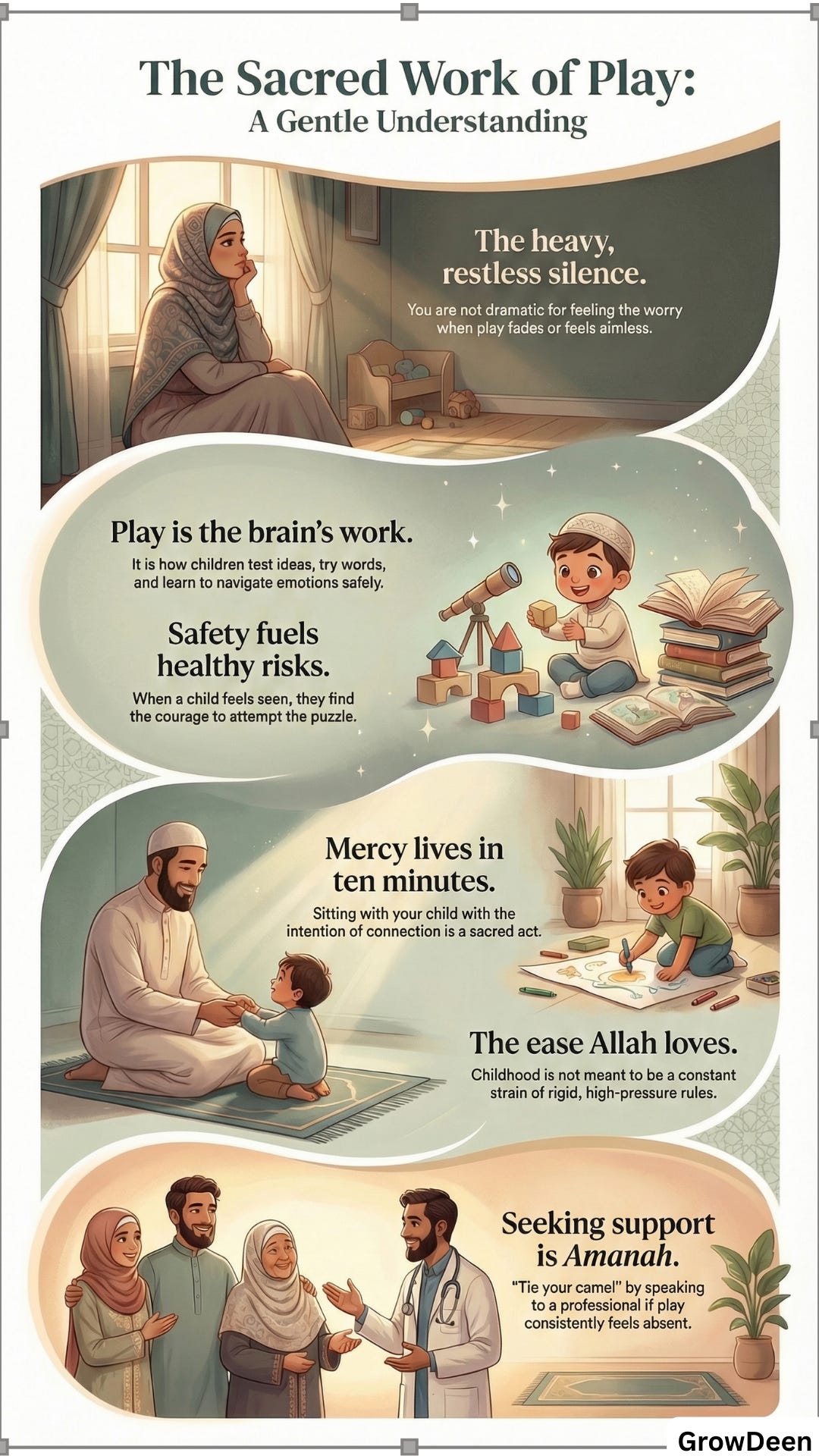
It is one of those afternoons.
The toys are everywhere, but your child looks bored anyway.
They pick something up, drop it, then drift back to you with that restless energy that makes you feel tired before anything even happens.
And in your mind, a worry taps your shoulder.
Why do they not want to play anymore.
Is this normal.
Am I supposed to fix this.
You are not dramatic for feeling it.
You are a parent who is paying attention.
The “messing around” that is actually doing a lot
Play can look almost silly from the outside.
A baby staring at your face like you are the whole universe.
A toddler dragging a bucket across the floor like it is serious work.
A child turning a couch cushion into a mountain, then a cave, then a ship.
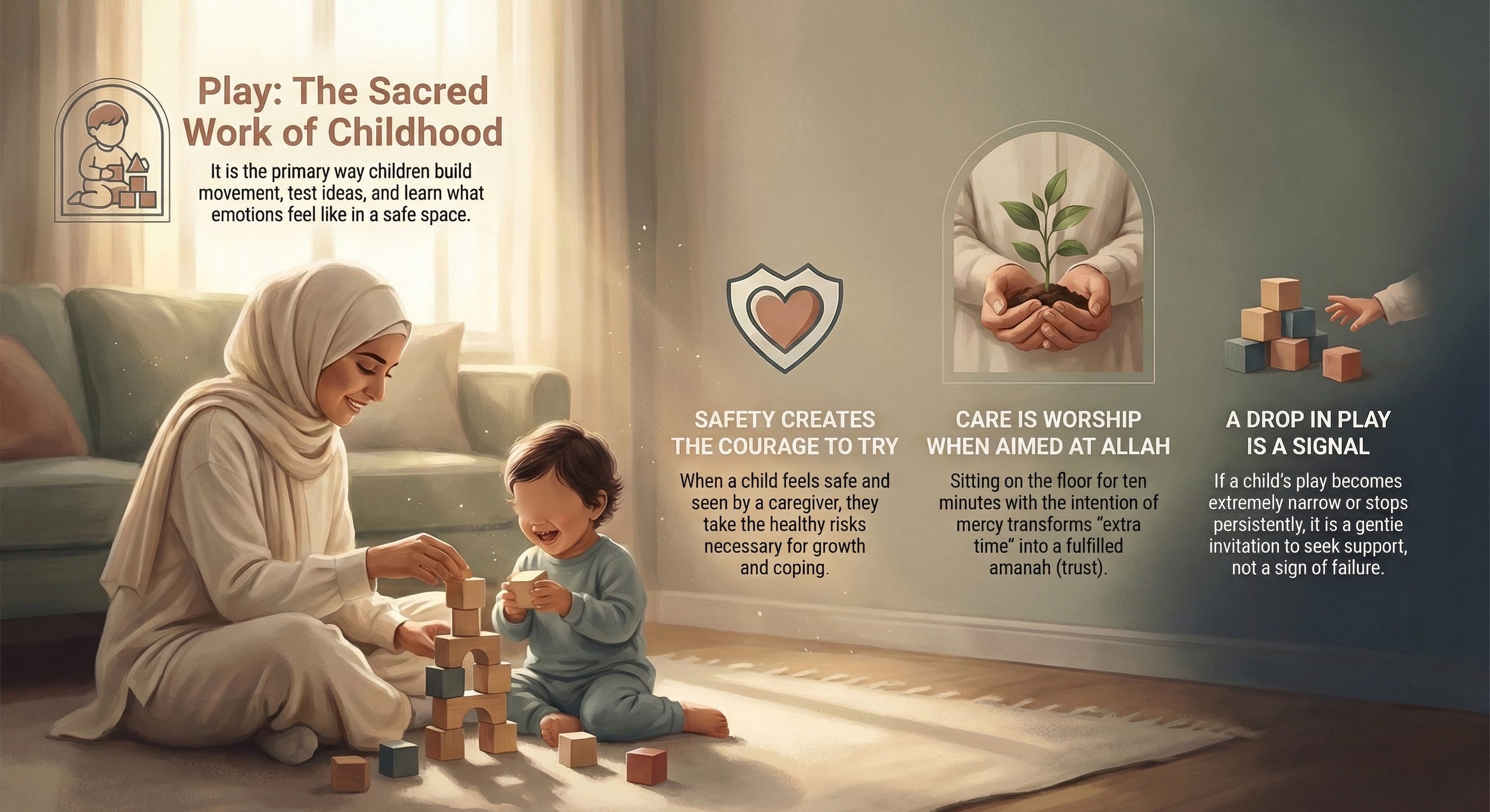
But underneath it, play is one of the main ways children build their brains and their confidence. It is how they practise movement, test ideas, try words, read social cues, and learn what emotions feel like in a safe space. Pediatrics has treated play as central, not optional. [10]
And when child development researchers talk about the early years, they keep returning to the same core truth. Children grow inside relationships and environments, not in isolation. [1] [7]
So yes, your living room counts.
Even on days it looks like chaos.
When a child feels safe, they take healthier risks
There is a simple emotional job that play often does.
It helps a child feel safe and seen.
And when a child feels safe, they usually try more.
They attempt the puzzle.
They climb the step.
They take a turn with another child, even if it goes badly.
Those small risks are how coping grows.
This is not only about fun. It is about development across the whole child, physical, thinking, social, emotional. [1] [10]
Relational health research describes how warm, responsive caregiving supports children’s development across domains. [3] [4] And even research on children who experienced early deprivation shows how much consistent caregiver interaction can change outcomes over time. [5]
If you have ever wondered, Does sitting on the floor with them matter.
It does.
Allah’s mercy can live inside ten minutes of play
As Muslim parents, it helps to reframe something that quietly steals our peace.
We sometimes treat play like “extra time” we should feel guilty about.
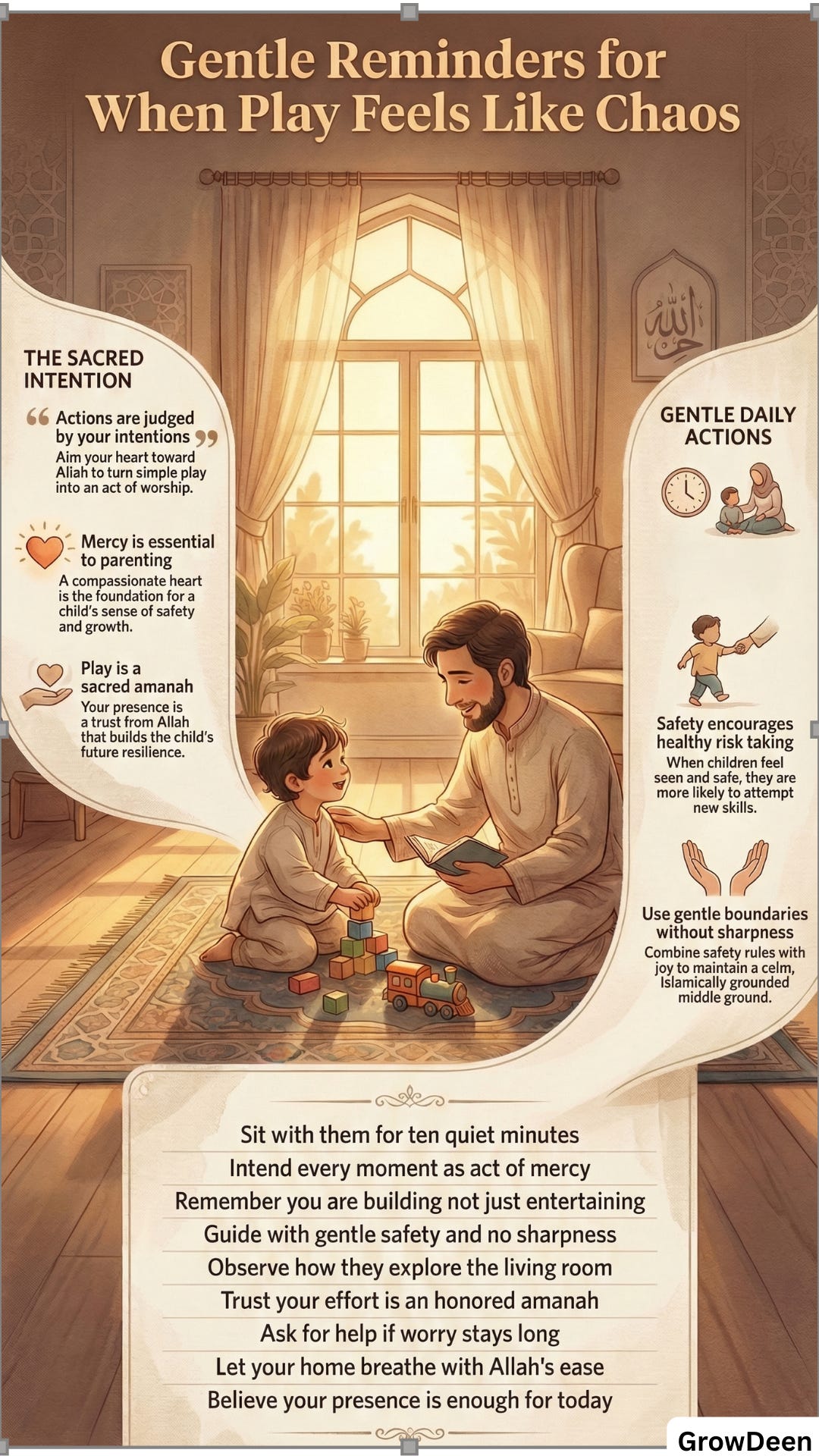
But care is worship when the heart is aimed at Allah.
The Prophet ﷺ taught that actions are judged by intentions. [11] So if you sit with your child for a few minutes with the intention of mercy, connection, and wellbeing, it is not wasted time. It is part of amanah.
And mercy is not a side trait in parenting. The Prophet ﷺ made it clear that compassion toward children matters, and that a heart without mercy is missing something essential. [12]
If you need a simple internal line to steady yourself, try this.
I am not entertaining them. I am building them.
Not in a pressured way.
In a human way.
The ease Allah loves is not the same as “no rules”
Children need room, and they also need guidance.
Some parents swing between two extremes. Either we let everything go because we are tired, or we tighten everything because we are scared.
Islam gives a calmer middle.
Allah tells us He wants ease for people and does not want hardship for them. [13] Ease does not mean a home with no boundaries. It means we do not turn childhood into constant strain.
So if you are guiding play, keep it safe, keep it values aligned, and still leave space for joy.
A gentle boundary script that works across ages is this.
You can play. I will help you keep it safe.
Then you follow through without sharpness.
Two kinds of play your child needs, and why both matter
Some play is unstructured. It appears on its own.
A child builds with cushions. Dresses up. Pretends the spoon is a microphone. Makes up a “shop” on the sofa.
Pretend play has been discussed as a meaningful space where children practise ideas, roles, and flexible thinking. [8] It can also quietly build resilience, especially when a caring adult is nearby and the child is allowed to try, fail, and try again. Supportive relationships and active skill building strengthen resilience. [6]
Other play is structured. It has a place, a time, and often an adult guiding it.
A swimming lesson. A library story group. A family board game. A ball game. A simple class.
As children grow, many benefit from both, not because one is better, but because each does something different. [10]
And you do not need a perfect balance.
You just need enough variety that your child’s world does not shrink into one narrow lane.
If you are finding this kind of guidance helpful, you might want to subscribe for free. Not for pressure. For support. So you have gentle, practical reminders to return to when parenting feels heavy.
How play changes as your child grows
Play shifts with age.
A baby’s play might be your face, your voice, peekaboo, a soft texture, a pause that lets them coo back. Those back and forth interactions are part of how early language pathways grow in the child’s wider daily environment. [2]
A toddler often wants big movement and repetition. Carrying, pushing, dumping, climbing, stomping, running.
A preschooler often loves open ended objects and pretend. They also start moving into more social play, first beside other children, then more interactively. [7]
A school age child might enjoy longer projects, games with rules, building forts, obstacle courses, cooking, art, or sports.
Across cultures and locations, many milestones and behaviours are broadly similar among healthy children, even though timing still varies. [9]
So you do not need to panic if your child’s play does not match another child’s play perfectly.
But you can stay curious.
When the drop in play is worth taking seriously
There are normal days when a child does not want to play.
They are tired. Sick. Overstimulated. Stuck in a rut.
That often passes.
But sometimes, a noticeable drop in play, or a very narrow interest in play, can be a signal to check in.
If a baby rarely engages in interactive games like peekaboo.
If a toddler’s play seems extremely limited, or toys are used in ways that feel very different from peers for a long stretch.
If a preschooler shows little interest in pretend play or playing with other children.
These are examples that can be worth discussing with a health professional or educator, especially if the pattern is persistent. Work discussing early intervention also highlights how careful observation of play and engagement matters when children have developmental differences, including autism. [9]
If this is landing close to home, please do not carry it alone.
Seeking support is not failure. It is part of amanah.
Tie your camel and trust in Allah. [14]
And hold onto this, especially if fear is trying to swallow your chest.
Allah does not burden a soul beyond what it can bear. [15]
Sometimes the next right step is not fixing everything.
It is simply speaking to a trusted professional, asking the question, and letting someone help you see clearly.
You are allowed to ask for that.
You are allowed to need that.
GIFTS FOR YOU, DEAR PARENT
If you’ve reached this part of the page, it tells me something meaningful about you.
You weren’t just skimming or passing time. You stayed because something here felt relevant to your real life.
Because you care.
Because you want to do things with more awareness.
Because you’re trying, even when it feels overwhelming.
That is not small.
So I didn’t want this article to remain just words on a page. I wanted it to gently step into your daily life in practical ways. That’s why we prepared these Life Gifts for you.
Not as extras.
Not as decorations.
But as simple tools to help you hold onto what mattered most in what you just read.
Here’s what you’ll find inside:
Gentle Understanding Card
A clear and simplified summary of the core concept from this article, so you can revisit the main idea anytime without rereading everything.
Heartfelt Dua Card
A carefully chosen dua connected to this stage of life, because we know that real strength and ease ultimately come from Allah’s help.
Gentle Actions Card
Practical examples to help you translate knowledge into action, so what you learned becomes part of your daily rhythm.
Gentle Reminders Card
Short, steady reminders drawn from the key points, designed to be printed or saved and placed somewhere you’ll see often.
These were designed slowly and thoughtfully, with time, care, and sincere dua. We created them because we genuinely want to walk alongside you, not just through one article, but through every stage of this lifelong journey.
If these gifts support you even in a small way, I would love for you to continue receiving them.
Subscribe so that each new Gift arrives directly in your inbox whenever we release the next stage. That way, you won’t miss the tools designed to support you right where you are.
May Allah place barakah in your effort, accept your intention, and make this path easier and more rewarding than it feels right now.
Please share it with a family or friend who may benefit from this knowledge.
What is one moment with your child that feels hardest lately, and what kind of support would make it feel lighter?
References
[1] Center on the Developing Child at Harvard University. (2017, updated 2021). Three principles to improve outcomes for children and families, 2021 update. https://developingchild.harvard.edu/resources/report/three-principles-to-improve-outcomes-for-children-and-families/
[2] Ford, A.L.B., Elmquist, M., Merbler, A.M., Kriese, A., Will, K.K., and McConnell, S.R. (2020). Toward an ecobehavioral model of early language development. Early Childhood Research Quarterly, 50(Part 1), 246 to 258. https://doi.org/10.1016/j.ecresq.2018.11.004
[3] Frosch, C.A., Schoppe Sullivan, S.J., and O’Banion, D.D. (2019). Parenting and child development: A relational health perspective. American Journal of Lifestyle Medicine, 15(1), 45 to 59. https://doi.org/10.1177/1559827619849028
[4] Julian, M.M., Lawler, J.M., and Rosenblum, K.L. (2017). Caregiver child relationships in early childhood: Interventions to promote well being and reduce risk for psychopathology. Current Behavioral Neuroscience Reports, 4, 87 to 98. https://doi.org/10.1007/s40473-017-0110-0
[5] McCall, R.B., Groark, C.J., Hawk, B.N., Julian, M.M., Merz, E.C., Rosas, J.M., Muhamedrahimov, R.J., Palmov, O.I., and Nikiforova, N.V. (2019). Early caregiver child interaction and children’s development: Lessons from the St. Petersburg USA orphanage intervention research project. Clinical Child and Family Psychology Review, 22, 208 to 224. https://doi.org/10.1007/s10567-018-0270-9
[6] National Scientific Council on the Developing Child. (2015). Supportive relationships and active skill building strengthen the foundations of resilience: Working paper No. 13. Center on the Developing Child at Harvard University. https://developingchild.harvard.edu/wp-content/uploads/2024/10/The-Science-of-Resilience2.pdf
[7] National Scientific Council on the Developing Child. (2004, updated 2009). Young children develop in an environment of relationships: Working paper No. 1. Center on the Developing Child at Harvard University. http://developingchild.harvard.edu/resources/wp1/
[8] Skolnick Weisburg, D. (2015). Pretend play. WIREs Cognitive Science, 6(3), 249 to 261. https://doi.org/10.1002/wcs.1341
[9] Raulston, T.J., Ousley, C.L., Hinton, E.M., and Ramirez, A.M. (2024). Beyond trial counts: Considerations for measuring play and engagement during early intervention for autistic children. Behavior Analysis in Practice, 17(4), 1216 to 1227. https://doi.org/10.1007/s40617-024-01002-3
[10] Yogman, M., Garner, A., Hutchinson, J., Hirsh Pasek, K., and Michnick Golinkoff, R., Committee on Psychosocial Aspects of Child and Family Health and Council on Communications and Media. (2018). The power of play: A pediatric role in enhancing development in young children. Pediatrics, 142(3), e20182058. https://doi.org/10.1542/peds.2018-2058
[11] Sahih al Bukhari 1 and Sahih Muslim 1907. Actions are judged by intentions. https://sunnah.com/bukhari:1 and https://sunnah.com/muslim:1907a
[12] Sahih al Bukhari 5997 and Sahih Muslim 2318. Mercy to children. https://sunnah.com/bukhari:5997 and https://sunnah.com/muslim:2318
[13] Qur’an, Surah Al Baqarah 2:185. https://quran.com/2/185
[14] Jami at Tirmidhi 2517. Tie your camel and trust in Allah. https://sunnah.com/tirmidhi:2517
[15] Qur’an, Surah Al Baqarah 2:286. https://quran.com/2/286