
The Kind of Physical Activity Young Children Need Most Still Looks Like Play
In A Muslim Home, Active Play Can Be Part Of Caring For An Amanah

Free gift for you! A practical companion resource is waiting for you near the end of this article to help you remember, apply, and benefit from what you read. Don’t forget to download!
From birth to 5 years, regular playful movement helps children build strength, coordination, confidence, sleep, self regulation, and healthy habits, and these goals sit comfortably within an Islamic ethic of mercy, balance, and care for the body.
It starts so early that we almost miss it.
A baby kicking on a blanket. Rolling toward a toy with great effort. A toddler climbing onto a cushion as if it were a mountain. A preschooler running nowhere in particular, just running because the body feels alive and the day is open.
No one has said the word exercise.
No one needs to.
For young children, movement begins long before organised sport, long before drills, long before anyone talks about fitness. In the early years, movement is one of the main ways children grow.[1][2][5][7][11]
The body starts learning before a child knows the word exercise
Physical activity in early childhood helps strengthen bones, muscles, hearts, and lungs. It supports balance, coordination, posture, flexibility, and motor development. It also connects with sleep, mood, confidence, and self regulation. And when children move with other people, they are often building language, turn taking, and belonging at the same time.[1][2][7][9][11]
That makes this easier to see clearly.
Playful movement is not extra. It is not what happens after the “real” learning is done. For many young children, it is one of the main places learning is happening.
The care of Allah includes the child’s body too
In a Muslim home, a child’s body is not an afterthought. It is part of the trust Allah has placed in a family. Recent qualitative research exploring Muslim scholars’ views on physical activity found that physical activity was widely understood as something supported by Islamic teachings, while also noting that Muslim communities often still lack enough explicitly Islamic health initiatives.[12]
So when Muslim parents encourage movement, outdoor play, strength, coordination, and bodily skill, they are not borrowing something foreign. They are caring for an amanah.
Allah says about Talut that Allah increased him in knowledge and stature.[13] The Prophet ﷺ also said, “The strong believer is better and more beloved to Allah than the weak believer, though there is good in both.”[16] And he said, “Your body has a right over you.”[17] Physical strength is not the highest virtue by itself, but it is still a blessing, and the body still has claims that should not be neglected.
What active play looks like at different ages
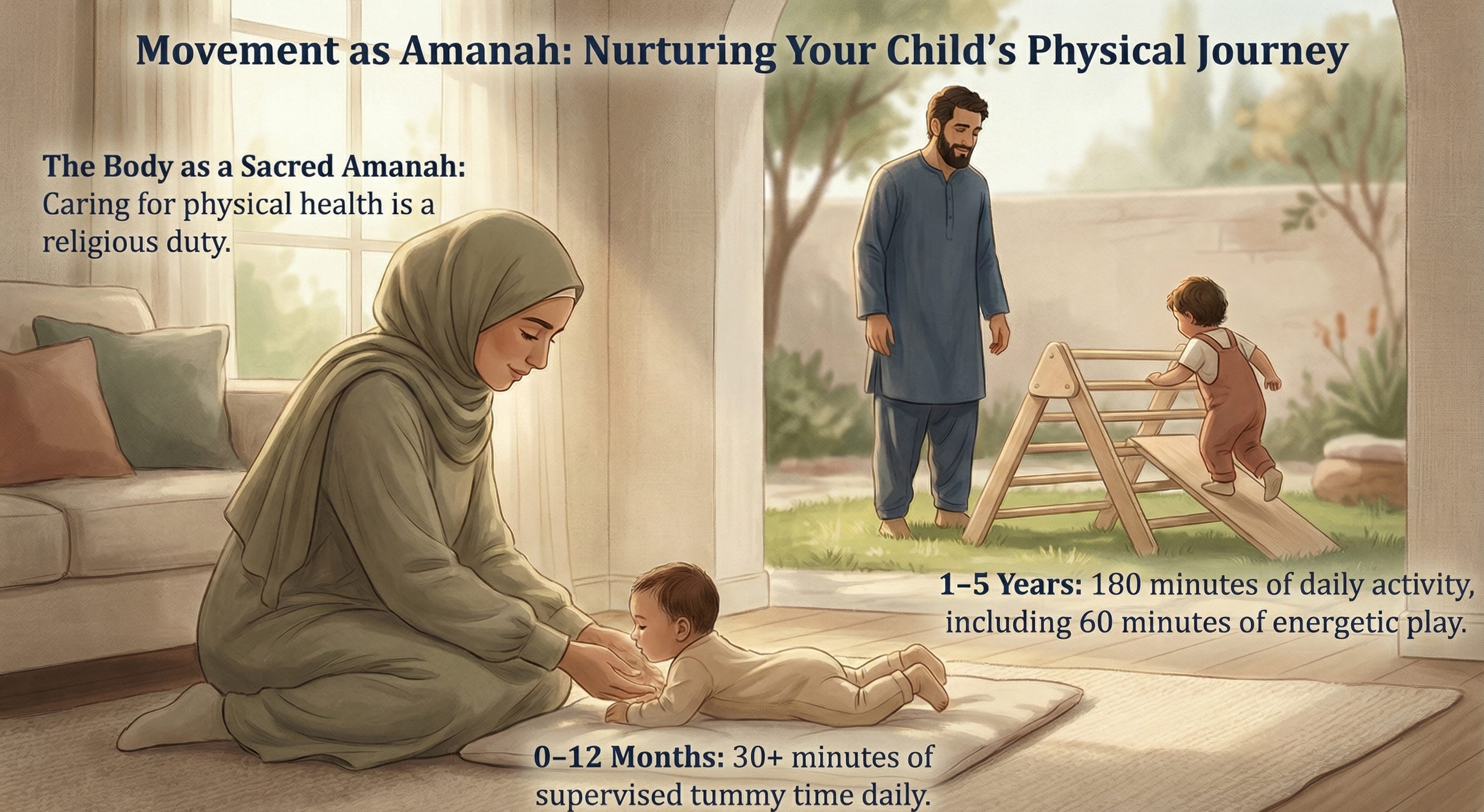
From birth to 12 months, the goal is not exercise in the adult sense. It is supervised floor based play, free movement, and time to explore the body. Current guidance says infants should be physically active several times a day in different ways, and before they are mobile this includes supervised floor play, reaching and grasping, and at least 30 minutes of tummy time spread across the day while awake.[1][2][5]
Tummy time matters because it helps build the head, neck, shoulders, and upper body muscles babies later use for rolling, crawling, sitting, and more.[5] Research has also found tummy time classes feasible and acceptable for mothers with infants, which is a helpful reminder that even simple support around movement can matter.[6]
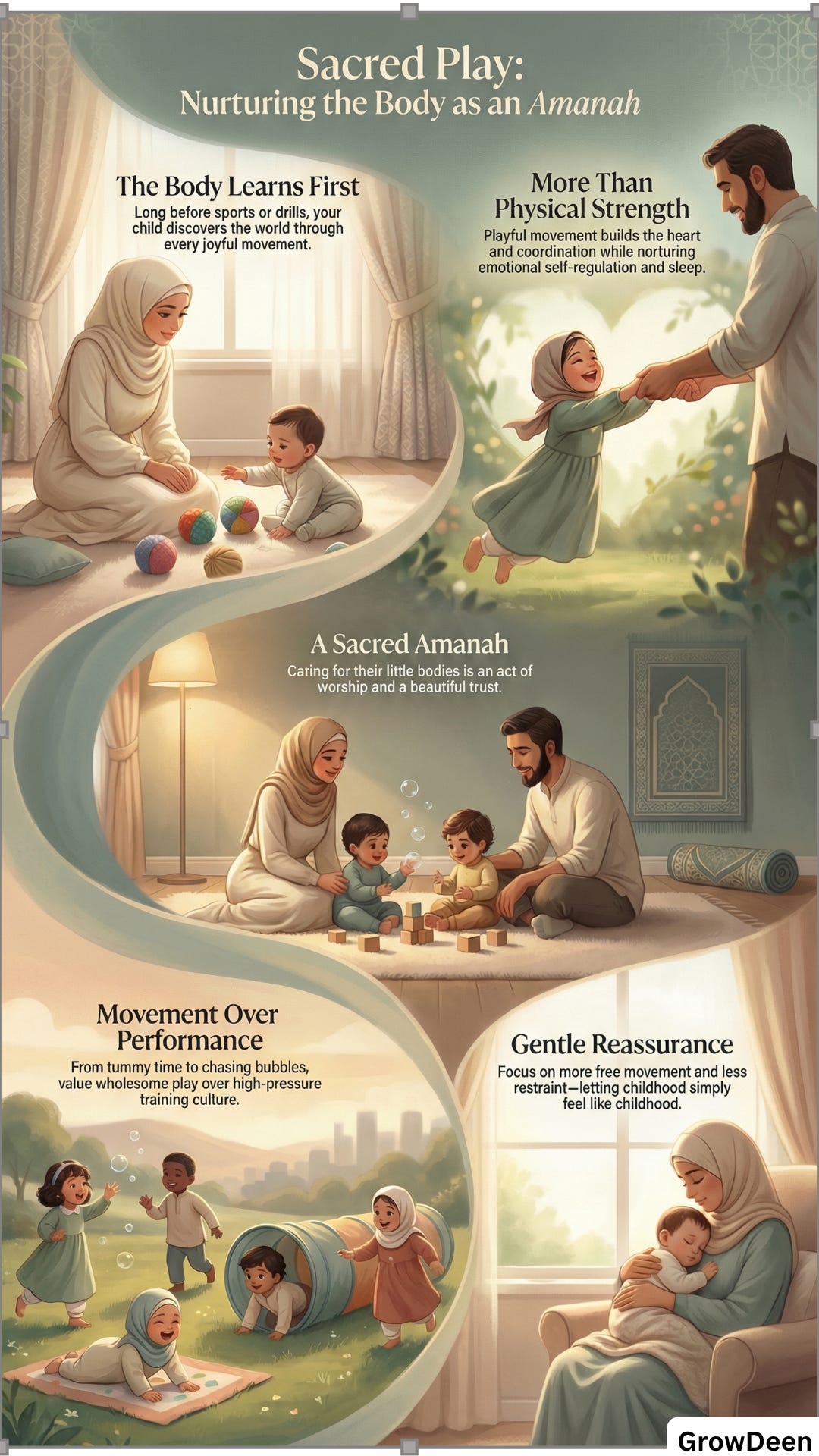
This movement does not need expensive equipment. A large blanket on the floor. A safe bit of grass outside. A rattle just out of reach. A parent lying face to face with the baby and smiling, talking, clapping, or playing peekaboo. These small things count.[5][6][11]
And they work best when the child is not rushed. Babies need room to explore their own timing.
Once children move into the toddler years, the picture changes. Between 1 and 2 years, children should accumulate at least 180 minutes of physical activity across the day, including energetic play.[1][2] That sounds like a lot until you remember what childhood is like when it is allowed to be itself.
Walking from room to room. Climbing the sofa. Carrying random objects for mysterious reasons. Dancing when a rhyme starts. Splashing in puddles. Throwing a ball badly and then chasing after it with full commitment.
For children aged 3 to 5 years, the recommendation remains at least 180 minutes through the day, with at least 60 minutes of energetic play included in that time.[1][2] This does not require a formal program. It requires opportunity. Space to move. Less time strapped into seats and strollers. Fewer long sedentary stretches. Objective review data suggest preschool children can spend large parts of the day sedentary, so intentional movement opportunities really do matter.[7]
Outside often changes everything
Children in this age range usually do best when activity still feels like play. Balls of different sizes and textures can be rolled, thrown, kicked, bounced, or caught. Chalk lines can become walking paths, jumping paths, or running tracks. Bubbles can turn into chasing games. Music can become dancing. A park can become climbing, hanging, sliding, and pretending. A beach, trail, field, riverbank, or patch of grass can become a place to run, gather, balance, and explore.[4][9][11]
Nature matters too. A 2024 study found associations between natural blue and green space and preschool children’s movement behaviours, which fits something many parents already feel in practice. When the environment feels open and alive, children often move more freely.[4]
This is also where a bit of challenge can matter. Research on risky play found positive associations with children’s well being, involvement, and physical activity.[10] That does not mean carelessness. It means childhood should not be padded so heavily that a child never gets to test balance, climbing, speed, height, or recovery in a sensible, supervised way.
If this kind of gentle, practical, Islamically grounded parenting support helps you think more clearly about daily life, subscribe for free so each new piece can meet you right where you are.
Strength without pressure
For young children, physical activity should still feel like childhood. Educational review work on preschool activity strategies points toward playful, varied, enjoyable movement woven into daily life, not heavy pressure or joyless structure.[9] Longitudinal research on sport participation suggests early sport can support confidence and self regulation best when participation is gentle and age appropriate, not harshly performance driven.[3][8]
That sits beautifully with Islamic balance.
Allah says, “Eat and drink, but do not be excessive.”[14] Early childhood health is not meant to be built on extremes. Not neglect. Not obsession. Not a sedentary life disguised as comfort. Not performance culture dressed up as discipline. Balance matters.
And there is room in the Sunnah for movement, play, and physical skill. Aisha رضي الله عنها narrated that she raced the Prophet ﷺ, beating him once, then later he beat her and joked about it.[18] And on Eid, the Prophet ﷺ allowed the Abyssinians to display their play with shields and spears while he stood so Aisha could watch.[19] These moments show that wholesome movement and recreation were not erased from Muslim life. They had a place.
Let childhood still feel like childhood
So perhaps the practical rule is this.
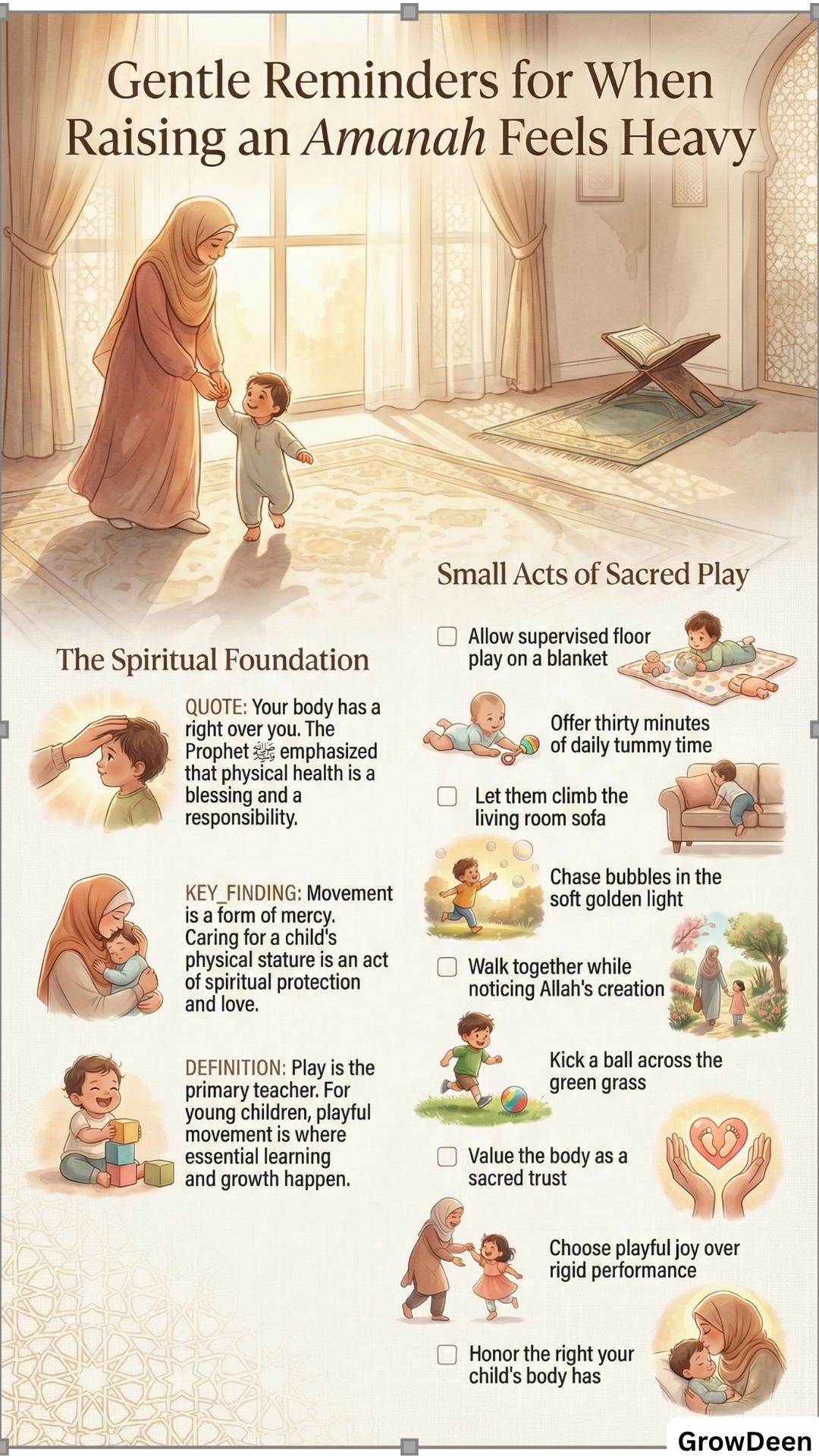
If movement in your home looks like tummy time on a blanket, walking instead of always sitting in the stroller, chasing bubbles, kicking a ball, running to a tree and back, carrying something light, climbing the playground, dancing in the living room, or taking family walks while noticing Allah’s creation, then something good is already being built.[1][2][5][11]
There is also wisdom in not leaning on weak slogans. Many people quote the line about teaching children swimming, archery, and horse riding as a Prophetic hadith. Its attribution is disputed, so it is wiser not to rely on it. Stronger and clearer texts already give enough direction. Value strength. Honour the body’s rights. Allow wholesome play. Raise children with mercy and balance.[16][17][18][19]
And Allah says, “Protect yourselves and your families from a Fire.”[15] That protection is spiritual first, but it is not only abstract. It includes the habits we build into daily life. A family that normalises movement, outdoor time, bodily care, and joyful activity is also protecting its children from patterns of passivity and harm.
In the end, physical activity for 0 to 5 years should feel like life in the body, not a training camp.
More movement.
More free play.
More room.
Less restraint.
Less long sitting.
More joy in the day.
That is good public health, and it sits comfortably inside an Islamic vision of mercy, strength, and responsible care.[1][2][12][16][17]
GIFTS FOR YOU, DEAR PARENT
If you’ve reached this part of the page, it tells me something meaningful about you.
You weren’t just skimming or passing time. You stayed because something here felt relevant to your real life.
Because you care.
Because you want to do things with more awareness.
Because you’re trying, even when it feels overwhelming.
That is not small.
So I didn’t want this article to remain just words on a page. I wanted it to gently step into your daily life in practical ways. That’s why we prepared these Life Gifts for you.
Not as extras.
Not as decorations.
But as simple tools to help you hold onto what mattered most in what you just read.
Here’s what you’ll find inside:
Gentle Understanding Card
A clear and simplified summary of the core concept from this article, so you can revisit the main idea anytime without rereading everything.
Heartfelt Dua Card
A carefully chosen dua connected to this stage of life, because we know that real strength and ease ultimately come from Allah’s help.
Gentle Actions Card
Practical examples to help you translate knowledge into action, so what you learned becomes part of your daily rhythm.
Gentle Reminders Card
Short, steady reminders drawn from the key points, designed to be printed or saved and placed somewhere you’ll see often.
These were designed slowly and thoughtfully, with time, care, and sincere dua. We created them because we genuinely want to walk alongside you, not just through one article, but through every stage of this lifelong journey.
If these gifts support you even in a small way, I would love for you to continue receiving them.
Subscribe so that each new Gift arrives directly in your inbox whenever we release the next stage. That way, you won’t miss the tools designed to support you right where you are.
May Allah place barakah in your effort, accept your intention, and make this path easier and more rewarding than it feels right now.
Please share it with a family/friend who may benefit from this knowledge.
What is one moment with your child that feels hardest lately, and what kind of support would make it feel lighter?
Subscribe for free if you want more gentle, practical, Islamically grounded support for the real moments of parenting.
References
[1] Australian Government Department of Health, Disability and Ageing. (2021). Physical activity and exercise guidelines for all Australians.
[2] World Health Organization. (2019). Guidelines on physical activity, sedentary behaviour and sleep for children under 5 years of age.
[3] Eime, R.M., Casey, M.M., Harvey, J.T., Charity, M.J., Young, J.A., & Payne, W.R. (2015). Participation in modified sports programs: A longitudinal study of children’s transition to club sport competition. BMC Public Health, 15, Article 649.
[4] George, P., Murray, K., Trost, S.G., Boruff, B., & Christian, H. (2024). Associations between natural blue and green space and preschool children’s movement behaviours. People and Nature, 6(4), 1668-1680.
[5] Hewitt, L., Kerr, E., Stanley, R.M., & Okely, A.D. (2020). Tummy time and infant health outcomes: A systematic review. Pediatrics, 145(6), Article e20192168.
[6] Hewitt, L., Stephens, S., Spencer, A., Stanley, R.M., & Okely, A.D. (2020). Weekly group tummy time classes are feasible and acceptable to mothers with infants: A pilot cluster randomized controlled trial. Pilot and Feasibility Studies, 6, Article 155.
[7] Hnatiuk, J.A., Salmon, J., Hinkley, T., Okely, A.D., & Trost, S. (2014). A review of preschool children’s physical activity and sedentary time using objective measures. American Journal of Preventive Medicine, 47(4), 487-497.
[8] Howard, S.J., Vella, S.A., & Cliff, D.P. (2018). Children’s sports participation and self-regulation: Bi-directional longitudinal associations. Early Childhood Research Quarterly, 42, 140-147.
[9] Kreichauf, S., Wildgruber, A., Krombholz, H., Gibson, E.L., Vögele, C., Nixon, C.A., Douthwaite, W., Moore, H.J., Manios, Y., Summerbell, C.D., & ToyBox-study group. (2012). Critical narrative review to identify educational strategies promoting physical activity in preschool. Obesity Reviews, 13(s1), 96-105.
[10] Sando, O.J., Kleppe, R., & Sandseter, E.B.H. (2021). Risky play and children’s well-being, involvement and physical activity. Child Indicators Research, 14, 1435-1451.
[11] Yogman, M., Garner, A., Hutchinson, J., Hirsh-Pasek, K., & Golinkoff, R.M. (2018). The power of play: A pediatric role in enhancing development in young children. Pediatrics, 142(3), Article e20182058.
[12] Safi, A., Hossain, M., & Myers, T. (2025). Faith, health and well-being: a qualitative study exploring Islamic perspectives on physical activity and the role of Imams (scholars). Discover Social Science and Health, 5, 95.
[13] The Qur’an, Surah Al-Baqarah 2:247
[14] The Qur’an, Surah Al-A‘raf 7:31
[15] The Qur’an, Surah At-Tahrim 66:6
[16] Sahih Muslim, Hadith 2664
[17] Sahih al-Bukhari, Hadith 5199
[18] Sunan Abi Dawud, Hadith 2578, graded Sahih by Al-Albani
[19] Sahih al-Bukhari, Hadith 949 and 950