
The Kind of Care a One Month Old Actually Needs
What Your Newborn Is Learning From Your Arms

In the first month, your baby’s growth is mostly nurtured through feeding, sleep, gentle connection, and calm responses to crying, with early support sought if something feels off.
It is dark again.
You are standing in the kitchen with one hand on a bottle, one hand on your baby, and your eyes half open like they have forgotten what full sleep feels like.
Your baby’s cry rises, then pauses, then rises again. You check the diaper. You check the milk. You check your own patience.
And somewhere inside you, a small, shaky thought whispers.
Am I doing enough.
Are they okay.
Why does this feel so hard.
If this is you, come closer.
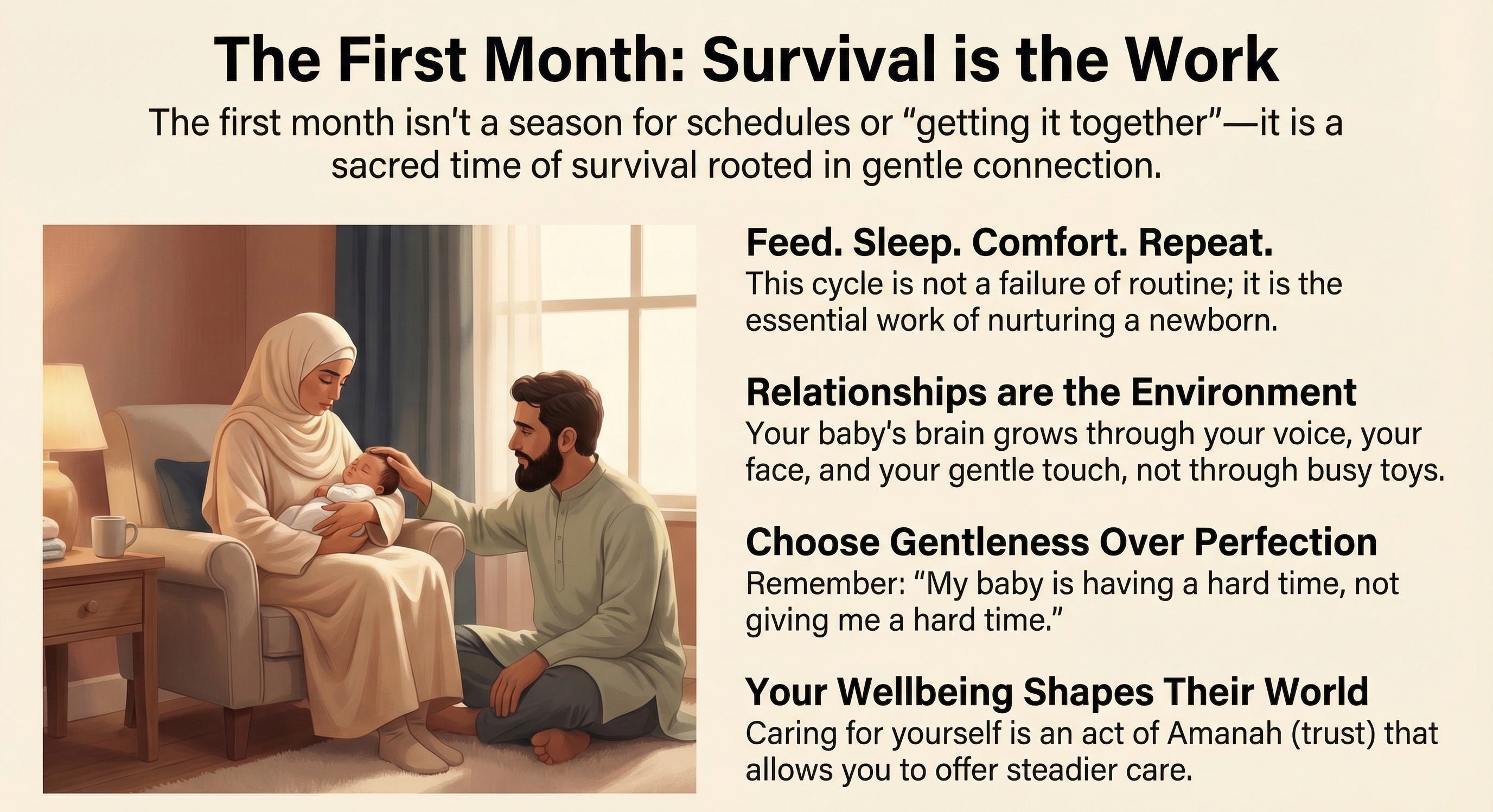
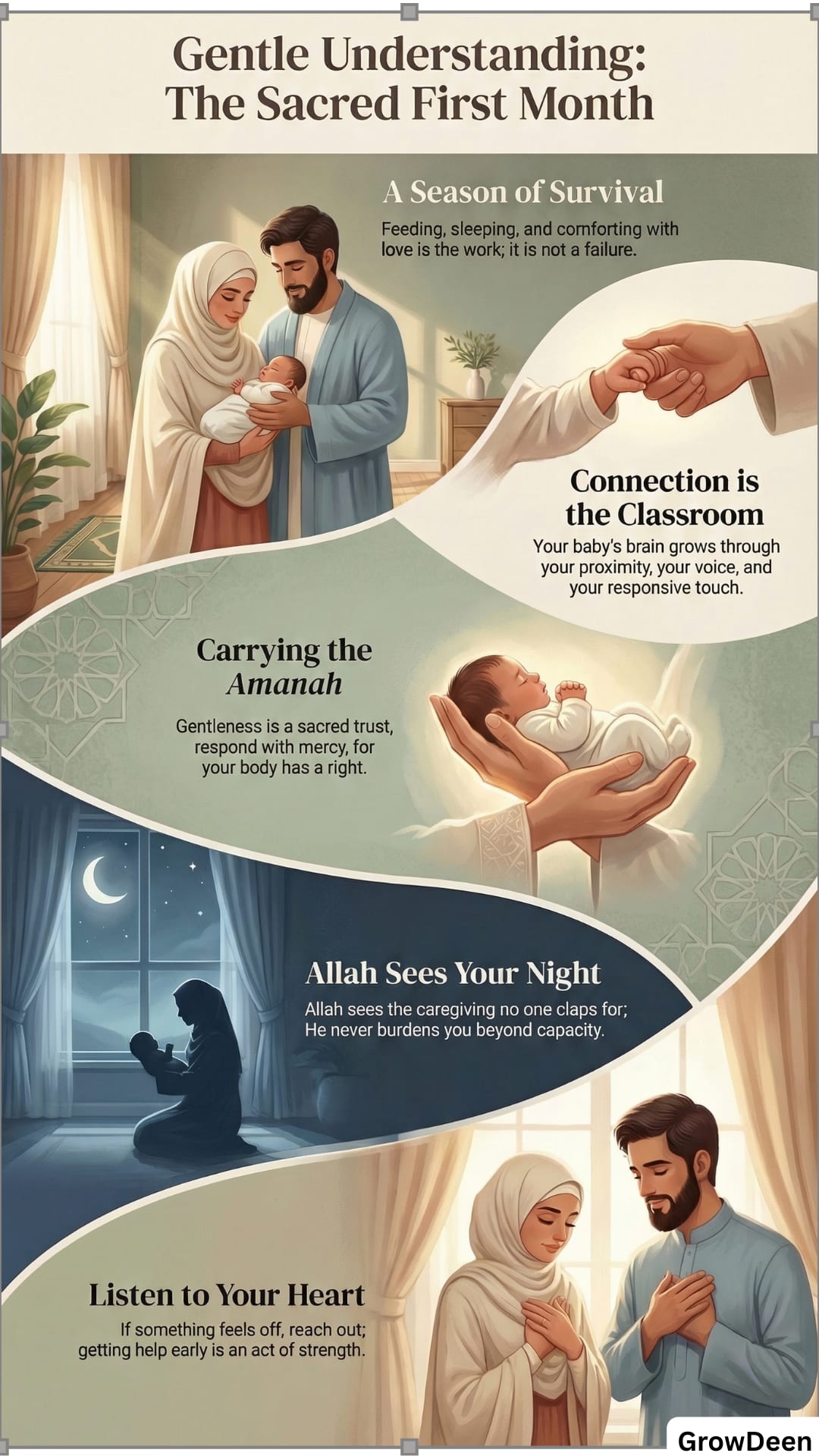
The first month is not a schedule season. It is a survival season. And survival done with love is not “less than.” It is the work.
The first month is mostly three things, and that is not a failure
In the early weeks, life shrinks into a small circle.
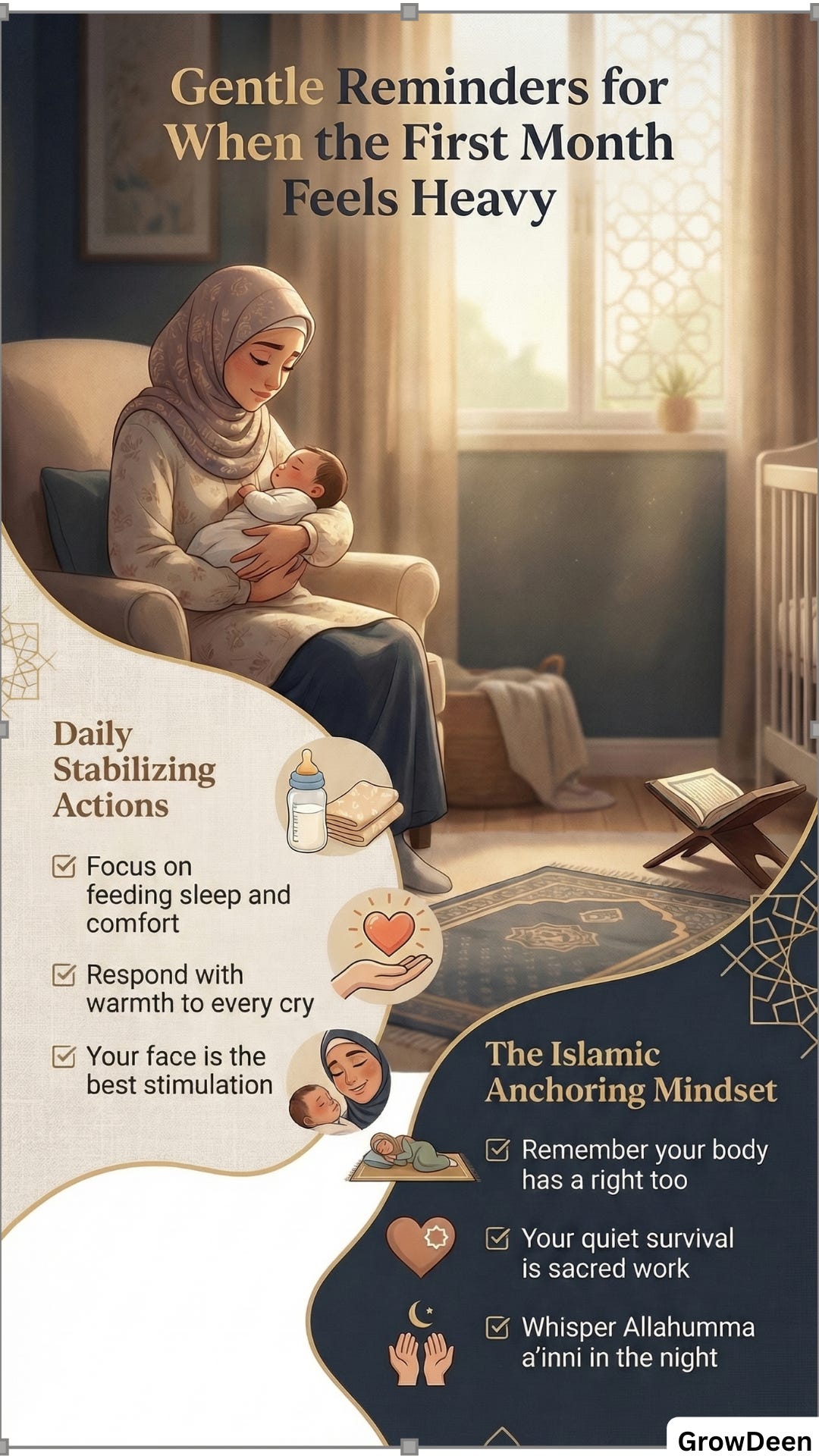
Feed. Sleep. Comfort. Repeat.
Some days you will feel like you did nothing else, and yet you did everything.
Your newborn’s brain is already busy. Even before they can smile back properly, they are taking in the world through what they can see, hear, and feel when you are near. Ordinary moments, repeated over and over, are part of how early brain connections form and become a foundation for later learning, health, and behaviour. [1]
If you are holding your baby and whispering, I am here, even if you never say the words, that counts.
What a one month old might be doing quietly
At around one month, your baby is not “behind” because they are not doing big things. Their development is simply small and close right now.
They may be drawn to faces and prefer looking at you up close.
They may startle at sudden sounds, and they may seem calmer when they hear your voice.
They may hold your gaze for a moment, then look away like they have spent all their energy in two seconds.
Crying is still the main language. Your baby may also make tiny throat sounds, little coos, little attempts. When you respond with warmth, your baby begins to learn something deep and steady. Signals lead to care. [2] [3]
This is not only bonding. It is early learning inside relationship. Decades of work in child development keeps returning to that point. Relationships are not background. They are the environment where development happens. [10]
The kind of “stimulation” your baby actually needs
Sometimes parents hear the word stimulation and imagine flashing toys, busy routines, or pressure.
Your baby needs something far simpler.
Your voice.
Your face.
A gentle touch.
A pause that lets them breathe and settle.
Talking, singing, reading a few lines, even telling your baby what you are doing while you change the diaper, all of that is a kind of early play. It supports connection and introduces your baby to sounds and rhythms that later support language. [4]
Look for the tiny cues. If your baby turns away, yawns, stiffens, or seems fussy, they might be saying, I need a break.
And you can respond without guilt.
You are not “missing a window.” You are listening.
Allah’s gentleness belongs in your tone, even when you are exhausted
This stage can bring out a side of you that surprises you.
The tiredness is not normal tiredness. It is deep.
So if you catch yourself getting sharp, do not label yourself as a bad parent. Label yourself as a human who needs support.
Then return to gentleness.
Allah commanded Musa and Harun to speak gently even to Fir‘awn. [15] So gentleness in your home, with a tiny baby who is not trying to be difficult, is not a luxury. It is the most fitting way to carry this amanah.
And the Prophet ﷺ was known for mercy. He made it clear that a heart without mercy is missing something essential. [14]
If you need an internal sentence to hold you steady, use this one.
My baby is having a hard time, not giving me a hard time.
Crying is communication, and your response is teaching safety
Sometimes you will know exactly why your baby is crying.
They are hungry. Uncomfortable. Overstimulated. Lonely.
And sometimes you will not know.
You will try everything and still feel helpless.
That is normal too.
Picking up a newborn, cuddling them, speaking softly, rocking, feeding, changing, trying again, this does not spoil a baby. At this age, soothing is part of healthy caregiving. Responsive care supports a baby’s sense of safety and the beginnings of secure attachment. [2] [3]
There is also an important safety line that deserves to be said plainly.
Never shake a baby.
If you feel overwhelmed or frightened by what you might do, place your baby somewhere safe, step back, breathe, and reach out to someone you trust or a support service.
The Prophet ﷺ gave a principle that fits even in the hardest moments. There should be neither harming nor reciprocating harm. [16]
Walking away for a minute to keep your baby safe is not weakness.
It is amanah.
If you are finding these reminders helpful, you are welcome to subscribe for free. Not because you need more noise in your life, but because you deserve calm, steady support in the moments that feel lonely.
You are part of the environment your baby is growing in
Parents sometimes treat self care like a separate topic, like it belongs at the end of the list.
In the newborn stage, it is not separate.
Your wellbeing shapes your baby’s environment.
When you are supported, you can offer steadier care. When you are running on empty, everything feels sharper, including crying.
So choose one small thing that makes the day lighter.
A shower while someone holds the baby.
A meal you did not cook.
A nap where you do not “push through.”
A message to someone safe that says, I need you.
Islam encourages balance. The Prophet ﷺ reminded companions that the body has a right. [17] Caring for yourself is part of staying able to care for your child.
And please hear this clearly.
If you are carrying anxiety, sadness, or panic that feels bigger than you, especially in the birthing parent, reach out for support. Getting help early can change everything.
You are not meant to white knuckle this alone.
When it is time to seek advice, even if you cannot explain why
You know your baby best.
If something in you keeps saying, Something is off, it is worth listening.
Evidence informed developmental surveillance exists partly because early concerns matter, and checking in is often better than waiting. [5]
Reach out to your child and family health nurse or paediatrician if your one month old is not feeding well, seems unusually sleepy, is difficult to soothe in a way that worries you, is not moving arms or legs as expected, does not respond to bright light or does not seem to notice faces, is not making any small sounds like gurgling, or does not seem to react to loud sounds.
Most concerns will have an explanation that is treatable or temporary.
And if something needs support, you will be glad you asked early.
Now let me leave you with something for the heart.
The quiet acts count.
Feeding at 3 a.m. when you are exhausted.
Holding your baby when they cannot settle.
Trying again when yesterday was messy.
Actions are judged by intentions. [11] And Allah does not burden a soul beyond what it can bear. [13]
If you want a du‘a to whisper in the middle of the night, try this.
Allahumma a‘inni. O Allah, help me.
And trust that Allah sees the caregiving no one claps for.
GIFTS FOR YOU, DEAR PARENT
If you’ve reached this part of the page, it tells me something meaningful about you.
You weren’t just skimming or passing time. You stayed because something here felt relevant to your real life.
Because you care.
Because you want to do things with more awareness.
Because you’re trying, even when it feels overwhelming.
That is not small.
So I didn’t want this article to remain just words on a page. I wanted it to gently step into your daily life in practical ways. That’s why we prepared these Life Gifts for you.
Not as extras.
Not as decorations.
But as simple tools to help you hold onto what mattered most in what you just read.
Here’s what you’ll find inside:
Gentle Understanding Card
A clear and simplified summary of the core concept from this article, so you can revisit the main idea anytime without rereading everything.
Heartfelt Dua Card
A carefully chosen dua connected to this stage of life, because we know that real strength and ease ultimately come from Allah’s help.
Gentle Actions Card
Practical examples to help you translate knowledge into action, so what you learned becomes part of your daily rhythm.
Gentle Reminders Card
Short, steady reminders drawn from the key points, designed to be printed or saved and placed somewhere you’ll see often.
These were designed slowly and thoughtfully, with time, care, and sincere dua. We created them because we genuinely want to walk alongside you, not just through one article, but through every stage of this lifelong journey.
If these gifts support you even in a small way, I would love for you to continue receiving them.
Subscribe so that each new Gift arrives directly in your inbox whenever we release the next stage. That way, you won’t miss the tools designed to support you right where you are.
May Allah place barakah in your effort, accept your intention, and make this path easier and more rewarding than it feels right now.
Please share it with a family/friend who may benefit from this knowledge.
If you want gentle, medically grounded, Islamically rooted reminders for the newborn weeks, subscribe for free so you receive the next article and the next set of Gifts without having to search for them on a tired day.
Comment question
What part of the first month feels heaviest for you right now, nights, feeding, crying, or something else?
References
[1] Center on the Developing Child at Harvard University. (2017, updated 2021). Three principles to improve outcomes for children and families, 2021 update. https://developingchild.harvard.edu/resources/report/three-principles-to-improve-outcomes-for-children-and-families/
[2] Frosch, C.A., Schoppe Sullivan, S.J., and O’Banion, D.D. (2019). Parenting and child development: A relational health perspective. American Journal of Lifestyle Medicine, 15(1), 45 to 59. https://doi.org/10.1177/1559827619849028
[3] McCall, R.B., Groark, C.J., Hawk, B.N., Julian, M.M., Merz, E.C., Rosas, J.M., Muhamedrahimov, R.J., Palmov, O.I., and Nikiforova, N.V. (2019). Early caregiver child interaction and children’s development: Lessons from the St. Petersburg USA orphanage intervention research project. Clinical Child and Family Psychology Review, 22, 208 to 224. https://doi.org/10.1007/s10567-018-0270-9
[4] Ford, A.L.B., Elmquist, M., Merbler, A.M., Kriese, A., Will, K.K., and McConnell, S.R. (2020). Toward an ecobehavioral model of early language development. Early Childhood Research Quarterly, 50(Part 1), 246 to 258. https://doi.org/10.1016/j.ecresq.2018.11.004
[5] Zubler, J.M., Wiggins, L.D., Macias, M.M., Whitaker, T.M., Shaw, J.S., Squires, J.K., Pajek, J.A., Wolf, R.B., Slaughter, K.S., Broughton, A.S., Gerndt, K.L., Mlodoch, B.J., and Lipkin, P.H. (2022). Evidence informed milestones for developmental surveillance tools. Pediatrics, 149(3), e2021052138. https://doi.org/10.1542/peds.2021-052138
[6] Yogman, M., Garner, A., Hutchinson, J., Hirsh Pasek, K., and Michnick Golinkoff, R., Committee on Psychosocial Aspects of Child and Family Health and Council on Communications and Media. (2018). The power of play: A pediatric role in enhancing development in young children. Pediatrics, 142(3), e20182058. https://doi.org/10.1542/peds.2018-2058
[7] Centers for Disease Control and Prevention (CDC). (2025). CDC’s developmental milestones. https://www.cdc.gov/act-early/milestones/
[8] Onigbanjo, M.T., and Feigelman, S. (2024). The first year. In R. Kliegman and J.W. St Geme III (Eds), Nelson textbook of pediatrics (22nd edn, pp. 151 to 156). Elsevier.
[9] Kliegman, R.M., and Marcdante, K.J. (2019). Nelson essentials of pediatrics (8th edn). Elsevier.
[10] National Scientific Council on the Developing Child. (2004, updated 2009). Young children develop in an environment of relationships: Working paper No. 1. Center on the Developing Child at Harvard University. http://developingchild.harvard.edu/resources/wp1/
[11] Sahih al Bukhari 1 and Sahih Muslim 1907. Actions are judged by intentions. https://sunnah.com/bukhari:1 and https://sunnah.com/muslim:1907a
[12] Sahih al Bukhari 5997 and Sahih Muslim 2318. Mercy to children. https://sunnah.com/bukhari:5997 and https://sunnah.com/muslim:2318
[13] Qur’an, Surah Al Baqarah 2:286. https://quran.com/2/286
[14] Sahih al Bukhari 5998 and Sahih Muslim 2319. Mercy is not removed except from the wretched. https://sunnah.com/bukhari:5998 and https://sunnah.com/muslim:2319a
[15] Qur’an, Surah Taha 20:44. https://quran.com/20/44
[16] Sunan Ibn Majah 2340. There should be neither harming nor reciprocating harm. https://sunnah.com/ibnmajah:2340
[17] Sahih al Bukhari 5199. Your body has a right over you. https://sunnah.com/bukhari:5199
[18] Qur’an, Surah Al Ahqaf 46:15. https://quran.com/46/15