
The Kind of Care a Breastfeeding Mother Actually Needs
You Are Not Weak You Are Undernourished

A breastfeeding mother does best when her recovery is protected with steady food, enough fluids, gentle movement, and a lifestyle that keeps her body safe and supported.
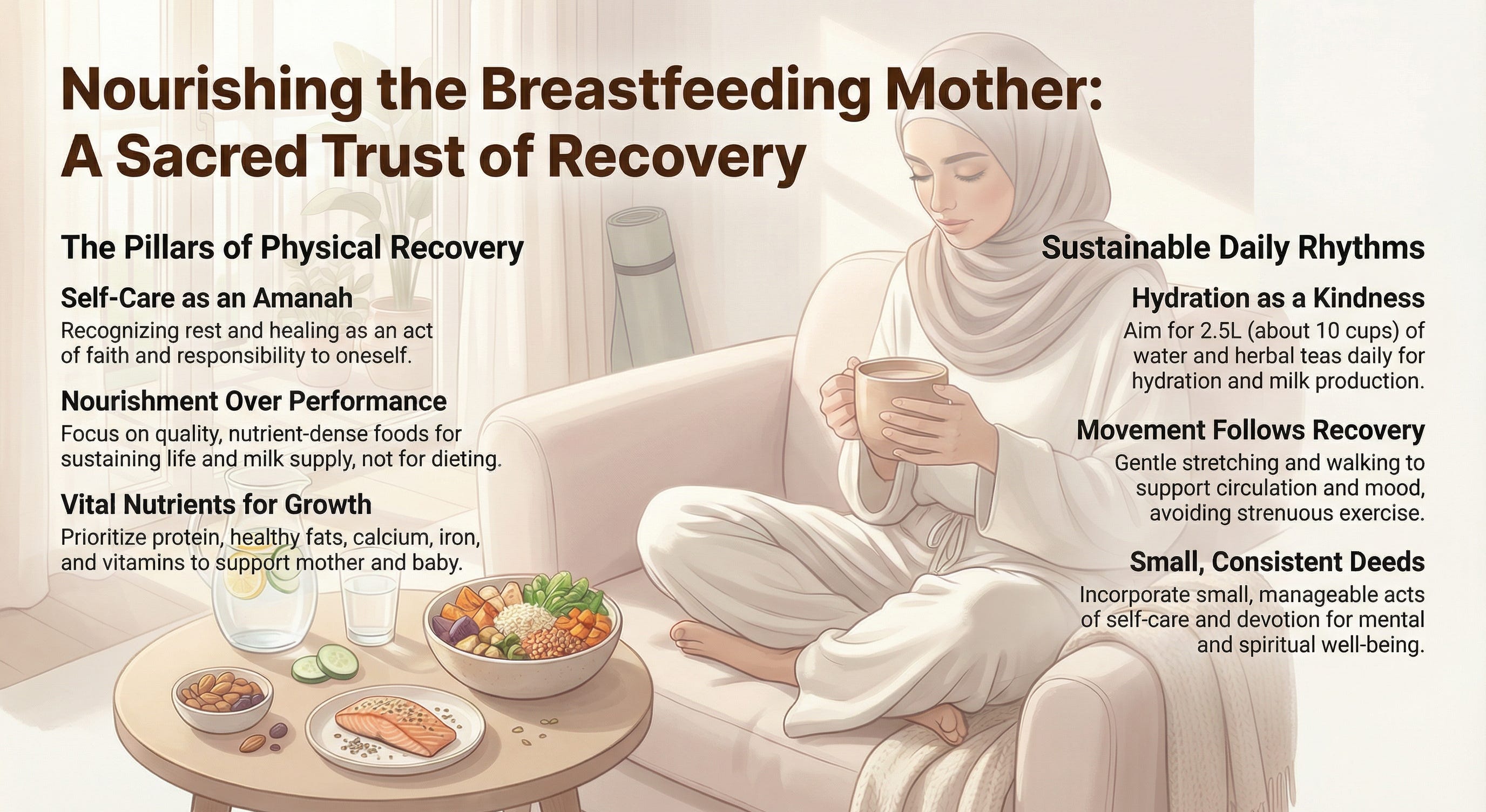
It is the kind of afternoon where you realize you have not eaten properly.
Not because you forgot.
Because the baby fed, then fed again, then finally slept, and you chose a shower over food. Or laundry. Or just sitting with your eyes closed.
Then you stand up too fast and feel it. That hollow lightheaded feeling.
And something in you whispers, I am supposed to be strong. Why do I feel like this?
Dear sister, nothing is wrong with you.
Breastfeeding can feel like it takes up the whole house, even when it is happening quietly in one chair.
Your body is healing from birth and making milk day after day. That is real work. Hidden work.
A steady, nourishing routine matters because it supports your recovery and helps you offer your baby consistent nourishment through breastmilk. [9] [13]
And as Muslims, caring for your body is not vanity. It is amanah.
Allah tells us, “Do not throw yourselves into destruction with your own hands.” [19]
Sometimes that verse shows up in small choices. The choice to eat. To drink. To rest. To stop running yourself into the ground.
When your body asks for care, it is not being dramatic
A breastfeeding mother often tries to push through.
I will eat later.
I will drink later.
I will exercise later.
But your body does not always wait politely.
Your milk, your energy, your mood, your healing, they are all tied to the basics. Food, fluids, and a rhythm that does not drain you.
If you hear yourself thinking, I should be able to do this without needing anything, pause.
That voice is not wisdom. That voice is pressure.
Your needs do not make you weak.
They make you human.
A breastfeeding diet is not strict, it is wide
The healthiest breastfeeding diet is not a perfect meal plan.
It is range.
A bit of vegetables and legumes most days.
Fruit when you can.
Grains that actually fill you.
Protein that keeps you steady.
Dairy or alternatives that support your body.
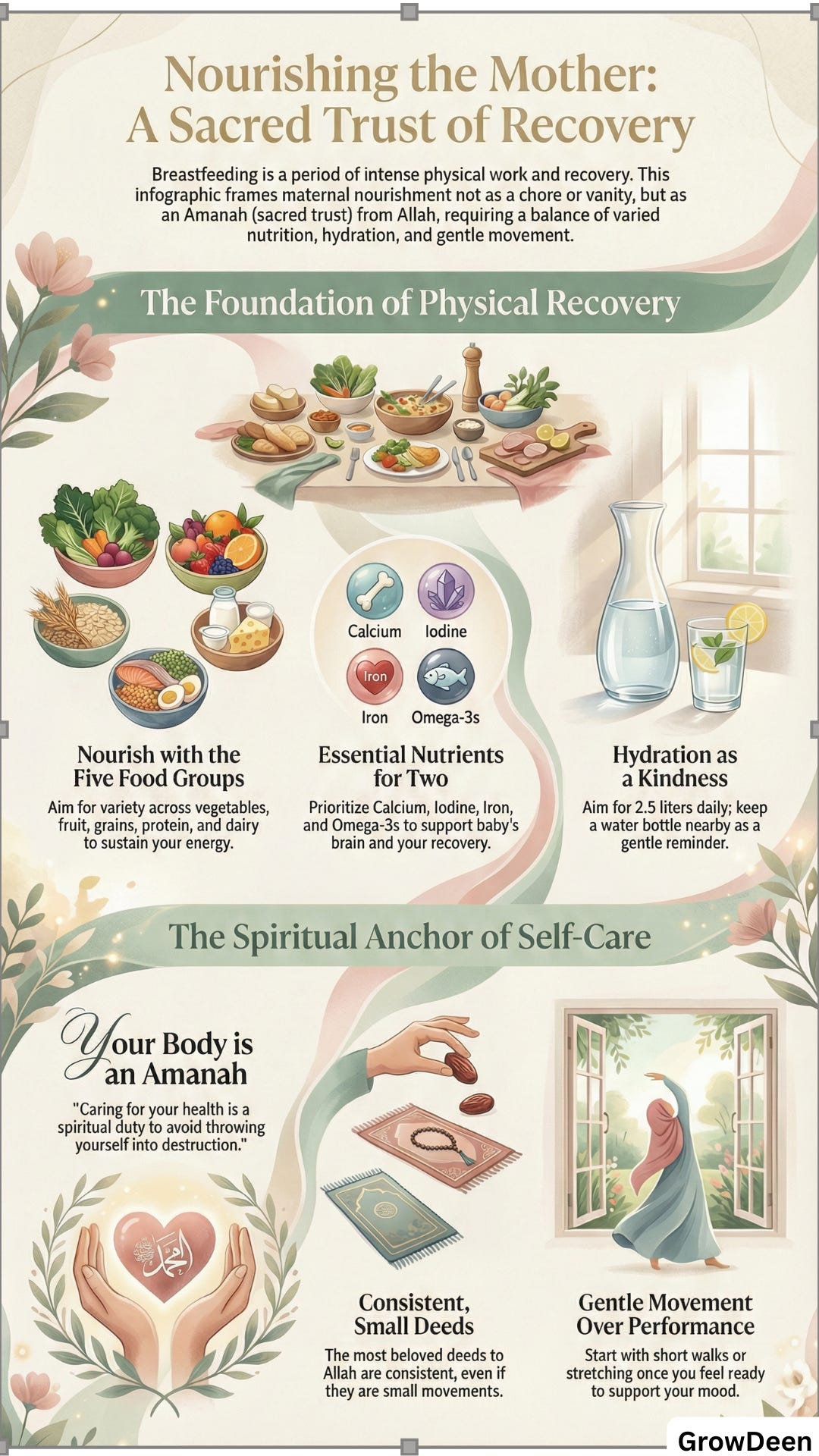
Guidance often frames this around the five main food groups, not because you need to count, but because your body needs variety during lactation. [12] [9] [22]
If today looks like eggs and toast, plus fruit, plus a simple curry later, Alhamdulillah.
If today looks messy, still Alhamdulillah.
We are aiming for nourishment, not performance.
The nutrients that quietly matter more than you think
You do not need to memorize vitamins.
But there are a few nutrients worth keeping on your radar during breastfeeding: calcium, iodine, iron, omega 3 fats, vitamin B12, vitamin D, and zinc. [9] [22]
Calcium supports your baby’s growing bones, and it is part of breastmilk. Think dairy or fortified alternatives, fish with soft edible bones like sardines, tofu, some dark greens, and almonds. [22]
Iodine supports your baby’s brain and nervous system, and it passes through breastmilk. Sources include dairy, seafood, iodised salt, and iodised bread. Some guidance recommends an iodine supplement of 150 micrograms daily during breastfeeding. [9] [13]
Iron matters for your baby’s developing brain, and babies also rely on iron stores built during pregnancy. Iron rich foods include meat, fish, chicken, eggs, lentils, beans, wholegrains, fortified cereals, tofu, nuts, dried fruit, and leafy greens. If you are low in iron, supplementation should be guided by a health professional. [22]
Omega 3 fats support your baby’s brain, eyes, nervous system, and immune function. Sources include oily fish such as salmon and sardines, plus some oils and walnuts. [22]
Vitamin B12 supports nervous system development. If you follow a vegan diet, B12 supplementation is essential. [22] [20]
Vitamin D helps with calcium absorption and bone growth. If you are low or at risk, supplementation may be needed, guided professionally. There is also separate guidance for infant vitamin D supplementation. [14] [15] [22]
Zinc supports growth and immune health. Sources include meat, poultry, fish, dairy, and grains. If you follow a vegan diet, supplementation might be needed. [20] [22]
If you are restricting foods, or you feel unsure, it is worth speaking with a GP or dietitian. [22]
Water is not optional when you are making milk
Breastfeeding increases fluid needs. A common target is around 2.5 litres a day, and you may need more in heat or on active days. [22]
A simple check is your urine. Pale yellow usually means you are hydrated enough. Dark yellow often means you need more fluids. [22]
Here is a gentle trick that actually works.
Keep a bottle where you feed.
Not as a rule.
As a kindness.
Water is still the simplest option, and often the most affordable.
The things to limit, without turning life into fear
This is not a guilt section.
This is a protection section.
Foods high in salt, saturated fat, and sugar, with low fibre, are best treated as occasional. Not because you are being watched, but because your baseline energy and nourishment matter right now. [12] [22]
Sugary drinks can add a lot without satisfying you. [22]
Caffeine passes into breastmilk, and newborns can be sensitive. Guidance often suggests up to 200 mg per day as an upper level. If you notice your baby is unsettled after caffeine, you can trial reducing it and see what changes. [6]
And about allergy avoidance, restricting common allergy foods while breastfeeding does not appear to reduce your baby’s allergy risk, and over restriction can create nutrient gaps. If allergy is suspected, it needs professional assessment, not self directed elimination. [10]
Protection is part of faith, and part of medicine
Some things are both medically risky and spiritually heavy.
Alcohol, smoking, vaping, and drugs can pass through breastmilk and influence a baby’s health and development. [1]
For us, there is another layer. Allah tells the believers to avoid intoxicants. [18]
So the safest approach during breastfeeding is to avoid alcohol, smoking, vaping, and drugs. [1] [4] [11] [16] [17]
If a mother smokes or vapes, breastfeeding is still considered the best feeding option, and harm reduction matters. Smoke and vape outside, avoid smoking or vaping for an hour before breastfeeding, reduce residue exposure by washing hands and brushing teeth, and keep all smoke and vape away from the baby. [4] [16] [17]
Vaping is not harmless, and there are concerns about exposures from e cigarette aerosols during pregnancy and early development. [11]
And with medicines, many are compatible with breastfeeding, but the safest path is to check with a doctor or pharmacist because it depends on the exact medication and dose. [1] [17]
Movement can help, but recovery comes first
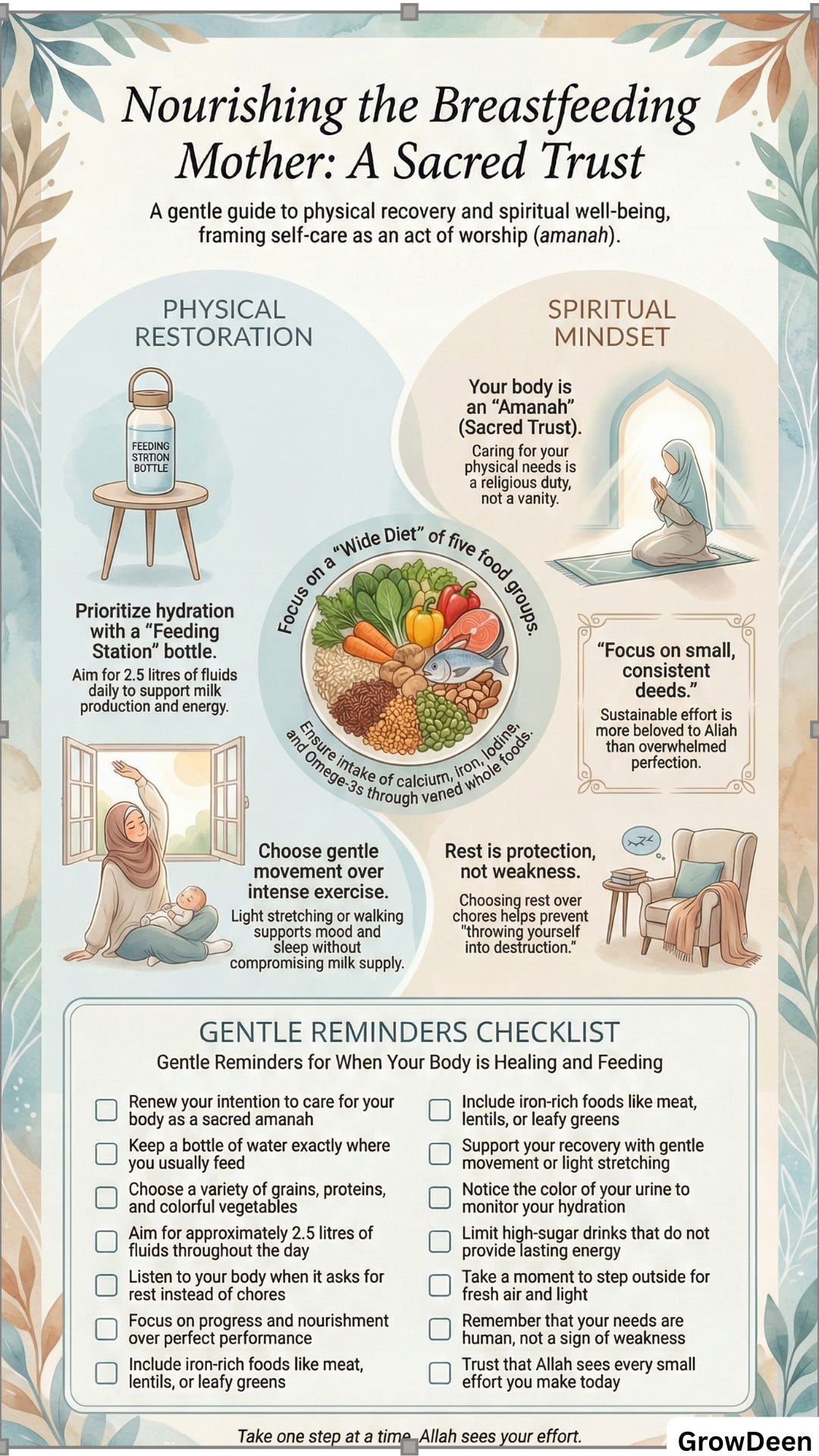
When you feel ready, regular movement can support strength and wellbeing. It is linked with better sleep, improved mood, and lower stress. [8]
Gentle beginnings count.
A short walk.
Light stretching.
Yoga or Pilates when your body allows. [2] [8] [9]
Meta analysis evidence suggests moderate exercise does not reduce breastmilk supply or harm infant growth. [3]
Higher intensity exercise can temporarily raise lactic acid in breastmilk, which may slightly alter taste for a short time, but it does not harm milk quality or baby health. [23]
If you are unsure what is appropriate for your recovery, speak with a doctor or physiotherapist. [8]
And here is something I love about our deen. Sustainable effort is beloved.
The Prophet ﷺ said that the most beloved deeds to Allah are those that are consistent, even if small. [20]
Postpartum life is exactly where that hadith feels like mercy.
A soft invitation, if you want support like this as you grow
If you are in the postpartum season and you want gentle reminders that protect your health without pressure, you are welcome to subscribe for free.
So when the next stage comes, it lands in your inbox like a quiet companion, not another task.
You are allowed to be cared for too
Breastfeeding mothers often feel like the whole family is pulling from them.
Milk.
Time.
Sleep.
Attention.
But you were not created to be emptied.
You were created to worship Allah with a body that deserves care.
So if today you eat one nourishing meal, drink a full bottle of water, and step outside for ten minutes, count that as a win.
Count that as protection.
Count that as mercy.
May Allah strengthen you, bless your milk, heal your body, and place barakah in the ordinary care you give every day. Ameen.
Gifts for You, Dear Parent
If you’ve reached this part of the page, it tells me something meaningful about you.
You weren’t just skimming or passing time. You stayed because something here felt relevant to your real life.
Because you care.
Because you want to do things with more awareness.
Because you’re trying, even when it feels overwhelming.
That is not small.
So I didn’t want this article to remain just words on a page. I wanted it to gently step into your daily life in practical ways. That’s why we prepared these Life Gifts for you.
Not as extras.
Not as decorations.
But as simple tools to help you hold onto what mattered most in what you just read.
Here’s what you’ll find inside:
Gentle Understanding Card
A clear and simplified summary of the core concept from this article, so you can revisit the main idea anytime without rereading everything.
Heartfelt Dua Card
A carefully chosen dua connected to this stage of life, because we know that real strength and ease ultimately come from Allah’s help.
Gentle Actions Card
Practical examples to help you translate knowledge into action, so what you learned becomes part of your daily rhythm.
Gentle Reminders Card
Short, steady reminders drawn from the key points, designed to be printed or saved and placed somewhere you’ll see often.
These were designed slowly and thoughtfully, with time, care, and sincere dua. We created them because we genuinely want to walk alongside you, not just through one article, but through every stage of this lifelong journey.
If these gifts support you even in a small way, I would love for you to continue receiving them.
Subscribe so that each new Gift arrives directly in your inbox whenever we release the next stage. That way, you won’t miss the tools designed to support you right where you are.
May Allah place barakah in your effort, accept your intention, and make this path easier and more rewarding than it feels right now.
Please share it with a family/friend who may benefit from this knowledge.
What is one moment with your child that feels hardest lately, and what kind of support would make it feel lighter?
If you would like more gentle postpartum support like this, you are welcome to subscribe for free so you do not have to search for the next piece when you are tired.
What is one small change you can make this week that would help you feel more nourished while breastfeeding?
References (hyperlinked)
[1] American Academy of Pediatrics Committee on Drugs (2001). The transfer of drugs and other chemicals into human milk. Pediatrics, 108(3), 776 to 789
[2] Amorim Adegboye AR, Linne YM (2013). Diet or exercise, or both, for weight reduction in women after childbirth. Cochrane Database of Systematic Reviews, CD005627
[3] Daley AJ et al. (2012). Maternal exercise and growth in breastfed infants: A meta analysis of randomized controlled trials. Pediatrics, 130(1), 108 to 114
[4] Dorea JG (2007). Maternal smoking and infant feeding: Breastfeeding is better and safer. Maternal and Child Health Journal, 11(3), 287 to 291
[5] Eat for Health (2016). Serve sizes, Commonwealth of Australia
[6] Food Standards Australia New Zealand (2021). Caffeine
[7] Friedmann I et al. (2017). Maternal and obstetrical predictors of sudden infant death syndrome. The Journal of Maternal Fetal and Neonatal Medicine, 30(19), 2315 to 2323
[8] Harrison CL et al. (2016). The role of physical activity in preconception, pregnancy and postpartum health. Seminars in Reproductive Medicine, 34(2), e28 to e37
[9] Jouanne M et al. (2021). Nutrient requirements during pregnancy and lactation. Nutrients, 13(2), 692
[10] Kramer MS, Kakuma R (2012). Maternal dietary antigen avoidance during pregnancy or lactation for preventing or treating atopic disease in the child. Evidence Based Child Health
[11] Orzabal M, Ramadoss J (2019). Impact of electronic cigarette aerosols on pregnancy and early development. Current Opinion in Toxicology, 14, 14 to 20
[12] NHMRC (2013). Australian dietary guidelines
[13] NHMRC (2010). Iodine supplementation for pregnant and breastfeeding women
[14] Tan ML, Abrams SA, Osborn DA (2020). Vitamin D supplementation for term breastfed infants. Cochrane Database of Systematic Reviews, CD013046
[15] CDC (2007). Children and second hand smoke exposure, Surgeon General report excerpt
[16] Weiser TM et al. (2009). Association of maternal smoking status with breastfeeding practices. Pediatrics, 124(6), 1603 to 1610
[17] The Women’s (2018). Medicines in breastfeeding
[18] Qur’an 5:90
[19] Qur’an 2:195
[21] Lovelady C (2011). Balancing exercise and food intake with lactation to promote postpartum weight loss. Proceedings of the Nutrition Society, 70(2), 181 to 184
[22] Lovelady CA et al. (2009). Effect of exercise training on loss of bone mineral density during lactation. Medicine and Science in Sports and Exercise, 41(10), 1902 to 1907
[23] Wright KS, Quinn TJ, Carey GB (2002). Infant acceptance of breast milk after maternal exercise. Pediatrics, 109(4), 585 to 589