
The Hidden Dangers in Everyday Home Life for Children
Keeping Children Safe at Home With Care, Calm, and Faith

Free gift for you! A practical companion resource is waiting for you near the end of this article to help you remember, apply, and benefit from what you read. Don’t forget to download!
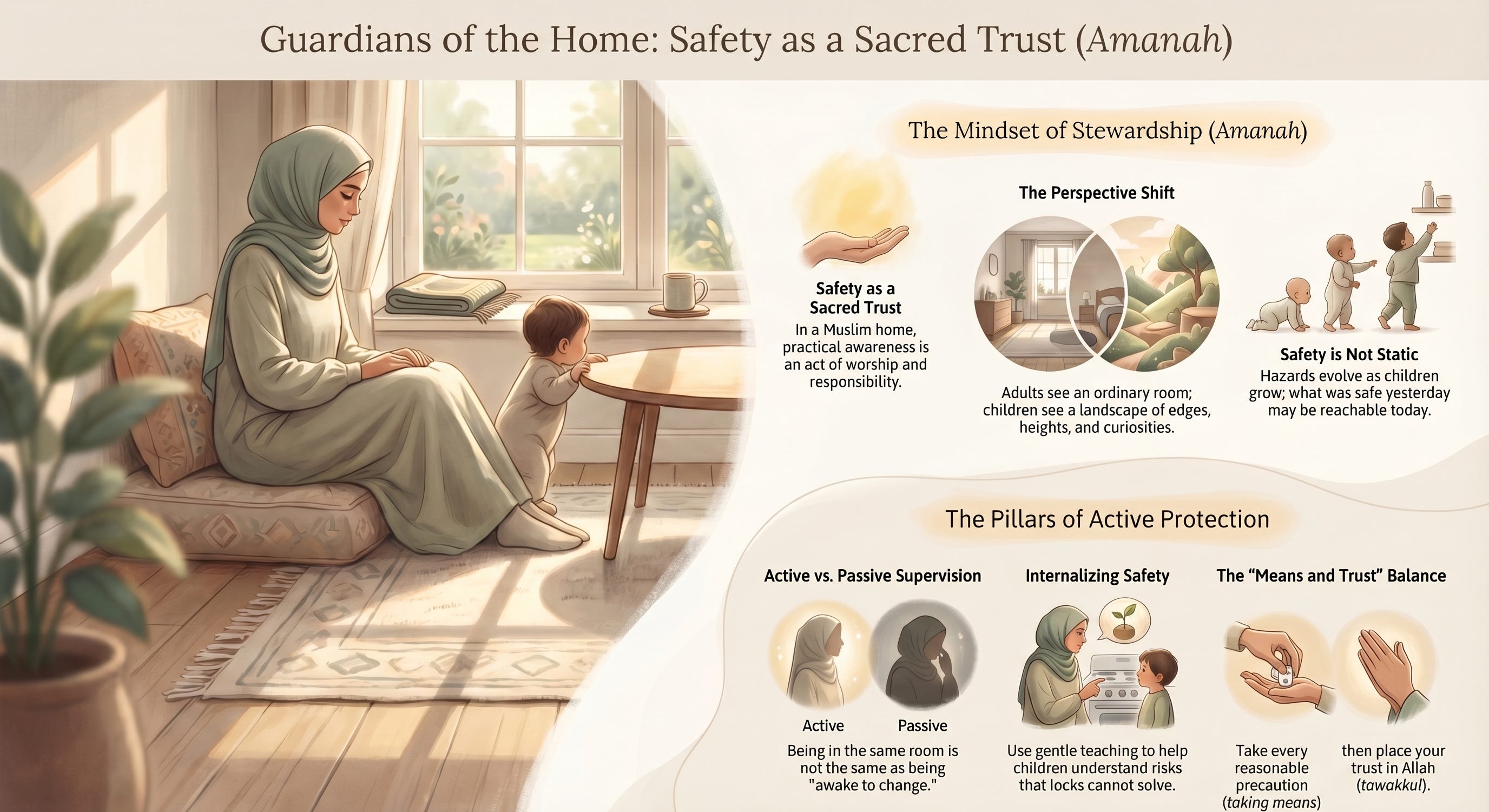
Keeping children safe at home is not about fear or perfection, but about steady awareness, thoughtful preparation, gentle teaching, and fulfilling the trust Allah has placed in your care.
You turn away for what feels like one ordinary second.
Maybe it is to rinse a cup. Maybe to answer someone calling your name. Maybe just to take a breath.
Then you hear a sound.
A drawer sliding open. A chair dragging across the floor. A cup tipping. Tiny footsteps moving faster than they should.
Your heart jumps before your body does.
You turn back and nothing terrible has happened. Not this time.
But that feeling stays in your chest.
Because if you are a parent, you know these moments. The almosts. The close calls. The things that remind you how quickly an ordinary room can become dangerous through the eyes and hands of a child.
And that is part of what makes home safety so emotionally tiring. The home may feel calm and familiar to you, but to a child it is full of invitation. Edges. Heat. movement. Height. Water. Buttons. Cords. Drawers. Little objects. Doors that open. Surfaces to climb. Things to pull. Things to taste.
That is not mischief in the deepest sense. It is how children learn. It is how they discover the world Allah has placed around them.
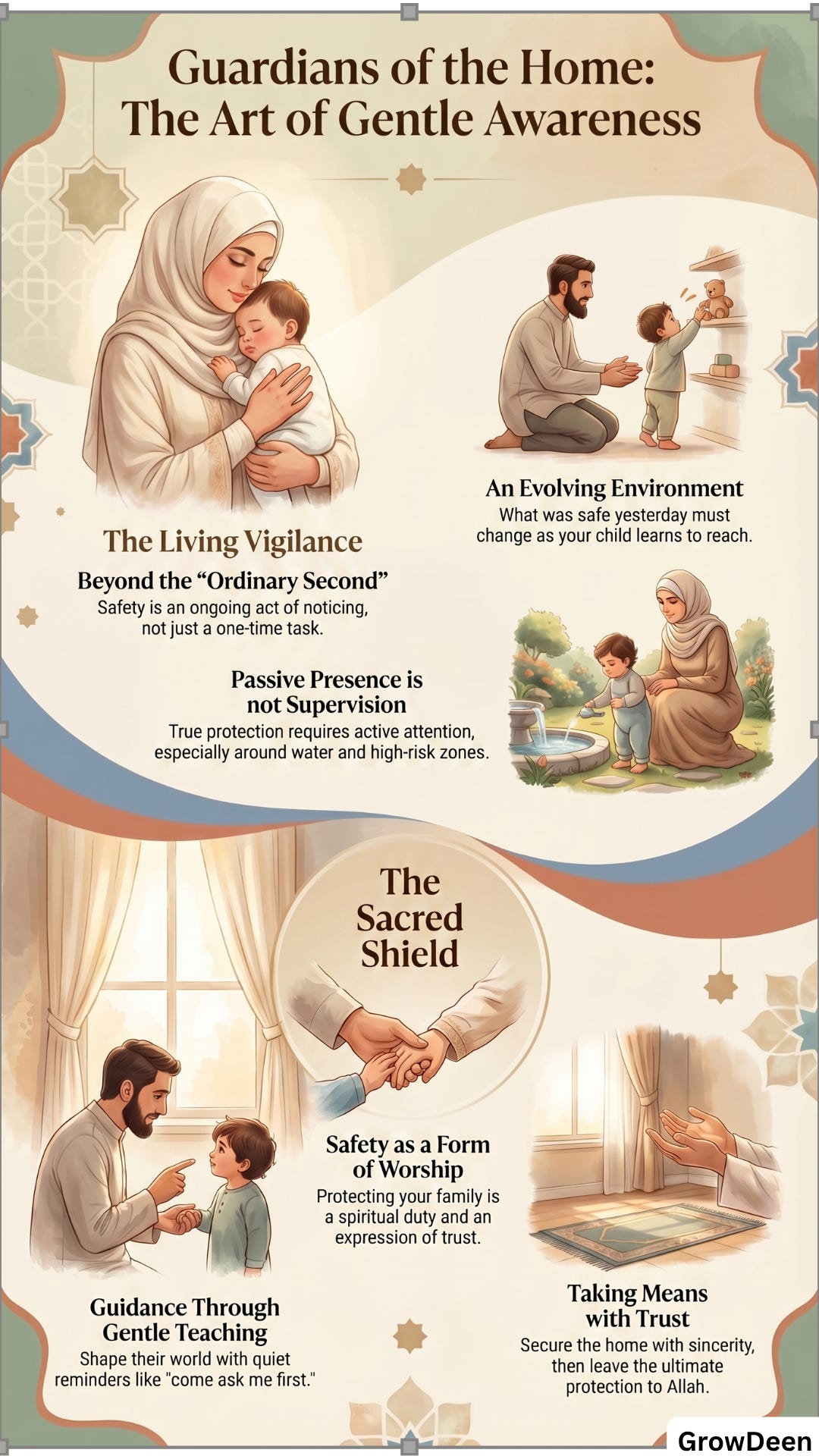
Which means safety at home is never just one afternoon of tidying hazards and then feeling done. It is an ongoing act of noticing, adjusting, teaching, and staying present.
The home feels ordinary to you. To them, it is full of risk.
At the centre of home safety is something simple, but demanding: supervision.
Even when a space has been prepared carefully, children will still fall, trip, pull, climb, open, test, and reach. Curiosity does not pause because a parent has installed a latch or moved a chair.
So a safe home is not a perfect home.
It is a watched one.
It is a home where adults remain awake to change, especially as children grow and begin reaching, climbing, and opening things that were once completely out of reach. What felt safe a month ago may no longer be safe now. A shelf that seemed irrelevant becomes tempting. A mug once far enough back on the counter is suddenly reachable. A knob can be turned. A drawer can be opened. A balcony chair can be dragged.
This can feel exhausting, and for many parents it is exhausting. You are not imagining that. The work of noticing all the time is real work. But it is also loving work.
Allah’s protection begins with the trust placed in your hands
Alongside supervision, the environment itself needs to change with the child.
What was safe for a baby may not be safe for a toddler. What worked for a toddler may no longer be enough for a curious preschooler or a confident five-year-old. Safety is not static because children are not static.
And that adjustment is not separate from faith.
Allah says, “O you who believe, protect yourselves and your families…” [9]
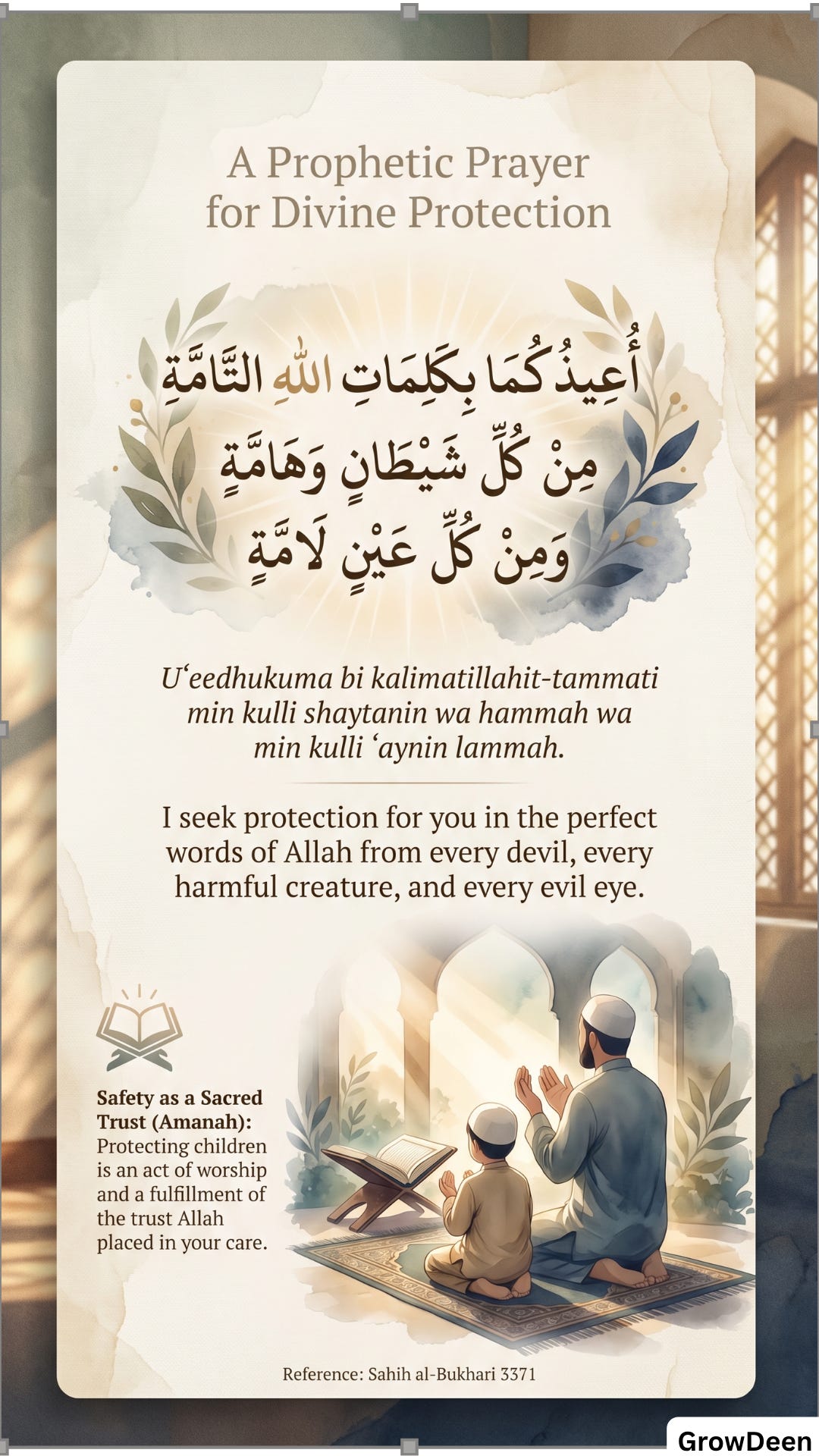
That protection includes spiritual care, of course. But it also includes physical care. It includes paying attention to the home, to routines, to risks, to things that can injure or harm. In a Muslim home, this practical awareness is not a worldly distraction from deen. It is part of amanah. Part of responsibility. Part of what it means to care for those entrusted to you.
And there is mercy in remembering this: you are not being asked to eliminate every possible risk from the life of a child. That is not possible. You are being asked to take reasonable means with sincerity, steadiness, and care.
Locks matter. But so does teaching.
There is another layer of safety that sometimes gets overlooked.
Children need to learn what is safe and what is not.
Not every lesson can come from a lock, a gate, a cupboard latch, or a higher shelf. Some of it must come through quiet teaching. Repeated reminders. Little moments that do not look dramatic at all.
“This is hot.”
“Hands stay away from the stove.”
“We sit when we eat.”
“That stays closed.”
“Come ask me first.”
“Only Mama opens that.”
Over time, these small teachings shape how a child moves through the world. They begin to understand that not everything is for touching. Not every object is for play. Not every curiosity should be followed.
This kind of gentle teaching is not harshness. It is preparation. It is one of the ways safety becomes internal instead of purely external.
The stroller, the cot, the chair, the corner—everyday things matter more than people realize
When it comes to furniture and baby equipment, the safest approach is not to choose what merely looks good or is popular. It is to choose what meets recognised safety standards and to use it as intended.
A carrier that supports properly.
A stroller that locks securely.
A cot that is stable.
A high chair used correctly.
Furniture that does not tip.
Window areas that do not invite climbing.
Parents often do not realize how many injuries happen from ordinary household items that seemed harmless at first glance. That is part of what makes home injuries so unsettling. They are so often tied to familiar objects rather than dramatic dangers.
Sometimes the best safety mindset is simply this: do not judge an item by how normal it looks. Judge it by what a child might do with it.
Could they pull it?
Climb it?
Tip it?
Trap fingers in it?
Use it to reach something dangerous?
That small mental shift changes what you see.
Burns and scalds happen in ordinary moments, not only in emergencies
Burns and scalds are among the most common home injuries, and they often happen quickly, inside very ordinary moments.
A cup of tea left close to the edge.
A mug placed on a low table “just for a second.”
A pan handle facing outward.
Steam rising from something a child wants to see more closely.
Bath water that feels fine to an adult hand until it suddenly does not.
These are not unusual parenting scenes. That is exactly why they matter.
Prevention here is quiet but intentional. Hot drinks stay well away from edges. Pan handles are turned inward. Kettles and hot foods are kept out of reach. Bath water is tested before a child enters. The room is checked before stepping away, even for a moment.
And if a burn does happen, knowing what to do matters immediately. Cooling the burn under cool running water for an extended period can reduce damage. This is the kind of practical knowledge parents hope never to need, but should not have to learn in panic.
Fire safety belongs here too. Working smoke alarms. Safe use of heaters. Awareness of fire risks around the home. These things may feel like background responsibilities, but they are part of protecting the atmosphere in which a child lives and sleeps.
The dangers that hide in plain sight
General safety inside and outside the home is made up of many small details that add up.
In the kitchen, attention goes to sharp objects, hot surfaces, glass items, cords, and cleaning products.
In bedrooms and living spaces, it moves toward furniture stability, window safety, blind cords, fall risks, and the general layout of what a child can climb or pull.
Outdoors, the focus shifts again: play areas, garden tools, sheds, gates, uneven surfaces, water, and the kinds of objects adults do not even notice anymore because they have become part of the background.
Children are drawn to places adults stop seeing. Stairs. Balconies. Gaps. Hinges. Door edges. Storage areas. Little ledges. Unwatched corners.
This is one reason it helps to occasionally scan the home from a child’s level, not your own. Bend down. Look across the room the way they see it. What is shiny? Reachable? Swinging? Loose? Tempting? Small enough to fit in a mouth?
That perspective changes everything.
Choking, suffocation, strangulation, and falls are not dramatic topics. They are everyday ones.
Some risks do not become obvious until the moment they happen.
Choking hazards can come from small household objects, coins, beads, broken toy parts, batteries, caps, buttons, and certain foods that are not age-appropriate or are served in unsafe ways. Part of prevention is regularly asking: what can this child pick up, and what can fit into their mouth?
Strangulation and suffocation risks can come from cords, blind strings, loose bedding, soft items left where they should not be, or enclosed spaces that seem innocent until they are not. These are not dramatic cinematic dangers. They are the kinds of hazards that sit quietly in ordinary rooms, which is why steady awareness matters so much.
Falls, too, are rarely complicated in theory and deeply distressing in real life. Securing furniture. Supervising climbing. Using barriers where needed. Paying attention to balconies, windows, stairs, beds, and chairs near ledges. These are simple adjustments, but the injuries they prevent can be serious.
Door and hinge safety deserves mention as well, because crushed fingers happen quickly and painfully. It is one of those details that can sound small until you have seen a child caught in that split second between curiosity and injury.
Sun, play, pools, trampolines—some risks arrive disguised as fun
Sun exposure is another everyday concern that can be overlooked because it does not always look urgent.
Young skin is sensitive. Harm can build gradually rather than all at once. Shade, appropriate clothing, and avoiding prolonged exposure during peak hours all matter. This is not about making outdoor life tense. It is about being thoughtful enough that joy does not come with preventable harm.
Then there are play-specific risks. Trampolines. Swimming pools. Playground equipment. These are often associated with fun, movement, and family time, which can make them feel emotionally safer than they actually are.
But a child being nearby is not the same as a child being watched.
Passive presence is not active supervision.
And that distinction matters more than people think.
Poisoning and water need a different level of seriousness
Poisoning risks often come from the most ordinary items in the house.
Medicines.
Cleaning liquids.
Detergents.
Dishwasher tablets.
Sprays.
Cosmetics.
Certain plants.
Things adults use daily without thought.
The safest approach is not occasional caution. It is consistency. Store these items high, locked, and out of sight. Do not rely on packaging. Do not rely on a child “usually not touching that.” Children are persistent, and their curiosity becomes stronger precisely when adults assume they understand more than they do.
Water safety deserves its own seriousness. Any amount of water can become dangerous for a young child. Baths. Buckets. Small pools. Ponds. Containers left filled after use. Water play that seems harmless until silence falls.
The key principle here is active, constant supervision.
Not checking from another room.
Not listening from nearby.
Not stepping away “for a second.”
Being physically present and attentive whenever a child is around water.
Because drowning can happen silently and quickly. Prevention is not complicated, but it requires discipline.
Learn first aid before you need it. Learn CPR before you hope you never will.
Learning basic first aid and CPR is one of the most valuable things a parent or caregiver can do.
These are skills most people hope never to use. But when they are needed, they matter immediately, not later. Not after searching. Not after guessing. Not after panic settles.
That is why regular training matters. It helps keep knowledge fresh. It turns vague awareness into something your hands and mind can actually do under pressure.
Keeping a first aid kit at home, in the car, and while travelling is part of that same mindset. Readiness does not remove fear completely. But it gives fear less control.
There are also many specific areas of safety that parents benefit from understanding more deeply over time:
How to prevent choking by offering age-appropriate foods, avoiding small hard items, and supervising eating.
How dangerous plants can become accidental poisonings during outdoor play.
How foreign objects sometimes end up in a child’s nose, ear, or mouth.
How falls happen not only from heights, but from routine furniture and climbing.
How cords, strings, bedding, and enclosed spaces can become strangulation or suffocation risks.
How pool safety depends on barriers, secure gates, and supervision.
How trampoline use becomes safer when rules are clear and an adult is watching closely.
Each area may sound small in isolation. Together, they create the real picture of a safer home.
If this kind of writing supports you, you can subscribe for free so these reminders come back to you gently, especially in seasons when you are carrying a lot and trying to remember a hundred small things at once.
Allah’s wisdom is in taking means, not pretending harm cannot happen
In Islam, care for a child is not only emotional or spiritual. It is also practical.
The Prophet ﷺ said, “Each of you is a shepherd, and each of you is responsible for his flock.” [10]
That responsibility includes protecting children from visible harm and invisible risk. It includes patience. It includes repeated attention. It includes returning to the same concerns again and again as the child grows and the home changes around them.
Allah also says, “And do not throw yourselves with your own hands into destruction.” [11]
Taking reasonable steps to prevent harm is part of faith. Not separate from it. Locking medicines away, securing windows, watching near water, learning CPR, checking smoke alarms, supervising on the trampoline—these are not worldly details beneath spiritual concern. They are part of responsible worship through care.
And then there is tawakkul.
You do what you can.
You secure the home.
You prepare.
You watch.
You learn.
And then you know that ultimate protection is with Allah.
That balance matters. Not panic. Not neglect. Means and trust together.
Gentleness still matters, even after the near miss
Even in moments of fear or after near-accidents, there is space for reflection instead of panic.
The Prophet ﷺ reminded us that gentleness is not placed in something except that it beautifies it [12].
That includes how we respond when a child makes a mistake, reaches for something dangerous, falls, spills, touches, climbs, or startles us half to death.
Safety is not only about preventing harm.
It is also about how a child is guided through the moments when things do go wrong. Calm correction. Clear boundaries. Firmness without humiliation. Seriousness without terror.
Emergency readiness is not dramatic. It is mercy in practical form.
Finally, it helps to prepare for emergencies in a simple, practical way.
Instead of relying on memory in a frightening moment, keep a clear list of essential emergency contacts relevant to your location. These commonly include:
Police services
Ambulance or emergency medical services
Fire services
Poison information or toxicology support
Local emergency or disaster response services
A nearby hospital or urgent care centre
Trusted family members or neighbours
Having these categories ready and easily accessible can save valuable time when it matters most. This is one of those preparations you may never think about on a normal day, and be deeply grateful for on a difficult one.
A safe home is not silent or restrictive.
It is still a place of play, laughter, movement, mess, and exploration.
But underneath that, there is quiet structure.
Objects placed with care.
Risks reduced where possible.
An adult paying attention.
And a child able to explore the world with a greater sense of security, which is exactly what they need in order to grow.
GIFTS FOR YOU, DEAR PARENT
If you’ve reached this part of the page, it tells me something meaningful about you.
You weren’t just skimming or passing time. You stayed because something here felt relevant to your real life.
Because you care.
Because you want to do things with more awareness.
Because you’re trying, even when it feels overwhelming.
That is not small.
So I didn’t want this article to remain just words on a page. I wanted it to gently step into your daily life in practical ways. That’s why we prepared these Life Gifts for you.
Not as extras.
Not as decorations.
But as simple tools to help you hold onto what mattered most in what you just read.
Here’s what you’ll find inside:
Gentle Understanding Card
A clear and simplified summary of the core concept from this article, so you can revisit the main idea anytime without rereading everything.
Heartfelt Dua Card
A carefully chosen dua connected to this stage of life, because we know that real strength and ease ultimately come from Allah’s help.
Gentle Actions Card
Practical examples to help you translate knowledge into action, so what you learned becomes part of your daily rhythm.
Gentle Reminders Card
Short, steady reminders drawn from the key points, designed to be printed or saved and placed somewhere you’ll see often.
These were designed slowly and thoughtfully, with time, care, and sincere dua. We created them because we genuinely want to walk alongside you, not just through one article, but through every stage of this lifelong journey.
If these gifts support you even in a small way, I would love for you to continue receiving them.
Subscribe so that each new Gift arrives directly in your inbox whenever we release the next stage. That way, you won’t miss the tools designed to support you right where you are.
May Allah place barakah in your effort, accept your intention, and make this path easier and more rewarding than it feels right now.
Please share it with a family/friend who may benefit from this knowledge.
What is one moment with your child that feels hardest lately, and what kind of support would make it feel lighter?
You do not need a perfect home to be a careful parent.
You need awareness.
You need steadiness.
You need the humility to keep adjusting.
And you need the mercy to remember that safety is built little by little, through a hundred small acts that no one applauds, but that matter deeply.
May Allah protect your home, guard your children, and place barakah in the care you give them.
If you would like more gentle, practical reflections like this, subscribe for free so each new piece reaches you when you need it.
What is one area of home safety that feels hardest to stay consistent with right now?
References
[1] Turner, S., Arthur, G., Lyons, R.A., et al. (2011). Modification of the home environment for the reduction of injuries. Cochrane Database of Systematic Reviews, CD003600.
[2] Child Accident Prevention Foundation of Australia (Kidsafe Australia). (2016). A parent’s guide to Kidsafe homes.
[3] Country Fire Authority (CFA). (2023). Smoke alarms.
[4] Kids Health, Children’s Hospital at Westmead. Falls from windows and balconies.
[5] Sherry, C. (2012). Kids can’t fly: The legal issues in children’s falls from high-rise buildings.
[6] Berecki-Gisolf, J., Gray, S., & Clapperton, A. (2016). Child injuries in the home.
[7] Shala, D.R., et al. (2019). Exploring parents’ knowledge of pediatric falls. Journal for Specialists in Pediatric Nursing.
[8] Pointer, S.C. (2019). Trends in hospitalised injury. Australian Institute of Health and Welfare.
[9] Qur’an, Surah At-Tahrim 66:6.
[10] Sahih al-Bukhari, Hadith 7138.
[11] Qur’an, Surah Al-Baqarah 2:195.
[12] Sahih Muslim, Hadith 2594.