
The First Weeks With Your Newborn
Your Baby Is Not Giving You A Hard Time, They Are New Here

The first weeks are not about perfection, they are about meeting your newborn with warmth, responsiveness, and steady care while their tiny body learns life outside the womb.

It is 2:13 a.m.
You are standing in the kitchen light, bouncing without thinking. Your baby’s cheeks are warm. Your shirt smells like milk. Your back hurts in a very specific spot that did not exist before.
You whisper, “Please,” under your breath, as if the word itself might settle them.
And then your mind starts doing that thing it does at night.
Am I missing something
Why are they still crying
Why does this feel so hard
Come closer, dear sister. Let me sit beside you for a moment.
These first weeks are not a performance. They are a beginning. A gentle, demanding, holy beginning.
Al Latif is in the softness you keep offering
Allah tells us that He brings us out of our mothers’ wombs knowing nothing, then gives us hearing, sight, and hearts so we may grow and become grateful [11].
Your baby is not only small. Your baby is new.
New to air. New to light. New to hunger. New to the feeling of being cold for two seconds. New to sound that is not filtered through water.
So they reach for what is familiar.
Your warmth. Your smell. Your voice. Your steady arms.
That is not an extra. That is the bridge into life.
Skin to skin contact supports regulation in breathing, heart rate, temperature, and stress hormones, and it helps bonding too [4]. When you hold your newborn close, you are not only comforting them. You are teaching their nervous system a first message: you are safe here.
Your baby is doing three things, and one of them is you
In these early weeks, your newborn’s world is simple.
They need to feed. They need to sleep in small pieces. They need to feel connected.
That connection is not a luxury. It is how secure attachment forms, and that attachment supports emotional regulation and healthy development [8].
Some babies arrive calm and observant. Some arrive intense and sensitive. Temperament varies. It does not mean something is wrong.
It only means you will get to know this particular child, slowly, through repetition.
And you will.
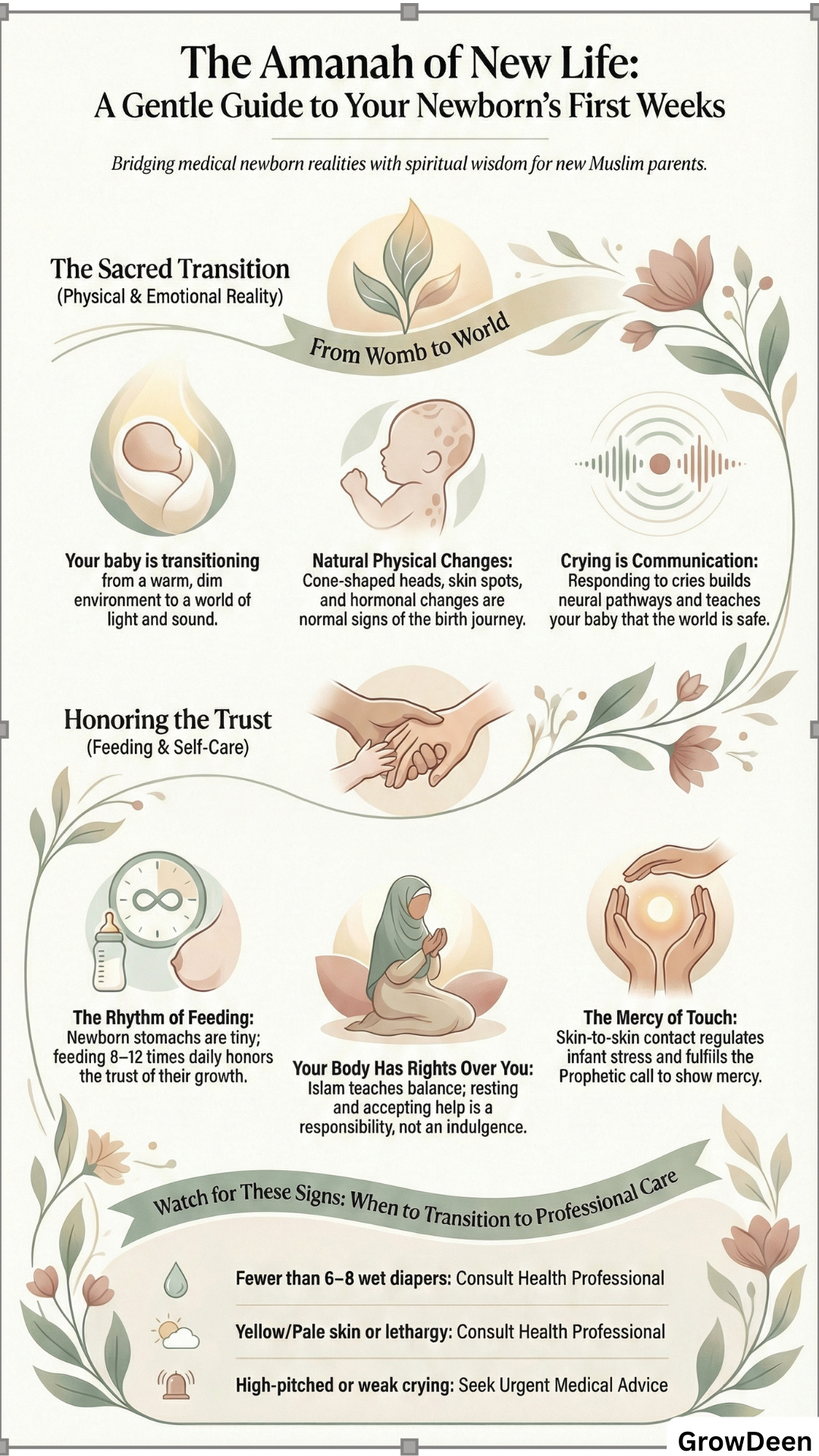
When your baby looks different than you expected
Sometimes new parents worry because their newborn does not match the photos in their head.
A slightly cone shaped head after birth can happen and often rounds out in days.
Puffy eyelids, mild swelling, and bruising can also happen, especially after assisted deliveries. If you notice yellowing of the skin or eyes, bring it up, because bruising can increase jaundice risk.
The umbilical stump usually dries, darkens, and falls off within around ten days. Keep it clean and dry. If you see redness spreading, sticky discharge, or a bad smell, get it checked.
You may also notice a surprising one: temporary breast swelling, sometimes even a milky discharge. This can happen due to maternal hormones still circulating, and it usually settles on its own within weeks [5].
None of this makes you a bad parent. It makes you a parent with a brand new baby.
Tiny tummies create frequent needs
Newborn stomachs are small. That is why the feeding feels constant.
Many newborns feed every two to three hours, often eight to twelve times a day. Healthy full term babies usually guide the rhythm, and it helps to watch cues like alertness, mouth movements, and hands moving toward the mouth.
Weight loss in the first days is common as extra fluid leaves the body. What matters is the pattern. Many references use around ten percent as a threshold for concern, and most babies regain birth weight within one to two weeks [1] [3] [9].
If breastfeeding feels shaky, please do not carry that alone. Support improves outcomes and protects your confidence [2]. Sometimes you need one calm, knowledgeable person to adjust a latch and suddenly the whole day changes.
Sleep, too, comes in short stretches. Patterns take time. There may be no routine yet, only rhythms forming slowly.
If someone tells you, “You should have them on a schedule by now,” you have permission to ignore that.
Rahmah looks like responding, again and again
Bonding does not require a perfect mother. It grows through small, repeated acts.
Touch.
Eye contact.
A soft voice.
Picking them up when they cry.
The Prophet ﷺ taught that the one who does not show mercy to the young is not from us [12]. In the newborn stage, mercy often looks like you, exhausted, choosing gentleness anyway.
If you want a simple sentence to hold when you feel yourself tightening, try this:
My baby is not giving me a hard time. My baby is having a hard time.
That sentence can change your hands. Your tone. Your heart.
If you would like more pieces like this, written for real life nights and real life fog, you are welcome to subscribe for free. It simply means you will have something calm waiting for you in your inbox when you need it.
When crying feels like it is swallowing the whole day
Crying is your baby’s only language right now.
Hunger. Fatigue. Gas. A wet diaper. Being overstimulated. Wanting closeness. Sometimes it is simply the release of a tiny body that has had too much sensation.
Try one small loop, not ten different strategies at once.
Feed.
Change.
Hold close.
Dim the lights.
Rock slowly.
Whisper comfort.
If your baby cries for long periods with no clear cause, colic is one possibility, and it is worth checking in with a clinician to rule out other issues [6]. You deserve reassurance and practical guidance.
Also, please hear me on this: if you feel overwhelmed, reach out too. Support for families dealing with excessive crying matters, because the strain is real [7].
You are not meant to be alone in this.
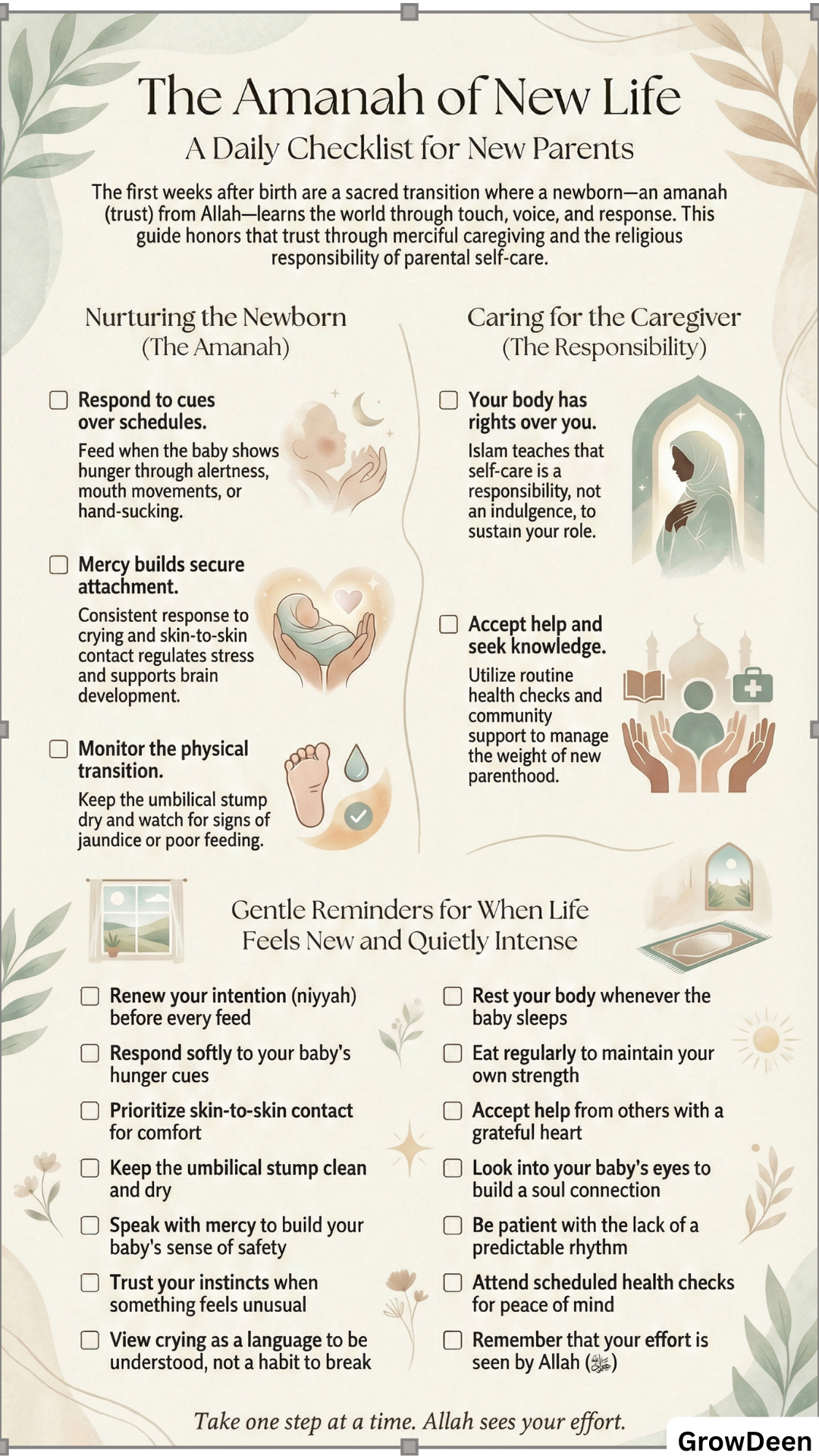
Your baby’s checkups are for you, too
Regular newborn checkups help monitor growth, feeding, jaundice, and development.
Bring your questions. Write them in your phone if your mind feels foggy.
These visits are not only about your baby’s body. They are also a place for you to say, “I am not coping,” or, “I am anxious,” or, “I need help.”
The World Health Organization highlights that postnatal care includes both physical checks and emotional support for mother and newborn [10]. You deserve care in this fragile window.
Let me end where you began.
These early weeks are not about mastering motherhood.
They are about meeting a tiny soul with steady mercy.
Every diaper changed while sleepy.
Every feed offered with patience.
Every whispered dua.
Allah is Al Latif, the Most Gentle, and He placed gentleness inside you for this exact season.
May Allah give you sakinah in your home, strength in your body, and light in your heart.
Gifts for You, Dear Parent
If you’ve reached this part of the page, it tells me something meaningful about you.
You weren’t just skimming or passing time. You stayed because something here felt relevant to your real life.
Because you care.
Because you want to do things with more awareness.
Because you’re trying, even when it feels overwhelming.
That is not small.
So I didn’t want this article to remain just words on a page. I wanted it to gently step into your daily life in practical ways. That’s why we prepared these Life Gifts for you.
Not as extras.
Not as decorations.
But as simple tools to help you hold onto what mattered most in what you just read.
Here’s what you’ll find inside:
Gentle Understanding Card
A clear and simplified summary of the core concept from this article, so you can revisit the main idea anytime without rereading everything.
Heartfelt Dua Card
A carefully chosen dua connected to this stage of life, because we know that real strength and ease ultimately come from Allah’s help.
Gentle Action Card
Practical examples to help you translate knowledge into action, so what you learned becomes part of your daily rhythm.
Gentle Reminders Card
Short, steady reminders drawn from the key points, designed to be printed or saved and placed somewhere you’ll see often.
These were designed slowly and thoughtfully, with time, care, and sincere dua. We created them because we genuinely want to walk alongside you, not just through one article, but through every stage of this lifelong journey.
If these gifts support you even in a small way, I would love for you to continue receiving them.
Subscribe so that each new Gift arrives directly in your inbox whenever we release the next stage. That way, you won’t miss the tools designed to support you right where you are.
May Allah place barakah in your effort, accept your intention, and make this path easier and more rewarding than it feels right now.
What is the hardest hour of your day right now, and what would make it feel even a little lighter?
References
[1] DiTomasso, D., & Cloud, M. (2019). Systematic review of expected weight changes after birth for full term, breastfed newborns. Journal of Obstetric, Gynecologic & Neonatal Nursing. https://doi.org/10.1016/j.jogn.2019.09.004
[2] Gavine, A., et al. (2022). Support for healthy breastfeeding mothers with healthy term babies. Cochrane Database of Systematic Reviews. https://doi.org/10.1002/14651858.CD001141.pub6
[3] Miyoshi, M., et al. (2020). Determinants of excessive weight loss in breastfed full term newborns. International Breastfeeding Journal. https://doi.org/10.1186/s13006-020-00263-2
[4] Moore, E. R., et al. (2016). Early skin to skin contact for mothers and their healthy newborn infants. Cochrane Database of Systematic Reviews. https://doi.org/10.1002/14651858.CD003519.pub4
[5] Raveenthiran, V. (2013). Neonatal mastauxe. Journal of Neonatal Surgery. https://www.ncbi.nlm.nih.gov/pmc/articles/PMC4420448/
[6] Turner, T., & Palamountain, S. (2025). Infantile colic: Clinical features and diagnosis. UpToDate. https://www.uptodate.com/contents/infantile-colic-clinical-features-and-diagnosis
[7] Harskamp Van Ginkel, M. W., et al. (2023). Healthcare support during excessive infant crying. Acta Paediatrica, 112(3), 434 to 441. https://doi.org/10.1111/apa.16606
[8] Woodhouse, S. S., et al. (2020). Secure base provision: Links between caregiving and infant attachment. Child Development. https://doi.org/10.1111/cdev.13224
[9] Verd, S., et al. (2018). Impact of in hospital birth weight loss on breastfeeding outcomes. International Breastfeeding Journal. https://doi.org/10.1186/s13006-018-0169-6
[10] World Health Organization. (2022). WHO recommendations on maternal and newborn care for a positive postnatal experience. https://www.who.int/publications/i/item/9789240045989
[11] Qur’an 16:78. https://quran.com/16/78
[12] Sunan at Tirmidhi 1921. He is not one of us who does not show mercy to our young. https://sunnah.com/tirmidhi:1921