
The First Five Years And The Kind Of Home That Changes A Life
Your Child Is Learning More From Your Tone Than Your Advice

In the first five years, your child’s body, emotions, thinking, and speech grow most through warm relationships, playful everyday life, and a home atmosphere shaped by gentleness and intention.
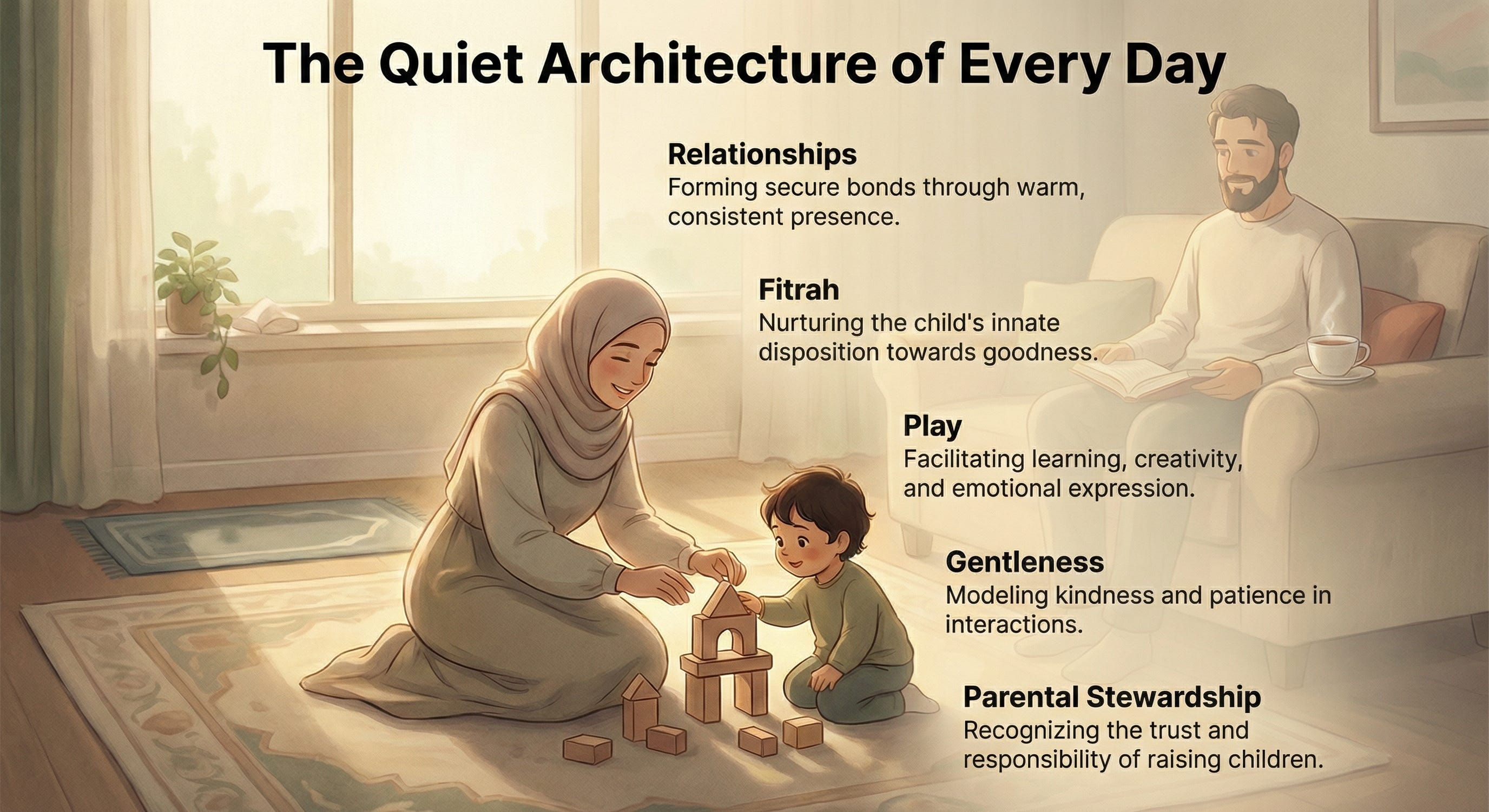
You’re trying to leave the house.
One shoe is missing. Someone is crying because the banana broke. Your toddler is insisting they can pour the water themselves.
You catch your reflection for a second and think, Is any of this even good for them.
Because in your head, “development” still sounds like a neat checklist. First steps. Clear speech. Good behaviour. A child who listens.
But real life is sticky. Loud. Tender. Repetitive.
And yet, inside this chaos, something is being built.
Quietly. Constantly.
It is not only growing, it is becoming
When people say “development,” they often mean height and milestones.
But your child is also developing their ability to calm down after big feelings, to trust you, to try again, to understand words, to make sense of the world, to connect with others. It all moves together. One area shifts, the others wobble or catch up. [7]
The first five years carry a weight that is easy to miss because the days look ordinary. Early brains build connections fast, and those early foundations echo into health, learning, and behaviour later. [1] [5]
So yes, the missing shoe matters.
But so does the way you speak when you are frustrated.
So does the way you repair after a hard moment.
The care of Allah in attentive parenting
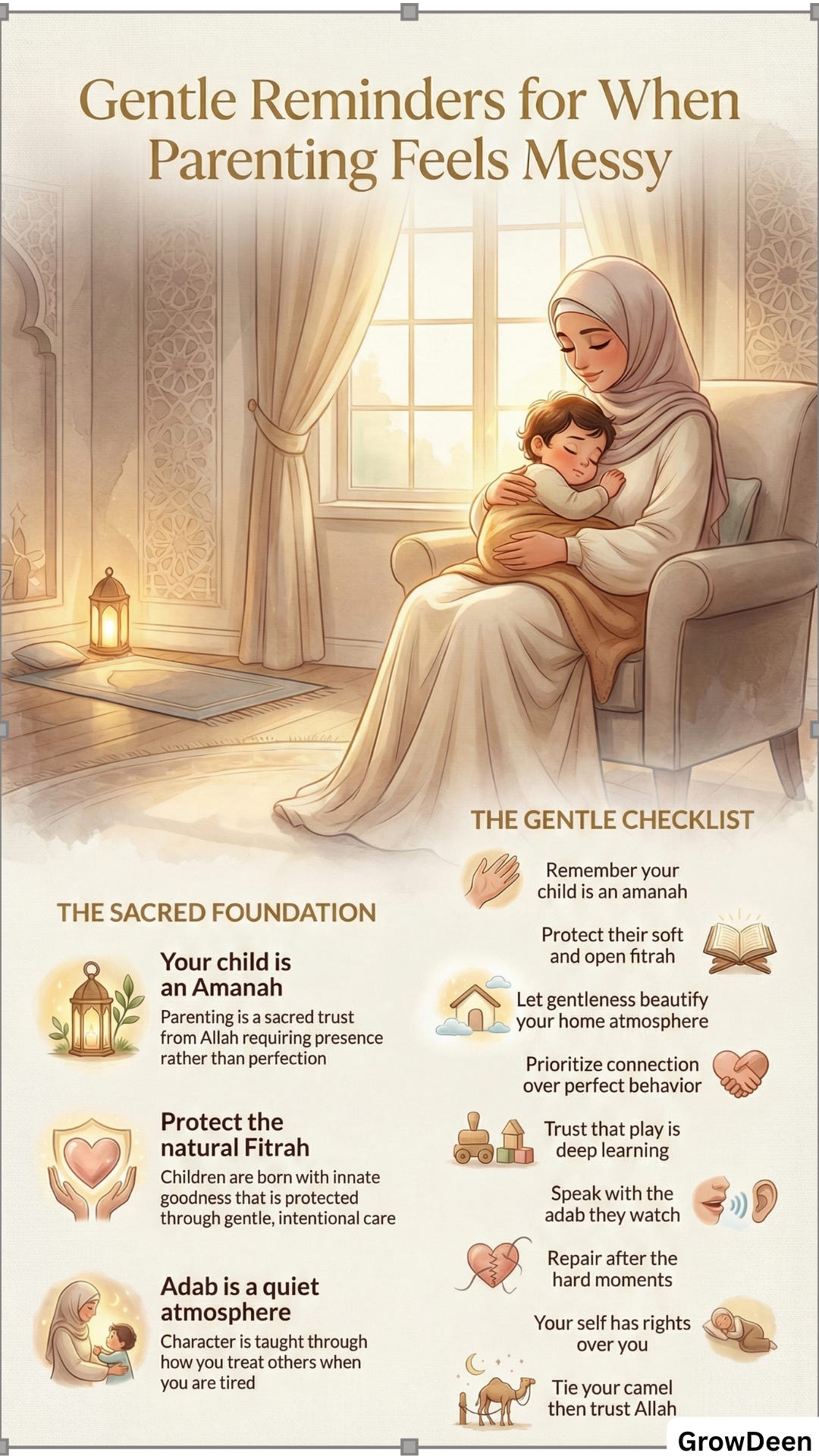
As a Muslim parent, you are not raising a project. You are raising an amanah.
And that does not mean perfection. It means presence.
Allah reminds us that the hearing, the sight, and the heart will be asked about. [12] It does not have to make you afraid. It can make you more awake. More intentional.
And the Prophet ﷺ taught that every child is born upon the fitrah. [13]
So when you are holding your child through their early years, you are not only managing behaviour. You are protecting something soft and open.
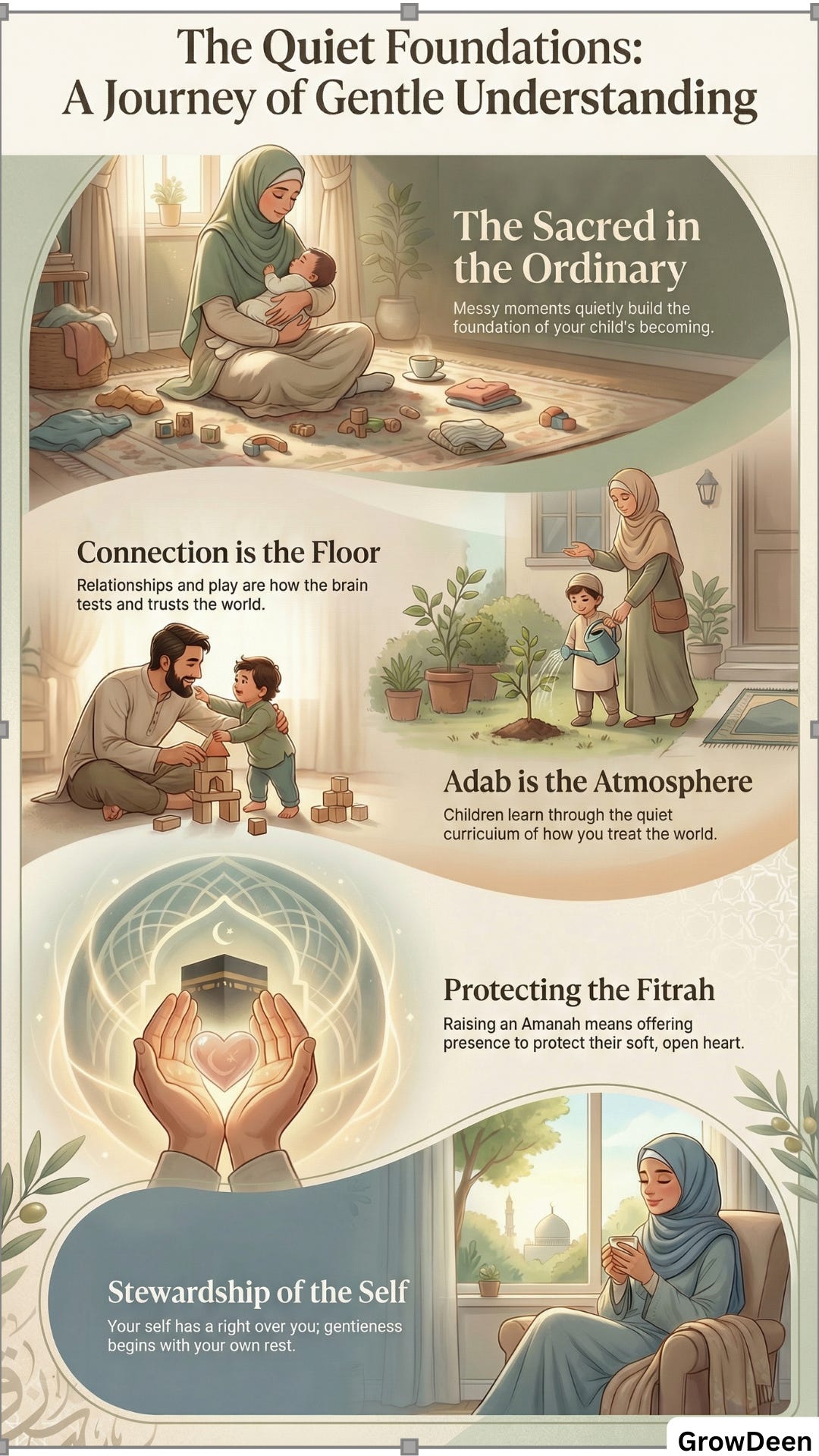
Relationships are the floor beneath everything
Children learn who they are through the people who care for them.
In nurturing, responsive relationships, a child learns a first truth that sits under everything else.
I am safe.
My signals matter.
I can come back to someone when the world feels too big. [5]
Research keeps circling back to this. Relationship is not decoration around development. It is part of how development happens. [4] [5]
Even in large intervention research with children who experienced early deprivation, the lesson is not complicated. Consistent caregiver interaction shapes outcomes. [4]
And then there is the quiet curriculum your child watches all day.
How you speak to your spouse.
How you respond to a neighbour.
How you treat a cashier when you are tired.
All of that teaches.
This is why adab is not a separate subject in a Muslim home. It is an atmosphere.
The Prophet ﷺ said gentleness is not found in something except that it beautifies it. [14]
A gentle home is not a home without boundaries.
It is a home where correction does not come dressed as harshness.
Play is how the brain learns without being forced
Play looks like fun because it is fun.
But it is also how children test the world. They explore, copy, fail, try again, and build skills across movement, social understanding, emotions, and creativity. [10]
Some play is loud. Some is quiet and repetitive.
Pretend play is especially precious. It lets children try on roles and feelings in a low pressure way. [8]
Adults sometimes feel they should direct every moment so it becomes “educational.” But pediatric guidance has been clear about this for a long time. Play itself is powerful, especially when it is shared with a caring adult. [10]
Language grows here too.
Those simple back and forth moments, naming what your child is focused on, responding to their sounds, following their attention, all of that supports early language development in a way that reflects the child’s whole environment. [2]
If your child has developmental differences, play still matters, but measuring “good engagement” is not always simple. Recent work on early intervention for autistic children highlights how careful we need to be in how we define and measure play and engagement. [6]
And Islamically, play does not need to be defended. The Prophet ﷺ showed compassion to children. His mercy was not stiff. [15]
If you intend play as care, bonding, and wellbeing, it becomes more than entertainment.
Actions are judged by intentions. [16]
The other quiet builders in your child’s day
Relationships and play sit at the centre. But they are not the only influences.
Each child comes with their own temperament and pace. Genes shape development too. [7]
Nutrition matters, not only for growth but for brain development. Research on micronutrients and brain development reminds us that the developing brain needs steady nourishment. [3]
Movement matters as well. Physical activity supports health, motor development, thinking, and a child’s confidence in exploring their world. [10]
Community matters too. A child’s world is not only the living room. Safe spaces and supportive services, like parks, libraries, health centres, child care, and early learning settings, can strengthen development. [1]
And for Muslim families, community can include the masjid and the people around it. A familiar face who smiles at your child. Someone who greets them by name.
Allah tells us to cooperate in righteousness and piety. [17]
Sometimes “cooperation” looks like making space for a toddler’s noise, and treating a tired mother with kindness.
Similar milestones, different timelines
One of the most relieving truths is this.
Across diverse places and cultures, healthy children show broadly similar neurodevelopmental milestones and behaviours, even though timing still varies from child to child. [9]
So you can hold two truths at once.
Variation is normal.
And if your gut keeps whispering that something is not right, you do not have to silence yourself.
Evidence informed milestone tools exist to guide developmental surveillance, partly so concerns can be noticed and supported early. [11]
If you are worried, bring it to your child and family health nurse, your GP, or your pediatrician.
Taking the means is part of trust.
Tie your camel, and trust Allah. [18]
You cannot pour gentleness from an empty body
Parents are always learning. Some days you feel wise. Some days you feel lost.
It is fine.
What matters is that you keep returning.
And you look after yourself enough to keep showing up.
The Prophet ﷺ reminded us that your self has a right over you, and your family has a right over you. [19]
So if stress, anxiety, or anger are rising, reach out. Make the call. Ask for support. Put the contact details somewhere easy to find, because overwhelmed brains forget even simple things.
This is not weakness.
This is stewardship.
If you needed a soft landing at the end of this, let it be this.
Even when parenting feels messy, foundations can still be forming.
And whoever relies upon Allah, then He is sufficient for him. [20]
A short dua for you, dear parent.
Our Lord, grant us from our spouses and our children comfort to our eyes, and make us leaders for the mindful. [20]
Here is a gentle invitation, only for your benefit.
If you want more of this kind of calm, grounded support, you can subscribe for free. So the next reflection meets you where you are, without you having to search for it on a hard day.
GIFTS FOR YOU, DEAR PARENT
If you have reached this part of the page, it tells me something meaningful about you.
You were not just skimming or passing time. You stayed because something here felt relevant to your real life.
Because you care.
Because you want to do things with more awareness.
Because you are trying, even when it feels overwhelming.
That is not small.
So I did not want this article to remain only words on a page. I wanted it to gently step into your daily life in practical ways. That is why we prepared these Life Gifts for you.
Not as extras.
Not as decorations.
But as simple tools to help you hold onto what mattered most in what you just read.
Here is what you will find inside.
Gentle Understanding Card
A clear and simplified summary of the core concept from this article, so you can revisit the main idea anytime without rereading everything.
Heartfelt Dua Card
A carefully chosen dua connected to this stage of life, because we know that real strength and ease ultimately come from Allah’s help.
Gentle Actions Card
Practical examples to help you translate knowledge into action, so what you learned becomes part of your daily rhythm.
Gentle Reminders Card
Short, steady reminders drawn from the key points, designed to be printed or saved and placed somewhere you will see often.
These were designed slowly and thoughtfully, with time, care, and sincere dua. We created them because we genuinely want to walk alongside you, not just through one article, but through every stage of this lifelong journey.
If these gifts support you even in a small way, I would love for you to continue receiving them.
Subscribe so that each new Gift arrives directly in your inbox whenever we release the next stage. That way, you will not miss the tools designed to support you right where you are.
May Allah place barakah in your effort, accept your intention, and make this path easier and more rewarding than it feels right now.
Please share it with a family or friend who may benefit from this knowledge.
Comment question
What is one small moment of connection with your child you want to protect this week, even if the day feels busy?
References
[1] Center on the Developing Child at Harvard University. Three principles to improve outcomes for children and families, 2021 update. Link
[2] Ford, A. L. B., Elmquist, M., Merbler, A. M., Kriese, A., Will, K. K., and McConnell, S. R. (2020). Toward an ecobehavioral model of early language development. Early Childhood Research Quarterly, 50(Part 1), 246–258. Link
[3] Mattei, D., and Pietrobelli, A. (2019). Micronutrients and brain development. Current Nutrition Reports, 8, 99–107. Link
[4] McCall, R. B., Groark, C. J., Hawk, B. N., Julian, M. M., Merz, E. C., Rosas, J. M., Muhamedrahimov, R. J., Palmov, O. I., and Nikiforova, N. V. (2019). Early caregiver child interaction and children’s development: Lessons from the St. Petersburg USA orphanage intervention research project. Clinical Child and Family Psychology Review, 22, 208–224. Link
[5] National Scientific Council on the Developing Child. (2004, updated 2009). Young children develop in an environment of relationships: Working Paper No. 1. Center on the Developing Child at Harvard University. Link
[6] Raulston, T. J., Ousley, C. L., Hinton, E. M., and Ramirez, A. M. (2024). Beyond trial counts: Considerations for measuring play and engagement during early intervention for autistic children. Behavior Analysis in Practice, 17(4), 1216–1227. Link
[7] Sharma, A., Cockerill, H., and Sanctuary, L. (2022). Mary Sheridan’s From Birth to Five Years: Children’s Developmental Progress (5th ed.). Routledge. Link
[8] Skolnick Weisburg, D. (2015). Pretend play. WIREs Cognitive Science, 6(3), 249–261. Link
[9] Villar, J., Fernandes, M., Purwar, M., Staines-Urias, E., Di Nicola, P., Ismail, L. C., Ochieng, R., Barros, F., Albernaz, E., Victora, C., Kunnawar, N., Temple, S., Giuliani, F., Sandells, T., Carvalho, M., Ohuma, E., Jaffer, Y., Noble, A., Gravett, M., and Kennedy, S. (2019). Neurodevelopmental milestones and associated behaviours are similar among healthy children across diverse geographical locations. Nature Communications, 10, 511. Link
[10] Yogman, M., Garner, A., Hutchinson, J., Hirsh-Pasek, K., and Michnick Golinkoff, R., with the AAP Committee on Psychosocial Aspects of Child and Family Health and Council on Communications and Media. (2018). The power of play: A pediatric role in enhancing development in young children. Pediatrics, 142(3), e20182058. Link
[11] Zubler, J. M., Wiggins, L. D., Macias, M. M., Whitaker, T. M., Shaw, J. S., Squires, J. K., Pajek, J. A., Wolf, R. B., Slaughter, K. S., Broughton, A. S., Gerndt, K. L., Mlodoch, B. J., and Lipkin, P. H. (2022). Evidence-informed milestones for developmental surveillance tools. Pediatrics, 149(3), e2021052138. Link
[12] Qur’an, Surah Al Isra 17:36. Link
[13] Sahih Muslim 2658. Every child is born upon the fitrah. Link
[14] Sahih Muslim 2593. Gentleness beautifies. Link
[15] Sahih al Bukhari 5998 and Sahih Muslim 2318. Mercy to children and showing compassion. Bukhari link Muslim link
[16] Sahih al Bukhari 1 and Sahih Muslim 1907. Actions are judged by intentions. Bukhari link Muslim link
[17] Qur’an, Surah Al Ma’idah 5:2. Link
[18] Jami` at Tirmidhi 2517. Tie your camel and trust in Allah. Link
[19] Sahih al Bukhari 1968. Your self has a right over you, and your family has a right over you. Link
[20] Qur’an, Surah At Talaq 65:3, and Qur’an supplication in Surah Al Furqan 25:74. Talaq link Furqan link