
The Danger That Hides in Everyday Water Around Your Home
What Parents Need to Remember About Water Safety

Free gift for you! A practical companion resource is waiting for you near the end of this article to help you remember, apply, and benefit from what you read. Don’t forget to download!
Preventing drowning in children depends on close, uninterrupted supervision, strong barriers around water, early water-safety learning, and adults who stay ready to respond before a small moment becomes a life-changing one.
Water can look so innocent.
A bucket left after cleaning.
A pond that has become part of the background.
A half-filled tub.
A shoreline on a quiet afternoon, sunlight resting on the surface as if nothing in the world could be hiding there.
And a child, of course, sees something different from what you see. Curiosity. Movement. Reflection. Play. Not danger. Not silence. Not how quickly a body can slip, tilt, vanish.
That gap matters.
Because drowning can happen quickly, quietly, and without the splashing people expect. [1][2][3][5][7][8]
It does not take much water, and it does not take much time
This is one of the hardest truths for families to accept, maybe because it pushes against the picture many people still carry in their minds.
They imagine drowning in deep water.
In dramatic water.
In obviously dangerous water.
But children drown in baths, ponds, tanks, buckets, water features, and even pet water bowls. [1][5]
For babies and toddlers especially, the danger is sharper. They are top-heavy. If they slip into shallow water, they may not be able to push themselves back up. They do not understand the hazard. They do not know how to get themselves out. [3][5][7][8]
Children under five remain among the groups at highest risk of drowning, and drowning remains a leading cause of death in early childhood. [3][5][7][8]
And for every fatal drowning, there are many more children who survive a non-fatal incident but are left with severe injury, including neurological harm. The source material notes that for every child who dies from drowning in Australia, roughly seven others are hospitalized after non-fatal incidents. [6]
So prevention is not only about death.
It is also about protecting a child from a single moment that can change the rest of their life.
The simplest rule is still the one that matters most
Stay with the child.
Not loosely.
Not from across the yard.
Not in the way adults sometimes mean it when they say, “I was watching.”
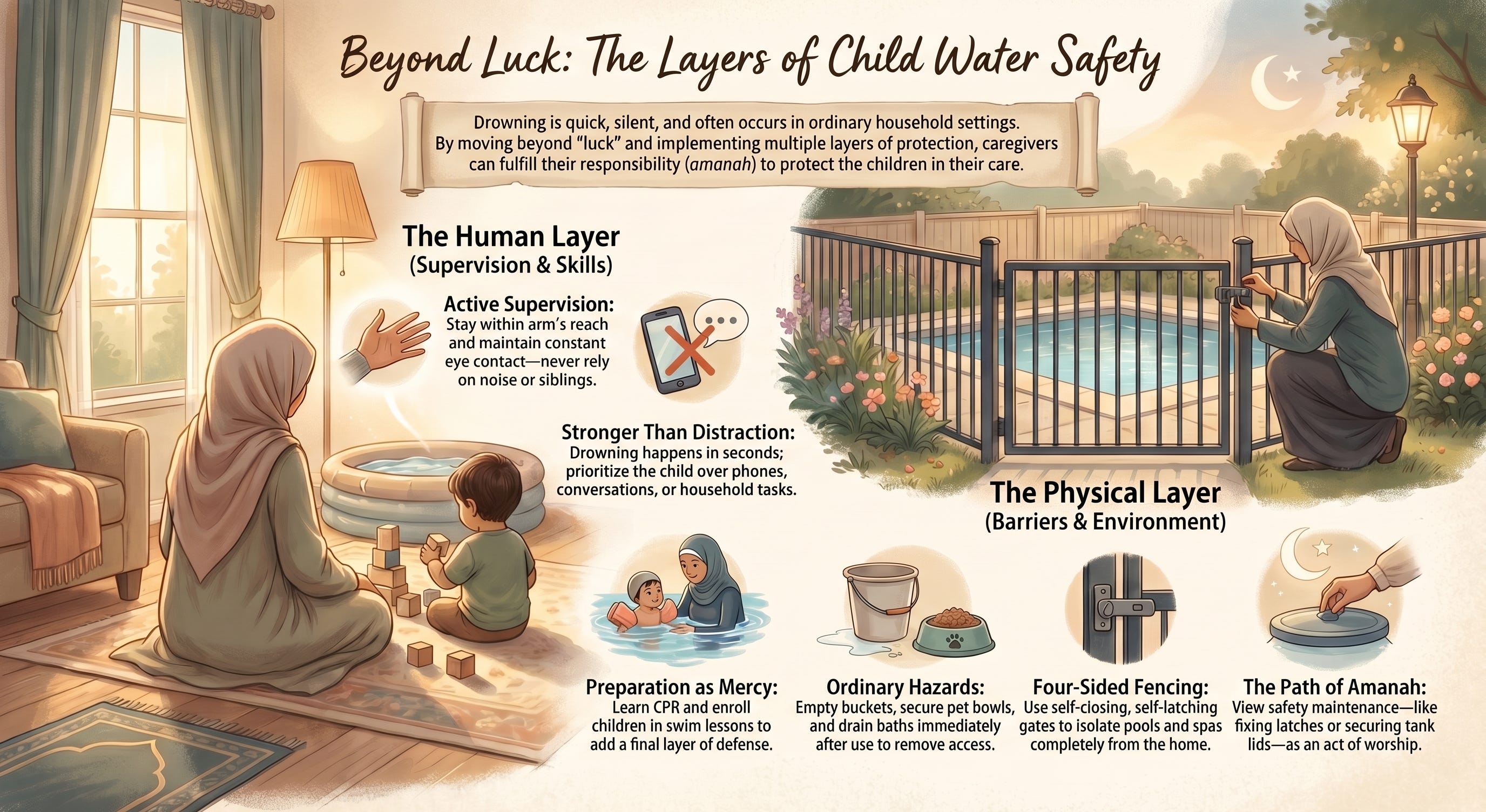
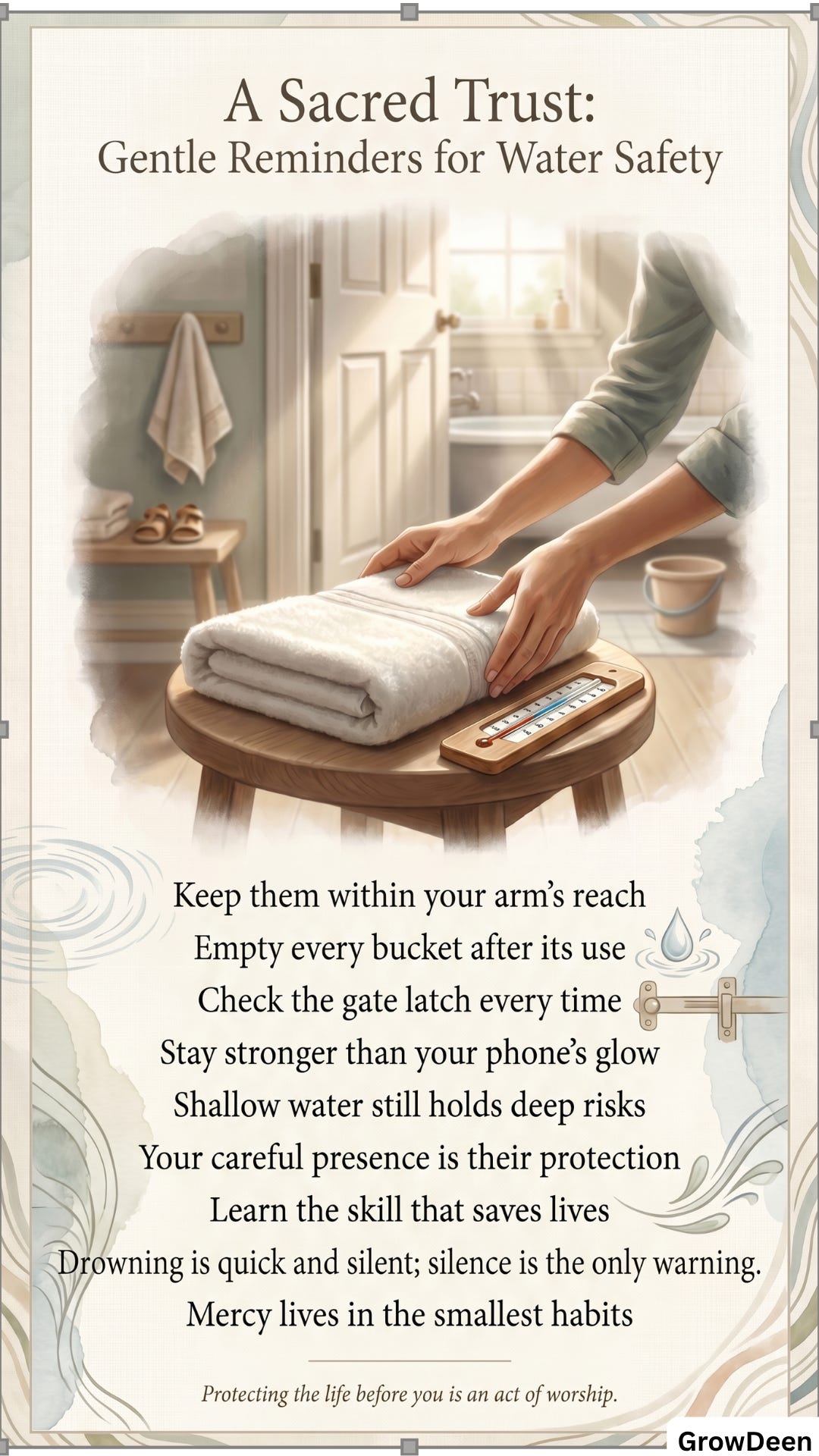
Active supervision means being able to see your child and keep them within arm’s reach whenever they are near water. [3][4][5]
That kind of supervision is not casual. It is not checking through a window while doing something else inside. It is not watching through a phone screen. It is not trusting an older sibling to notice trouble fast enough. [3][5][8]
This matters because drowning does not usually arrive with noise.
The CDC and WHO both emphasize that drowning can happen in seconds and is often silent. That means distraction is not a side issue. It is one of the main issues.
A text message.
A quick turn toward another child.
Going inside for one thing.
A conversation that pulls your mind away for a few seconds too long.
That is often all it takes.
The water around home is often the water people forget to fear
At home, water safety is mostly about access.
Young children often drown after wandering into water, not after intentionally “going swimming.” The source material highlights that many drowning deaths happen after children fall or wander into water, especially backyard pools, and reminds us that children can drown in only a few centimetres of water. [3][5][6]
That means the home strategy has to be physical before it is educational.
Empty water containers after use.
Keep baths inaccessible.
Secure lids.
Drain or cover water features.
Keep buckets off the floor and out of reach. [3][4]
These things can feel too ordinary to sound important.
But that is exactly the point.
Danger around children often hides in what feels ordinary.
The section on farms, larger properties, and outdoor water near the home matters here too. Dams, tanks, ponds, and creeks become part of the everyday background, and because they are always there, families can stop really seeing them. Safe play spaces should be fenced away from these hazards. Tank lids should be secured. Ponds should be drained or sealed where possible. And nearby ladders, windows, or trees should not be allowed to become climbing routes over barriers. [1][3][4]
A fence is not the whole answer, but it changes the story
Pool fencing needs to be spoken about plainly.
All home pools and spas should be protected by effective, four-sided fencing with self-closing, self-latching gates that isolate the water completely from the house and yard. That remains one of the clearest and strongest recommendations in pediatric and public-health guidance. Objects that can be climbed should be kept away from the fence. Gates should never be propped open. [3][8]
No, the fence is not everything.
But it is one of the strongest layers of protection families have.
Children do not need permission to move toward water. They only need access. A good barrier interrupts that path. It turns a dangerous impulse into a pause. And sometimes that pause is everything.
Lessons help, but they do not replace your presence
Children should be taught water safety and swimming from a young age, and many can begin learning around ages four to five. [3][7]
That fits current pediatric guidance. Swim lessons are one important layer of protection, and for some children they reduce drowning risk even at quite young ages.
But lessons are still only one layer.
They do not cancel the need for supervision.
They do not mean a child is now “safe” around water.
They do not turn a distracted adult into a careful one.
Older children also need to know what to do if they need help: stay calm, float, and raise an arm for assistance. [3] That kind of water competence matters because panic makes danger worse.
And life jackets belong here too. When children are near open water or boating, they should wear a properly fitted life jacket approved in their region. Lakes, rivers, and boats carry risks that change quickly, and swimming ability alone is not enough. A life jacket is not pessimism. It is mercy with foresight.
If this kind of writing helps you feel more steady in the real work of caring for children, subscribe for free so the next article and companion resources arrive quietly in your inbox.
CPR belongs in the plan before anyone needs it
CPR is not an optional extra in this conversation.
It belongs right in the middle of it.
First aid is an essential skill for the family, and if a child is found unresponsive and not breathing, emergency action should include calling emergency services and starting CPR. [3][4][7]
The Red Cross, CDC, and other safety guidance keep returning to the same truth. Supervision, barriers, lessons, life jackets, and CPR-trained adults work together. Not separately. Together.
That matters because prevention is layered.
One layer may fail.
A gate may be left unlatched.
A bucket may be forgotten.
A child may move faster than expected.
A distracted moment may happen.
And then what remains matters.
Allah’s mercy is in the precautions too
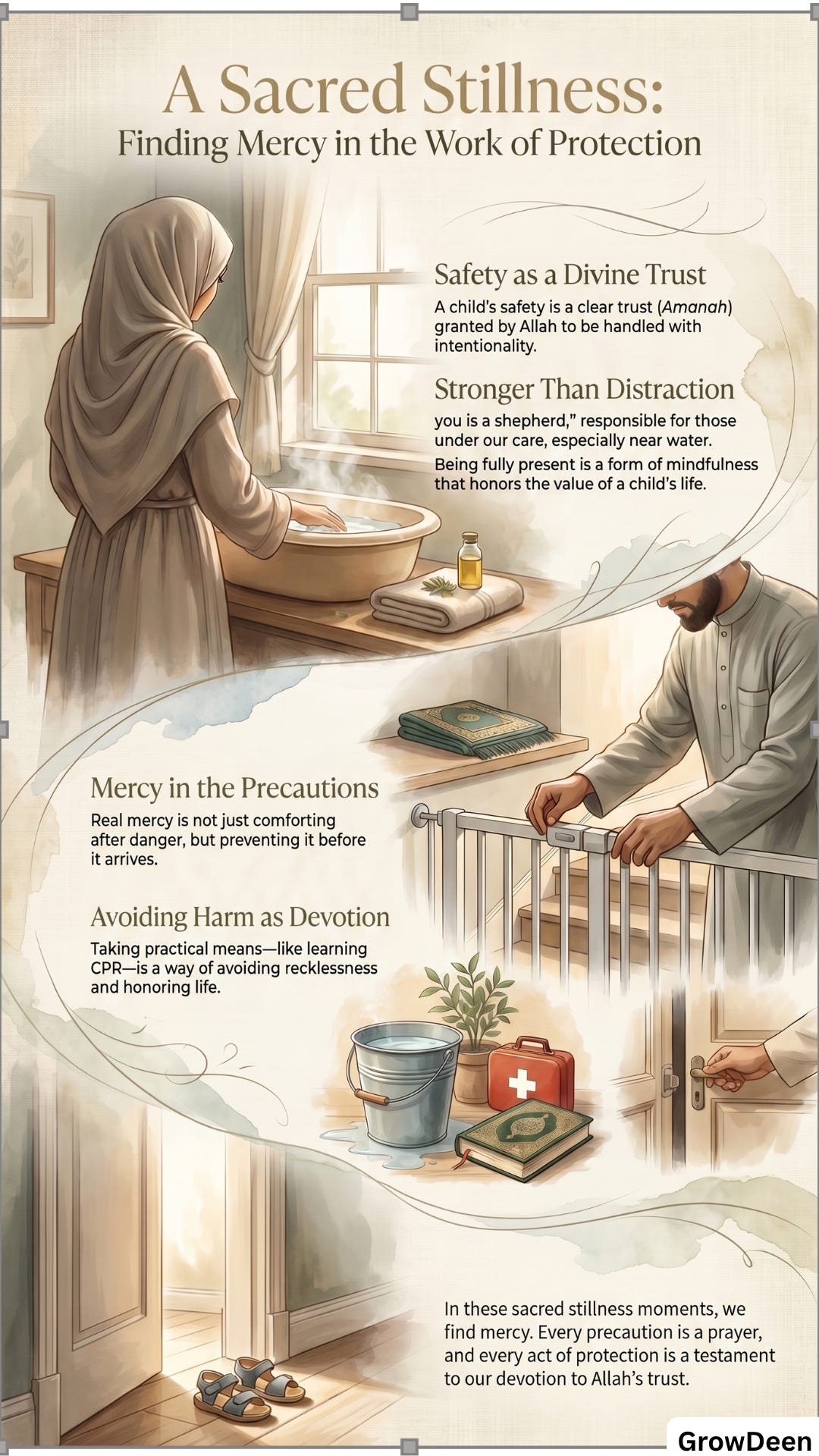
From an Islamic perspective, water safety sits naturally under amanah.
Allah says, “Indeed, Allah commands you to render trusts to whom they are due.” [9]
A child’s safety is one of the clearest trusts a parent or carer will ever hold.
And Allah says, “Do not kill yourselves. Indeed, Allah is ever Merciful to you.” [10]
The scholars explain that this includes avoiding causes of harm and not being reckless with life. Water safety belongs here without strain. Watching closely. Emptying containers. Securing access. Teaching a child to respect water. Learning CPR. Fastening a life jacket. Repairing a latch. Taking the means seriously because the life before you is not yours to handle carelessly.
The Prophet ﷺ said, “Each of you is a shepherd, and each of you is responsible for his flock.” [11]
Water safety lives inside that hadith.
And there is gentleness here too.
The Prophet ﷺ said, “Allah is gentle and loves gentleness in all matters.” [12]
Gentleness here is not softness without boundaries. It is the parent who stays near instead of drifting into distraction. It is the adult who chooses the patrolled beach, holds the child’s hand near the waves, checks the gate, fastens the life jacket, and protects without turning the whole day into fear.
The Prophet ﷺ also showed tenderness to children openly. [13]
Real mercy is not only what comforts after danger.
It is what prevents danger before it arrives.
The bucket emptied after use.
The fence repaired before summer.
The CPR class taken before anybody thinks they might need it.
The hand that does not let go near the shoreline.
In the end, water safety is built on layers, not luck
That is really the heart of it.
Water safety for children is not built on one heroic act.
It is built on layers.
Close supervision.
Strong barriers.
Swim learning.
Life jackets.
CPR.
Ordinary habits repeated until they become instinct.
Water will always be stronger than a small child.
So the adult must stay stronger than distraction.
Maybe that is the line worth keeping in your mind.
Not stronger than water.
Stronger than distraction.
That is where so much protection begins.
GIFTS FOR YOU, DEAR READER
If you’ve reached this part of the page, that tells me something meaningful about you.
You did not just skim this and move on.
You stayed.
And usually that means something in these words touched real life for you. Maybe a child you love. Maybe a fear you carry quietly. Maybe a responsibility you feel more deeply than you can always explain.
That matters.
Your willingness to slow down and really read is not small. It says something beautiful about your care, your intention, and the kind of responsibility you are trying to carry with more awareness.
I did not want this article to remain only words on a page.
I wanted it to go a little further than that.
Into your home.
Into your routines.
Into those ordinary moments where it is easy to forget what mattered most until the moment is already moving.
So we prepared a small companion pack for you.
Not as decoration. Not as a sales trick.
And not as something to download and forget.
But as a few thoughtful resources designed to help this article stay with you in real life. Gentle supports you can save, return to, print, reflect on, or use when you want the guidance in front of you without rereading everything from the beginning.
The hope is simple.
Not just that you read.
But that what you read becomes easier to remember, easier to revisit, and easier to act on.
These companion resources were made slowly, thoughtfully, with care and sincere du’a. They were prepared because some truths are too important to leave floating in memory. They deserve something steadier. Something you can hold onto when life gets busy again.
So please do download the companion pack.
And if it supports you, subscribe for free so future articles and companion resources arrive directly in your inbox. That way, the next time we publish something meant to help in a real stage of life, it reaches you without you having to go looking for it.
And if someone else comes to mind while you’re reading this, someone caring for children, someone living near water, someone who would genuinely benefit, share it with them too.
May Allah place barakah in your effort, accept your intention, and make what you carry as a parent, carer, or reader lighter and more rewarded than it feels in the moment.
What is one water-related situation you think families around you underestimate most, and what would help people take it more seriously?
Subscribe for free if you’d like future articles and companion resources that help Islamic wisdom and practical care stay close to real life.
References
[1] Byard, R. (2008). Rainwater tank drowning
[2] Conover, K., & Romero, S. (2018). Drowning prevention in pediatrics
[3] Denny, S.A., Quan, L., Gilchrist, J., McCallin, T., Shenoi, R., Yusuf, S., Hoffman, B., Weiss, J., Council on Injury, Violence and Poison Prevention, Agran, P.F., Hirsh, M., Johnston, B., Lee, L.K., Monroe, K., Schaechter, J., Tenenbein, M., Zonfrillo, M.R., & Quinlan, K. (2019). Prevention of drowning
[4] Forjuoh, S.N. (2013). Water safety and drowning prevention
[5] Royal Life Saving Australia. (2021). Royal Life Saving National Drowning Report 2021
[6] Royal Life Saving Australia. (2017). A 13 year national study of non-fatal drowning in Australia: Data challenges, hidden impacts and social costs
[7] World Health Organization. Drowning fact sheet and global drowning prevention guidance
[8] U.S. Centers for Disease Control and Prevention, American Academy of Pediatrics. Prevention of Drowning
[9] Qur’an, Surah An-Nisa 4:58
[10] Qur’an, Surah An-Nisa 4:29
[11] Sahih al-Bukhari 7138
[12] Sahih Muslim 2593
[13] Sahih al-Bukhari 5998