
The Children’s Medicine Mistake Loving Parents Can Make So Easily
The Calm, Careful Habits That Keep Children Safer With Medicine

Free gift for you! A practical companion resource is waiting for you near the end of this article to help you remember, apply, and benefit from what you read.
Don’t forget to download!
Giving medicine to a child safely is not about doing more. It is about slowing down, checking carefully, and remembering that the right medicine, at the right dose, in the right way, can help, while mistakes can cause real harm.
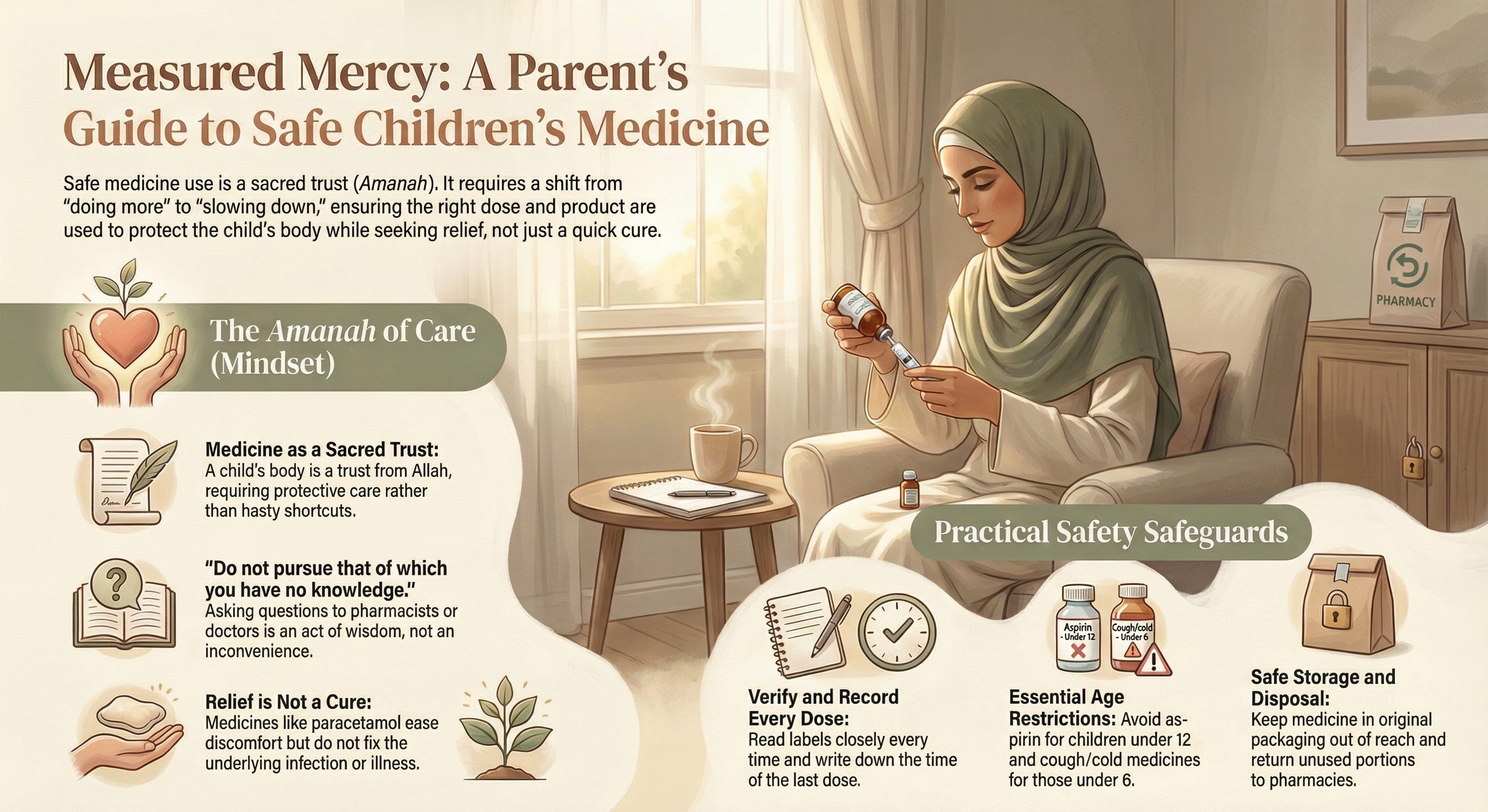
It can feel strangely heavy, holding a small bottle over a sleepy child.
You read the label once. Then again. Then you look at your child’s age, the syringe, the clock, and the line on the box that suddenly feels less simple than it did in the pharmacy. Maybe your child has a fever. Maybe they are miserable and crying. Maybe you are tired too. And in that moment, even a common medicine can stop feeling ordinary.
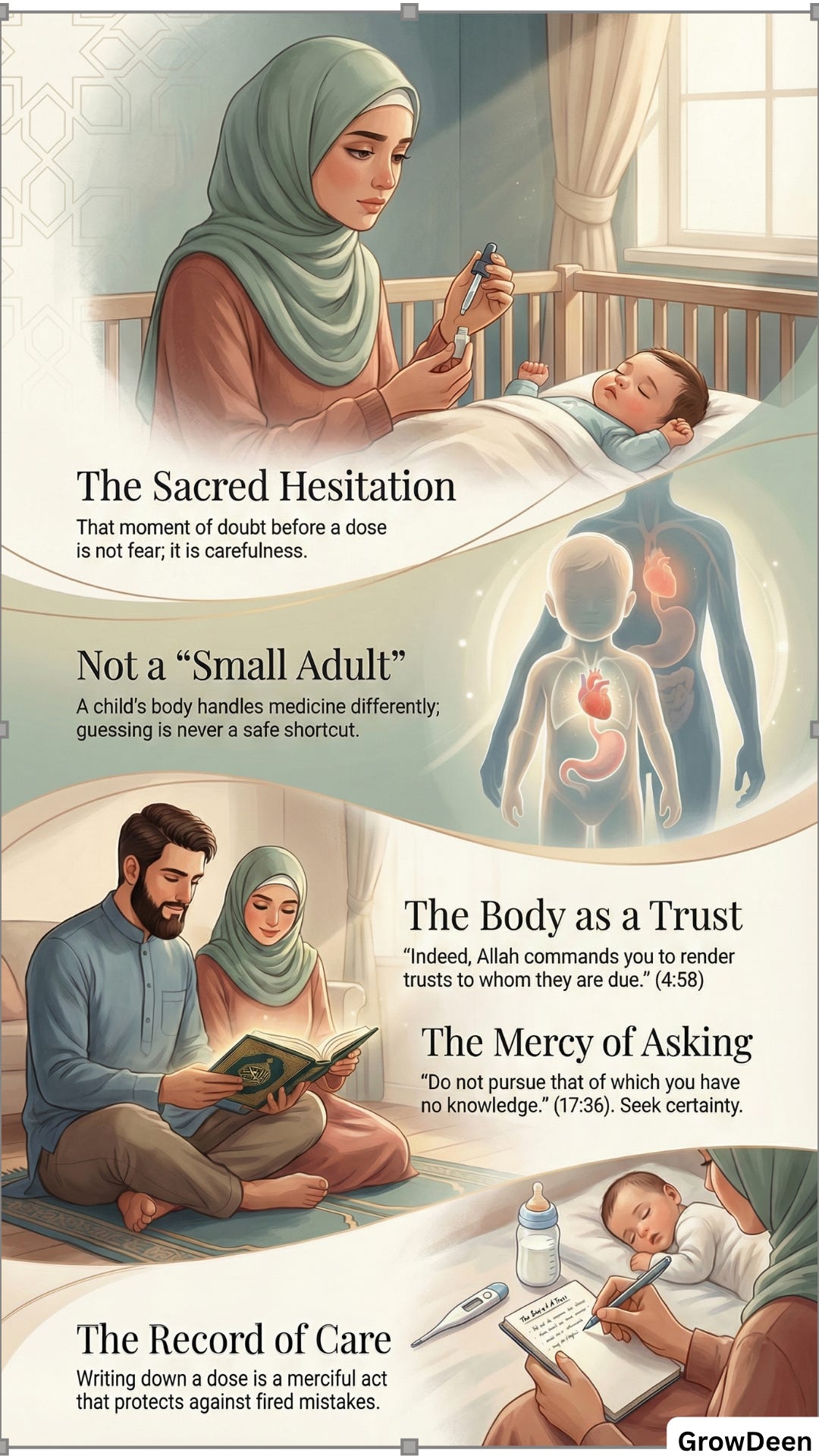
If you have ever hesitated before giving a dose, that hesitation is not foolish.
It is part of being careful.
The bottle may look familiar, but the body receiving it is small
Children’s medicines are not small versions of adult carelessness.
A child’s body handles medicines differently. Some medicines used by adults are not suitable for children at all, and even medicines that are commonly used in childhood still depend on the right product, the right strength, the right amount, and the right child. [1] [3] [6]
That is why guessing is never a safe shortcut.
Especially with a baby under 6 months, it is better to stop and ask a doctor or pharmacist than to try to sound confident in your own head while quietly hoping you are right. [1] [3]
Allah’s trust is present in the smallest dose
There is something deeply Islamic about careful medicine use.
Allah says, “Indeed, Allah commands you to render trusts to whom they are due.” [7]
A child’s body is part of that trust. Their pain matters. Their safety matters. Their smallness matters too. You are not just trying to make them feel better. You are trying to do it without causing a second harm while solving the first.
And Allah says, “Do not throw yourselves with your own hands into destruction.” [8]
That verse fits this topic more than people sometimes realize. Carefulness here is not fussiness. It is protection.
The right medicine can help, but it does not make the illness disappear
Paracetamol and ibuprofen are common examples of medicines that can genuinely help children when pain or fever is making them uncomfortable. [1] [2] [3] They can ease things like headache, earache, sore throat, fever, pain from injury, and other discomforts. [1] [2]
But they do not cure the infection itself. They do not fix the cause.
That matters, because sometimes a parent gives medicine hoping to solve the whole illness, when really the medicine is only helping the child cope while the body deals with what is wrong. And if a child is unwell but still comfortable and coping reasonably well, those medicines are not always automatically needed. [2]
Relief is useful.
It is not the same thing as cure.
Dosage is where loving parents can get into trouble
This is one of the quiet danger points.
Too much medicine can harm a child. The wrong medicine can harm a child too. [1] [3] [4]
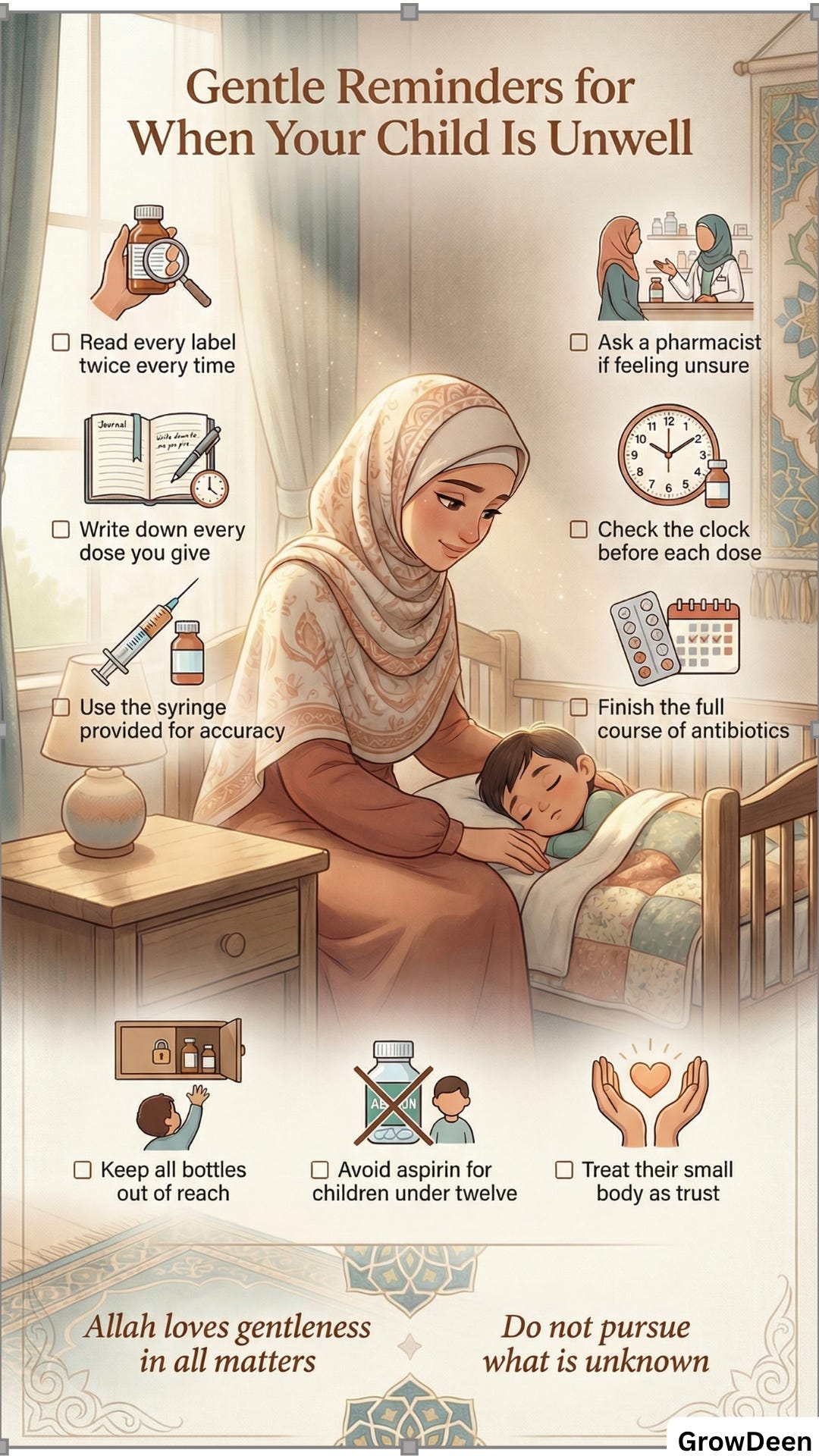
And because medicines come in different strengths and forms, what looks like “the usual one” may not actually be the usual one for your child. [1] [2] [3] That is why labels need to be read closely every time, not only the first time. It is also why writing down the last dose can protect against those tired-parent moments when nobody is completely sure what was already given and when. [1] [2]
The Prophet ﷺ said, “Actions are according to intentions.” [9]
Even something as plain as recording a dose can become part of merciful care when it is done to keep a child safe.
Not every medicine that sits on a shelf belongs in your child’s mouth
Some medicines need particular caution.
Aspirin should not be given to children under 12 unless a doctor specifically prescribes it, because of the risk of Reye’s syndrome, which is rare but can be fatal. So over the counter does not automatically mean harmless. [3]
Antibiotics need restraint too. They work for bacterial infections, not for every illness that feels awful. [3] [6] If antibiotics are prescribed, the full course needs to be finished, even if the child seems much better sooner. Leftover antibiotics should not be reused later and should never be passed from one child to another. [3] [6]
Cough and cold medicines bring another kind of temptation. Parents often want to do something when a child is congested and miserable. But for children under 6 years, cough and cold medicines, including decongestant nasal sprays, should not be used. [5] Saline sprays and drops are the safer option for blocked noses. [4] [5]
And antihistamines should not be used just to make a child sleep. [3] What feels like a shortcut can turn into another problem.
If gentle, practical, Islamically grounded support like this helps you feel steadier in everyday parenting, subscribe for free so each new article and life gift reaches you without you having to go searching later.
Sometimes wisdom sounds like asking one more question
When a medicine is prescribed or bought, it is worth asking basic questions, even if you feel awkward.
What is it for? How much should I give? How often? How do I give it? When should it start helping? Are there side effects? Could it interact with something else? How should it be stored? [4]
That is not inconvenience. That is wisdom.
Allah says, “Do not pursue that of which you have no knowledge.” [10]
There is such mercy in that verse for parents. You do not have to pretend certainty when you do not have it. You are allowed to ask. In fact, sometimes asking is the safest thing you do all day.
The medicine cupboard can become dangerous in very ordinary ways
Risk does not end after the dose is given.
Medicines should be kept out of children’s reach and left in their original packaging, because mistakes happen more easily when labels are missing, products are loose, or someone assumes they remember which bottle is which. [4]
Unused medicines should not be thrown casually into the bin or poured down the sink either. Returning them to a pharmacy for safe disposal is better for both the home and the environment. [4]
And if a child has accidentally taken medicine or been given the wrong amount, urgent advice matters. The Poisons Information Centre can be called on respective number of your local area. If the child stops breathing, loses consciousness, or has seizures, emergency help is needed immediately. Call the emergency line. [4]
These are not dramatic details.
They are the quiet edges of responsibility.
Mercy in parenting is not always soft looking
Sometimes mercy looks like saying yes to a medicine that truly helps.
Sometimes it looks like saying no to a medicine that is unnecessary, risky, or being used for the wrong reason.
Sometimes it looks like holding a child gently but firmly while the syringe goes in.
The Prophet ﷺ said, “Allah is gentle and loves gentleness in all matters.” [11]
And the Prophet ﷺ said, “Each of you is a shepherd and each of you is responsible for his flock.” [12]
That responsibility is not flashy. It is label reading in poor light. It is asking before assuming. It is checking the clock. It is not giving an older sibling’s medicine to the younger one because the symptoms “seem similar.” It is returning to care, even when you are tired and the whole thing feels annoyingly complicated.
This is part of mercy too.
Measured mercy.
The kind that protects a child while trying to relieve their pain in the right way.
GIFTS FOR YOU, DEAR PARENT
If you’ve reached this part of the page, it tells me something meaningful about you.
You weren’t just skimming or passing time. You stayed because something here felt relevant to your real life.
Because you care.
Because you want to do things with more awareness.
Because you’re trying, even when it feels overwhelming.
That is not small.
So I didn’t want this article to remain just words on a page. I wanted it to gently step into your daily life in practical ways. That’s why we prepared these Life Gifts for you.
Not as extras.
Not as decorations.
But as simple tools to help you hold onto what mattered most in what you just read.
Here’s what you’ll find inside:
Gentle Understanding Card
A clear and simplified summary of the core concept from this article, so you can revisit the main idea anytime without rereading everything.
Heartfelt Dua Card
A carefully chosen dua connected to this stage of life, because we know that real strength and ease ultimately come from Allah’s help.
Gentle Actions Card
Practical examples to help you translate knowledge into action, so what you learned becomes part of your daily rhythm.
Gentle Reminders Card
Short, steady reminders drawn from the key points, designed to be printed or saved and placed somewhere you’ll see often.
These were designed slowly and thoughtfully, with time, care, and sincere dua. We created them because we genuinely want to walk alongside you, not just through one article, but through every stage of this lifelong journey.
If these gifts support you even in a small way, I would love for you to continue receiving them.
Subscribe so that each new Gift arrives directly in your inbox whenever we release the next stage. That way, you won’t miss the tools designed to support you right where you are.
May Allah place barakah in your effort, accept your intention, and make this path easier and more rewarding than it feels right now.
Please share it with a family/friend who may benefit from this knowledge.
What is one moment with your child that feels hardest lately, and what kind of support would make it feel lighter?
Subscribe for free to keep receiving gentle, research rooted, Islamically grounded support for the real moments of parenting.
What part of giving medicine to your child feels most stressful or uncertain for you right now?
References
[1] Australian Medicines Handbook (AMH). (2023). AMH Children’s dosing companion 2023. AMH.
[2] Kanabar, D.J. (2017). A clinical and safety review of paracetamol and ibuprofen in children. Inflammopharmacology, 25, 1 to 9.
[3] MIMS Australia. (2024). MIMS online. MIMS Australia.
[4] The Royal Children’s Hospital (RCH). (2001). How to give medications to children. RCH.
[5] Smith, S.M., Schroeder, K., & Fahey, T. (2014). Over-the-counter (OTC) medications for acute cough in children and adults in community settings. Cochrane Database of Systematic Reviews, 2014(11), CD001831.
[6] Therapeutic Guidelines Ltd. (2024). eTG complete. Therapeutic Guidelines Ltd.
[7] Qur’an, Surah An-Nisa 4:58
[8] Qur’an, Surah Al-Baqarah 2:195
[9] Sahih al-Bukhari, Hadith 1; Sahih Muslim, Hadith 1907
[10] Qur’an, Surah Al-Isra 17:36
[11] Sahih Muslim, Hadith 2593
[12] Sahih al-Bukhari, Hadith 7138; Sahih Muslim, Hadith 1829