
The Car Seat Mistake That Increases Injury Risk By 3.5 Times
What Every Parent Should Know Before the Next Car Ride

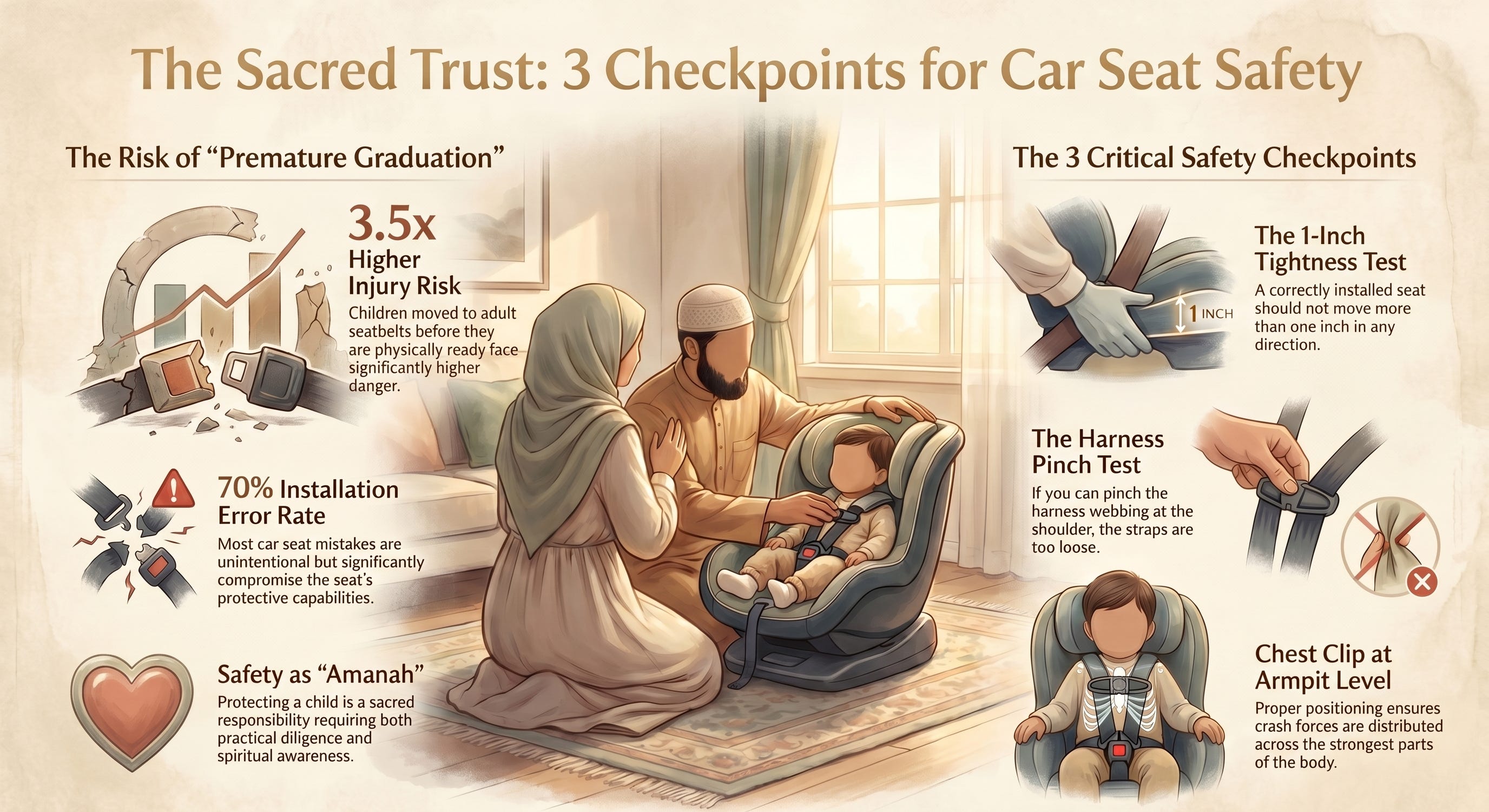
Studies show that children moved prematurely to adult seatbelts face 3.5 times higher risk of serious injury in crashes, and research reveals that over 70% of car seats are installed incorrectly. [1] This guide shows you the 3 critical checkpoints that determine whether your child’s seat will actually protect them.
You don’t really notice how fast a car moves until you imagine a sudden stop.
A child doesn’t understand momentum. They don’t brace. They don’t prepare. Their safety depends entirely on what’s holding them in place.
You’re being careful — I know you are. But here’s what stopped me when I reviewed recent car seat safety research: even the best-designed seat can fail if it’s not installed properly. And studies have shown that incorrect installation and misuse of child restraints are extremely common — significantly increasing injury risk. [2][3]
The difference between a car seat that protects and one that doesn’t often comes down to three things: whether it fits your child’s current size, whether it’s installed correctly, and whether you’re using it at the right stage.
Here’s why this matters more than most parents realize: children need to use an appropriate car seat for many years, not just infancy. [1][4][5] In most safety guidelines around the world, children should remain in child restraints until they are physically big enough for an adult seatbelt to fit correctly — not simply when they reach a certain age. [4][6]
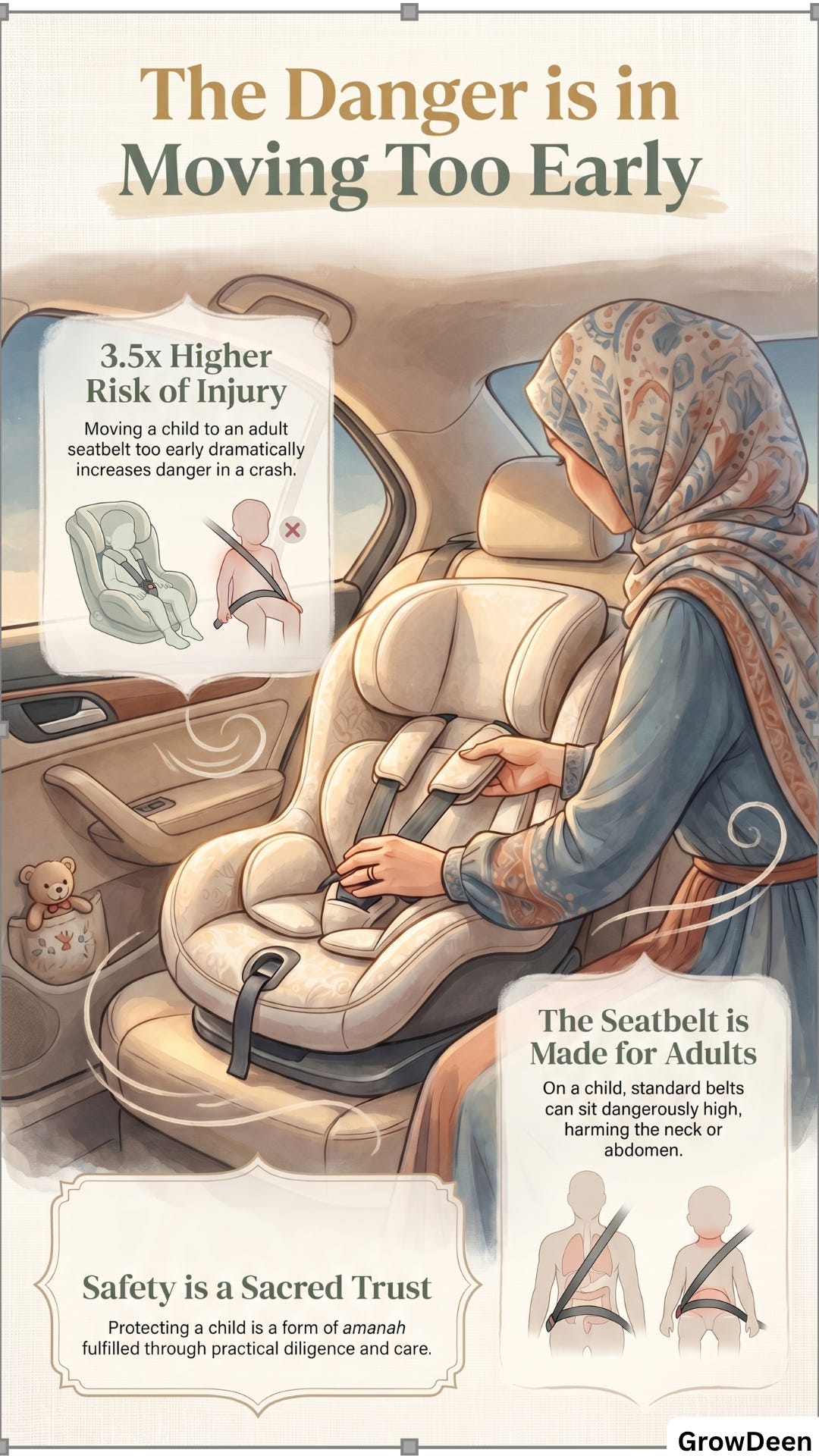
Moving too early increases the risk of serious injury in a crash by 3.5 times. [7] Researchers call this “premature graduation,” and it’s one of the most common car seat mistakes parents make.
Why This Guide Is Different From Generic Car Seat Advice
Current crash research and safety testing: Every recommendation is backed by vehicle safety studies, child restraint research, and injury prevention data (2008-2022).
Islamic framework integrated: This isn’t just installation steps — it’s about fulfilling the amanah (sacred trust) of protecting your child through both practical diligence and spiritual awareness.
Professional-level checklist included: You’ll get a free Car Seat Safety Verification Guide with installation checks, fit tests, and stage-by-stage guidelines — the same checklist technicians use at fitting stations.
The Question Isn’t “How Old?” — It’s “Does It Fit?”
Here’s something most people don’t realize: a standard seatbelt is designed for an adult body. On a child, it can sit too high across the abdomen or too close to the neck, turning a safety feature into a source of harm.
So the question isn’t just “How old is my child?” It’s “Does the restraint actually fit them properly?”
Car seats should match both your child’s size and stage of development. [1][8] That means moving through stages — rear-facing, forward-facing, booster — not by convenience or age alone, but by fit.
The 3 Critical Checkpoints That Determine Real Protection
Checkpoint 1: Is Your Child in the Right Stage?
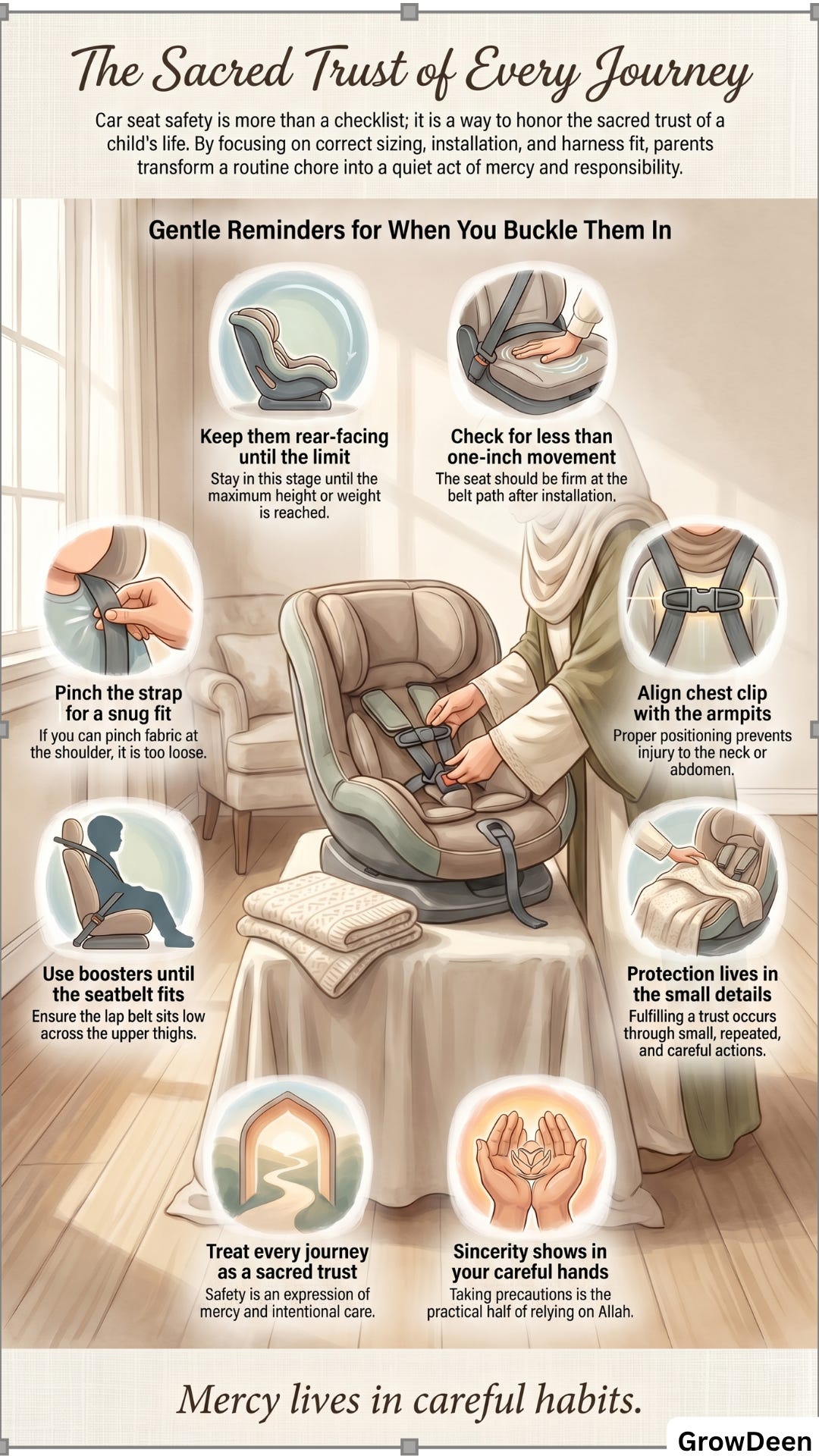
Rear-facing seats offer critical protection for the head, neck, and spine, especially in early years. Research consistently shows that rear-facing positioning reduces the risk of severe injury in young children during crashes. [5][9]
But here’s what caught my attention: many parents move their child to forward-facing too early — often because the child’s feet touch the back seat or because they think the child “looks uncomfortable.”
Your child’s feet touching the seat is normal and safe. What’s unsafe is moving them forward-facing before they’ve reached the maximum height or weight limit of the rear-facing seat.
Forward-facing seats with harnesses should be used until your child reaches the maximum weight or height limit — often 40-65 pounds depending on the seat. [1][4]
Booster seats should be used until the adult seatbelt fits properly. Here’s the test: the lap belt should lie snugly across the upper thighs (not the stomach), and the shoulder belt should lie across the shoulder and chest (not the neck or face). [4][6]
If the seatbelt doesn’t fit this way, your child still needs a booster — regardless of their age.
Checkpoint 2: Is It Installed Correctly?
Even the best seat can fail if it’s not installed properly. And here’s the uncomfortable truth: studies show that over 70% of car seats have installation errors. [2][3]
This isn’t about being a “bad parent.” It’s about car seats being genuinely difficult to install correctly without training.
That’s why I recommend having your seat professionally checked at a fitting station if one is available in your area. [1][2] When I had mine checked, I discovered I’d made three errors I didn’t even know were possible.
But if professional checking isn’t accessible, here’s what you need to verify:
The seat should be firmly attached using either the vehicle seatbelt or a compatible anchorage system (LATCH/ISOFIX) — not both unless the manufacturer’s manual specifically says to use both. [1]
The tightness test: After installation, try to move the seat side-to-side and front-to-back at the belt path. It shouldn’t move more than one inch in any direction.
The angle matters: Rear-facing seats need to recline at the correct angle (usually indicated on the seat) to protect your baby’s airway and provide proper head/neck support. Too upright or too reclined both create risks.
Checkpoint 3: Is the Harness Fitted Properly?
This is where I see the most mistakes — and it’s something you need to check every single time you put your child in the seat.
The harness should sit just above the shoulders for rear-facing and at or above the shoulders for forward-facing. [1][8] If the straps are coming out of the wrong slots, they won’t protect properly in a crash.
The harness should lie flat with no twists anywhere along the straps. Twisted straps can cut into your child or fail to distribute crash forces properly.
The pinch test: At your child’s shoulder, try to pinch the harness strap between your thumb and finger. If you can pinch any fabric together, it’s too loose. [1] The harness should be snug enough that you can only slip one or two fingers between the harness and your child’s collarbone.
The chest clip should sit at armpit level — not on the stomach, not on the neck.
I know this feels like a lot to remember when you’re rushing to get somewhere. That’s why I’ve created a free Car Seat Safety Verification Guide — a printable checklist you can keep in your car. Keep reading to download it at the end — it walks you through every critical check in under 2 minutes.
Where Your Child Sits Matters More Than You Think
The back seat is generally the safest place for children, especially those under 12 years old. [1][5] Front seats come with additional risks, particularly from airbags, which are designed for adult bodies and can cause serious injury to smaller passengers.
If your vehicle only has one row of seats, you’ll need to carefully choose the seat type and positioning — and in some cases, deactivate the passenger airbag if possible.
When a Car Seat Is No Longer Safe to Use
Here’s a question parents don’t always ask: “Is this car seat still safe to use?”
Car seats should be in good condition, not too old, and should not have been involved in a crash. [1] Materials degrade. Straps wear out. Internal structures weaken in ways you can’t always see.
Most manufacturers recommend replacing car seats after 6-10 years, even if they look fine. Check the expiration date — it’s usually stamped on the seat itself.
Second-hand seats add uncertainty. If you don’t know the full history of the seat — especially whether it’s been in a crash — it’s safer not to use it. [1] A crash can compromise the seat’s structure even when there’s no visible damage.
The Islamic Framework for Car Seat Safety
When I reflect on the verse where Allah says, “And do not expose yourselves to destruction” [10], I think about how a car crash isn’t something we plan for, but it is something we prepare for. Taking precautions doesn’t prevent every outcome, but neglecting them can increase harm in ways that are avoidable.
Another verse reminds us: “Indeed, Allah commands you to render trusts to whom they are due.” [11] A child’s safety is one of those trusts. It doesn’t only show up in big decisions. It shows up in small, repeated actions — tightening the harness, checking the fit, adjusting the seat as they grow.
The Prophet ﷺ said, “Each of you is a shepherd, and each of you is responsible for his flock.” [12] That responsibility includes the moments no one sees. The daily routines. The consistent habits. The decision to take a few extra minutes to secure something properly, even when it feels inconvenient.
He also said, “Whoever relieves a believer’s distress, Allah will relieve his distress on the Day of Resurrection.” [13] Preventing harm is a form of relieving distress before it happens. It’s a quiet kind of care.
And the Quran reminds us: “And whoever relies upon Allah — then He is sufficient for him.” [14] Reliance doesn’t replace effort. It comes after it. The seat is installed properly. The child is secured. The precautions are taken. And then, whatever happens, happens under Allah’s knowledge and mercy.
Protection Comes Down to Small, Repeated Actions
In the end, a car seat is just an object. But the way it’s used — that’s what protects your child.
And protection, most of the time, comes down to the things we choose to do carefully, again and again, even when nothing seems to be at risk.
If you’ve read this far, you’re the kind of parent who takes safety seriously — not as paranoia, but as protective responsibility. That tells me something beautiful about you.
Your Car Seat Safety Verification Guide
Inside the Car Seat Safety Verification Guide (one comprehensive PDF, 3 pages):
Page 1: The 2-Minute Pre-Drive Safety Check — A quick verification checklist you can run through before every drive: harness tightness (pinch test), chest clip position, strap placement, seat stability — designed as a laminated card you can keep in your car’s glove box or sun visor.
Page 2: Stage-by-Stage Transition Guide — Clear height/weight requirements for moving between rear-facing, forward-facing, and booster seats with visual “graduation tests” you can do at home — so you know exactly when (and when NOT) to move your child to the next stage.
Page 3: Installation Verification Checklist — The same checklist professional technicians use at fitting stations: attachment method, tightness test, angle check, harness routing — with troubleshooting tips for common installation errors.
This isn’t just a PDF to download and forget. It’s a reference tool designed to stay in your car and give you confidence every single time you buckle your child in.
This Car Seat Safety Verification Guide is what every GrowDeen subscriber receives with each article. We cover the full journey of raising Muslim children, all backed by scientific research and rooted in Islamic wisdom.
If you’re a Muslim parent who wants both evidence-based guidance AND Islamic perspective, subscribe for free so future resources arrive in your inbox before you need them.
You’ll receive just guidance when there’s something worth sharing, no clutter.
May Allah place barakah in your effort, accept your intention, and make the care you give more protective, more merciful, and more rewarded than it feels in the moment.
Share This With Someone Who Needs It
Think of one person right now: a parent who just had a baby and is choosing their first car seat, a friend whose toddler still rides forward-facing at 18 months, a relative whose child has outgrown the harness but isn’t quite big enough for a seatbelt, or someone who bought a second-hand seat without knowing its history.
This article could protect their child in a crash. Share it with them today — not because you’re being preachy, but because you care. Sometimes the most loving thing we can do is pass along knowledge that prevents harm in moments we hope never come.
References
[1] Australian Government. Child car seats: how to choose, install and use car seats. Raising Children Network.
https://raisingchildren.net.au/
[2] Brown, J., Finch, C.F., Hatfield, J., & Bilston, L.E. (2011). Child restraint fitting stations reduce incorrect restraint use among users of fitting stations. Accident Analysis & Prevention, 43(3), 1128-1133.
[3] Cross, S.L., Charlton, J.L., & Koppel, S. (2017). Parental beliefs and behaviours relating to child restraint use. Journal of Road Safety, 28(3), 43-54.
[4] National Transport Commission (NTC). (2021). Australian road safety and child restraint guidelines.
https://www.ntc.gov.au/
[5] Neuroscience Research Australia (NeuRA). (2021). National child restraint best practice guidelines.
https://www.neura.edu.au/
[6] Parab, A., Høye, A., & Paine, M. (2022). Seat belt fit in children aged 7–12 years. International Journal of Environmental Research and Public Health, 19(3), 1798.
[7] Koppel, S., Charlton, J.L., Fitzharris, M., Congiu, M., & Fildes, B. (2008). Are child occupants a significant source of driving distraction? Accident Analysis & Prevention, 40(2), 657-666.
[8] Brown, J., Fell, D., & Bilston, L.E. (2010). The importance of correct shoulder height labelling of child restraints. Pediatrics, 126(3), e490-e497.
[9] Whyte, T., Williamson, A., & Brown, J. (2020). The influence of restraint factors and seating position on child passenger deaths in New South Wales, Australia. International Journal of Environmental Research and Public Health, 17(4), 1346.
[10] Quran, Surah Al-Baqarah 2:195
[11] Quran, Surah An-Nisa 4:58
[12] Sahih al-Bukhari 7138
[13] Sahih Muslim 2699
[14] Quran, Surah At-Talaq 65:3