
The Car Seat Mistake Most Parents Make
And How to Know When Your Child Is Actually Ready

A 2022 study analyzing seat-belt fit in children aged 7-12 found that age-based guidelines often fail to account for individual size variation, leading to premature transitions that increase injury risk in crashes. [1] This guide shows you how to choose the right car seat based on fit, not just age—with a decision framework you can use at every stage.
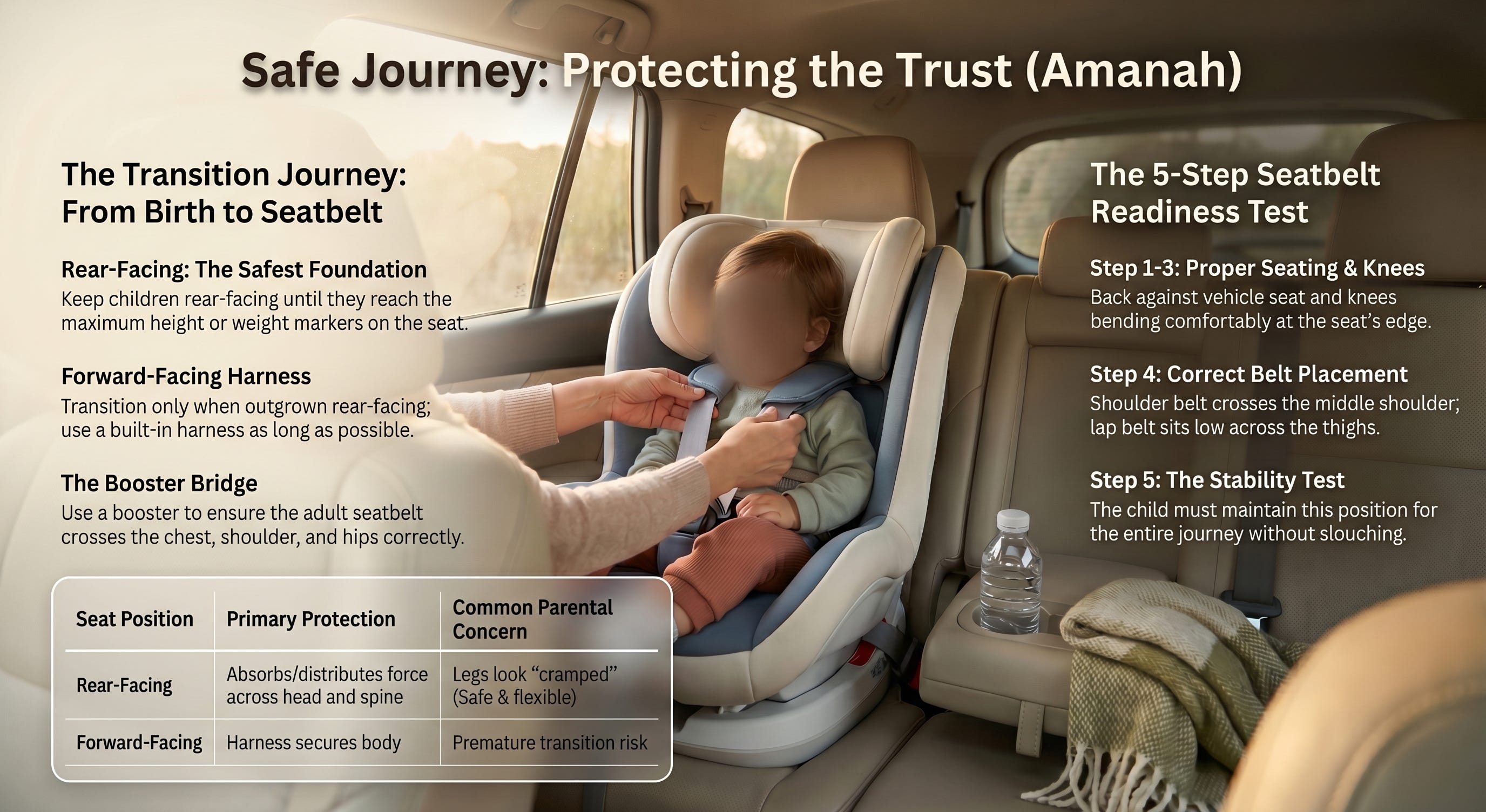
When you buckle your child into the car, you’re doing more than following the law. You’re holding a trust.
Every journey carries responsibility. The car seat you choose becomes part of how you protect what Allah has placed in your care.
But here’s what keeps coming up in my conversations with parents: the question isn’t just “What does the law say?” It’s deeper. What does your child actually need right now, at this size, at this stage?
Because when I studied the research on child restraint safety, one finding stopped me cold. Most parents transition their children to the next car seat stage too early—not because they’re careless, but because they’re following age guidelines that don’t account for the child sitting right in front of them. [2]
The safest car seat isn’t always the one that matches your child’s age. It’s the one that fits them properly.
Why This Guide Is Different From Generic Car Seat Advice
Backed by current research and real-world fit testing. Every recommendation comes from peer-reviewed studies and national safety guidelines updated through 2021-2022, not outdated rules.
Islamic framework for protection as amanah. This isn’t just about compliance—it’s about honoring the sacred trust of your child’s safety through both practical vigilance and spiritual awareness.
Includes a printable decision tool. You’ll get the Safe Journey Transition Guide (detailed below)—a 3-page PDF with fit checklists, stage-by-stage timelines, and the 5-step seat belt test you can keep in your car.
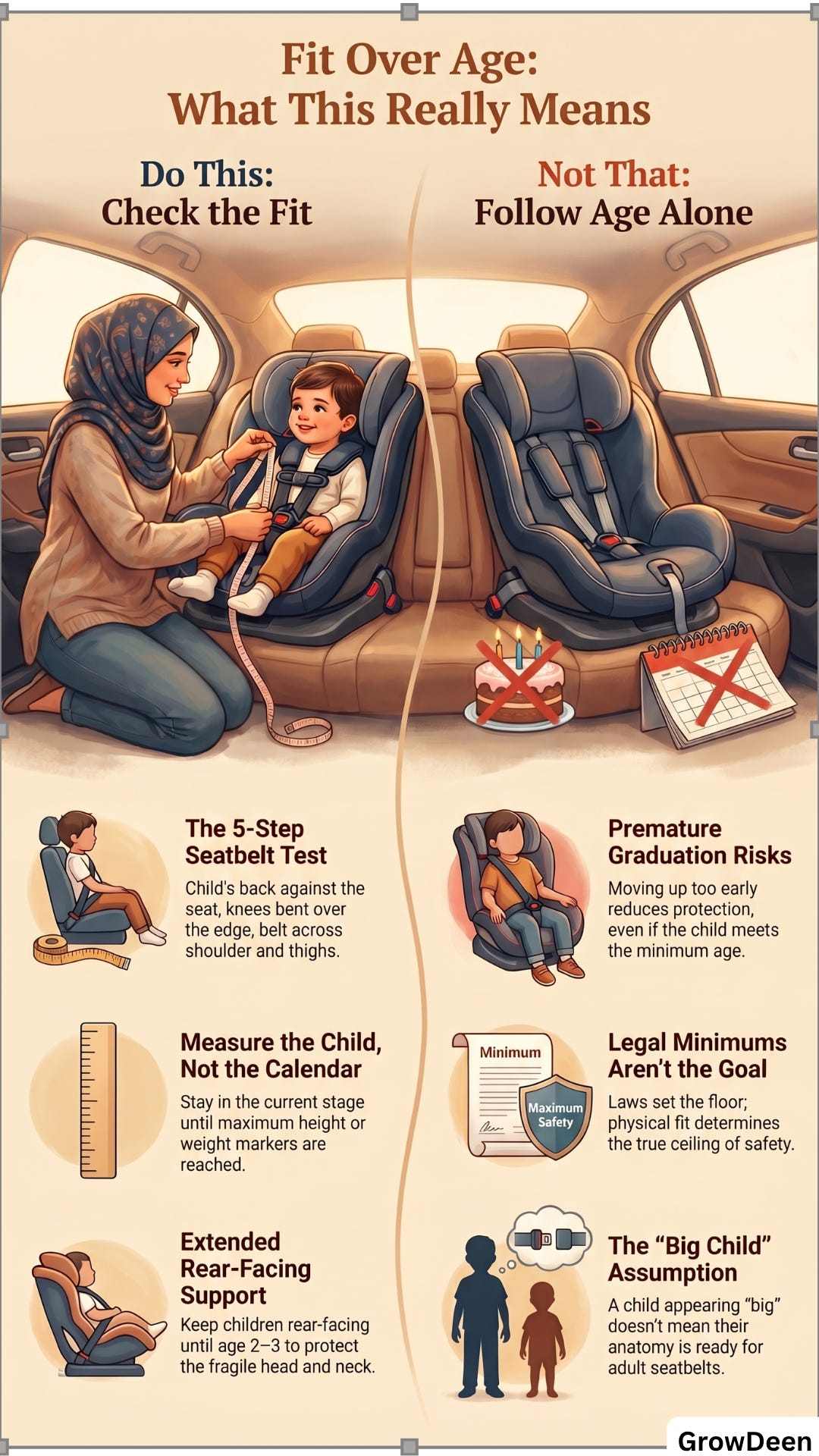
Understanding Child Restraint Systems: It’s About Fit, Not Just Age
In most countries, children are legally required to use an appropriate restraint system until somewhere around six to eight years old, though this varies depending on where you live. [3]
Here’s what matters more than the law: best practice always comes down to fit.
A smaller seven-year-old may still need a booster seat. A taller five-year-old might be ready to transition sooner. The child in front of you is the measure, not the calendar. [4]
There are several types of car seats, and understanding them helps you choose wisely:
Rear-facing car seats include infant capsules and convertible seats set to face the back of the vehicle. They come with built-in harnesses and provide critical support for a child’s head, neck, and spine. Many modern seats now allow extended rear-facing use, keeping children in this safer position until around two to three years old, or until they reach the seat’s height and weight limits. [5]
Forward-facing car seats use a built-in harness and face the front of the car. Some extended-harness models can accommodate children up to six to eight years old, depending on size. [6]
Booster seats raise the child so that an adult lap-shoulder seatbelt fits correctly across their body. If a booster seat is used, it must always be paired with a lap-shoulder seatbelt, never a lap-only belt. [7]
Convertible and combination seats offer flexibility—rear-facing first, then forward-facing, or forward-facing with harness transitioning to booster mode. These can extend the life of a single seat across multiple stages. [8]
The Prophet Muhammad ﷺ said, “Each of you is a shepherd, and each of you is responsible for his flock.” [9] This applies to the small details we overlook: the angle of a car seat, the tightness of a strap, the decision to wait one more year before moving up.
Birth to Around Six Months: The Rear-Facing Foundation
For newborns and very young infants, the choice is clear. Use a rear-facing car seat with a built-in harness. This is the safest position for protecting their fragile neck and spine during a crash. [10]
You have two main options. An infant capsule is designed specifically for newborns—portable and lightweight, but with a shorter lifespan. The other option is a convertible seat set to rear-facing mode, which can be used from birth and then switched to forward-facing later.
What matters most is that your baby rides facing backward for as long as possible. Rear-facing isn’t just a preference—it’s protection. In a frontal crash, the seat absorbs and distributes the force across the child’s entire back, rather than concentrating it on the neck and head. [11]
Allah says in the Qur’an, “And let those fear who, if they left behind weak offspring, would fear for them.” [12] Our children are weak. They depend entirely on what we choose for them. This verse isn’t just about inheritance or wealth. It’s about care in every form, including the car seat we install and the direction it faces.
Six Months to Around Three or Four Years: Staying Rear-Facing Longer
At this stage, many parents begin to wonder when they should turn the seat around.
The answer is simple: not yet.
Continue using a rear-facing seat for as long as possible. Only transition to forward-facing when your child reaches the maximum height markers indicated on the seat itself. [13] Rear-facing remains the safer option because it continues to distribute crash forces more evenly across the body.
Some parents worry that their toddler’s legs look cramped when rear-facing. But research shows that leg injuries are far less common and less severe than head and neck injuries. Children are more flexible than adults. Sitting cross-legged or with bent knees is not uncomfortable for them, and it’s far safer than facing forward too soon. [14]
Here’s the thing:
This is where patience matters. The Prophet ﷺ said, “The strong person is not the one who can overpower others, but the one who controls himself when angry.” [15] Patience isn’t just about anger. It’s about resisting the urge to rush a transition because it looks more convenient or because your child seems “big enough.”
I know this feels like a lot to track—especially when you’re managing car seats for multiple children or switching between vehicles. That’s why I’ve created a free Safe Journey: Your Child Car Seat Transition Guide—a printable tool with stage-specific checklists and fit tests. Keep reading to download it at the end of this article—it’s designed to stay in your glove compartment where you’ll actually use it.
Three to Four Years to Around Six to Eight Years: The Forward-Facing Stage
Once your child has outgrown the rear-facing limits, you can move to a forward-facing car seat with a harness. This stage can last several years, especially if you’re using an extended-harness seat designed to accommodate larger children. [16]
The transition depends on three things: the shoulder height markers on the seat, the weight limits, and how the harness fits your child. If the harness straps are coming from below your child’s shoulders, or if they’ve exceeded the weight limit, it’s time to consider the next step.
But don’t rush it. If your child still fits safely in the forward-facing harness seat, there’s no reason to move them to a booster. The harness provides better crash protection than a seatbelt alone. [17]
Some parents also begin introducing booster seats at this stage, especially if their child has outgrown the harness but is still too small for an adult seatbelt. A booster seat raises the child so the vehicle’s seatbelt crosses their body in the right places: across the chest and shoulder, not the neck, and low across the hips, not the stomach. [18]
Allah reminds us, “Indeed, Allah does not change the condition of a people until they change what is in themselves.” [19] The condition we’re changing here is vigilance. It’s easy to assume that because a child looks older, they’re automatically safer.
But safety requires us to check, measure, and verify—not assume.
[IMAGE: Side-by-side comparison showing correct booster seat positioning (seatbelt across shoulder and low on hips) vs. incorrect positioning (seatbelt across neck and stomach) - annotated diagram style with measurement indicators]
Six to Eight Years and Beyond: Booster Seats and the Seatbelt Test
At this stage, many children begin transitioning to booster seats paired with the vehicle’s seatbelt, or, if they pass the fit test, to using the adult seatbelt on its own.
But most children are still too small for an adult seatbelt at six or seven years old, even if the law in your area permits it. [20]
Here’s the reality: legal doesn’t always mean safest.
Laws set minimum standards, but your responsibility is to go beyond the minimum when your child’s body tells you they’re not ready yet.
The proper way to determine readiness for an adult seatbelt is through the five-step fit test:
Your child should be able to sit with their back fully against the vehicle seat, knees bent comfortably at the edge of the seat, the shoulder belt crossing the middle of the shoulder (not the neck or face), the lap belt sitting low across the thighs (not the stomach), and stay in this position for the entire journey without slouching or leaning forward. [21]
If even one of these fails, your child still needs a booster seat.
This isn’t about convenience. It’s about anatomy. A seatbelt designed for an adult body will not protect a child’s smaller frame the same way.
The Prophet ﷺ said, “Whoever does not show mercy will not be shown mercy.” [22] Mercy, in this context, means seeing your child as they are, not as you wish they were. It means protecting them even when it’s less convenient, even when they complain, even when other parents have already moved their children to regular seatbelts.
What About the Law?
Child restraint laws vary widely across countries and regions. Some countries have strict age-based requirements. Others focus on height or weight. Some combine all three. [23]
Instead of relying only on what’s legal, follow this principle: treat the law as the bare minimum, then look at your child.
Do they fit the seat properly? Are they physically ready for the next stage? Are you making this decision based on their development, or based on outside pressure?
Legal compliance is important. But it’s not the finish line. The finish line is your child arriving safely, every time, in a restraint that actually protects their body as it is right now.
Allah says, “O you who have believed, protect yourselves and your families from a Fire whose fuel is people and stones.” [24] Fire isn’t always literal. Sometimes it’s the consequence of a choice we didn’t think through, a transition we made too soon, a detail we missed because we were in a hurry.
Size and Safety: Knowing When to Move Up
The safest approach is this: stay in the current seat as long as it still fits properly.
Only move to the next stage when your child has physically outgrown the current one. [25]
Moving too early reduces protection. Even if your child meets the minimum age guideline, if they’re smaller than average, keeping them in the current seat longer is the wiser choice. If they’re larger than average, they may be ready to move up sooner—but only if the fit is correct.
Check the seat’s height markers. Check the harness position. Check the weight limit. These aren’t suggestions. They’re boundaries designed to keep your child safe.
Respecting them is part of respecting the trust you’ve been given.
The Qur’an says, “Indeed, Allah commands you to render trusts to whom they are due.” [26] Your child’s safety is a trust. The car seat is a tool, but the decision is yours.
And the measure of how well you’ve held that trust isn’t whether you followed the crowd. It’s whether you followed the evidence, the fit, and the need in front of you.
The Safe Journey Transition Guide: What’s Inside
If you’ve read this far, you’re the kind of parent who takes your child’s safety seriously—not as paranoia, but as protective love. That tells me something beautiful about you.
I know remembering every fit test, every height marker, and every transition rule is overwhelming when you’re already managing daily life with children. That’s why I created the Safe Journey: Your Child Car Seat Transition Guide—a tool designed to simplify these decisions.
Inside the Safe Journey Guide (one comprehensive PDF, 3 pages):
Page 1: Stage-by-Stage Decision Flowchart — A visual guide showing exactly when to transition between rear-facing, forward-facing, booster, and seatbelt stages based on your child’s measurements, not just age — designed like a laminated reference card you can keep in your glove compartment.
Page 2: The 5-Step Seatbelt Fit Test — A printable checklist with illustrations showing correct vs. incorrect seatbelt positioning — so you can verify proper fit in under 2 minutes before every long trip.
Page 3: Height Marker Tracker & Du’a for Travel — A simple tracker to record when your child reaches key height/weight milestones, plus the authentic du’a for safe travel in Arabic, transliteration, and English — organized by stage so you can see at a glance when it’s time to reassess.
This isn’t just a PDF to download and forget. It’s a tool designed to stay in your car—where you’ll actually use it when you need it most.
This Safe Journey Transition Guide is what every GrowDeen subscriber receives with each article. We cover the full journey of raising Muslim children, all backed by research and rooted in wisdom.
If you’re a Muslim parent who wants both evidence-based guidance AND Islamic perspective, subscribe for free so future resources arrive in your inbox before you need them.
You’ll receive content when it’s ready, no clutter, no spam just guidance when there’s something worth sharing.
Before you keep reading, do this: go to your car and run the 5-step seatbelt fit test with your child right now if they’re currently using a booster or adult seatbelt. It takes 2 minutes. I’ll wait.
May Allah place barakah in your effort, accept your intention, and make the journeys you take with your children protected, safe, and full of mercy.
Share This With Someone Who Needs It
Think of one person right now: a new parent in your family preparing for their first road trip, a friend whose child just turned six and is asking about moving to a regular seatbelt, a sister at the masjid whose toddler’s legs look cramped rear-facing and she’s wondering if it’s time to turn the seat around.
This article could protect their child. Share it with them today—not because you’re being preachy, but because you care. Sometimes the most loving thing we can do is pass along knowledge that prevents harm.
Frequently Asked Questions
Q: My 4-year-old’s legs look cramped rear-facing. Is it safe to turn the seat around?
A: Yes, it’s completely safe. Research shows leg injuries in rear-facing crashes are far less common and less severe than head and neck injuries. [27] Children are more flexible than adults—sitting cross-legged or with bent knees isn’t uncomfortable for them. Only turn the seat forward when your child reaches the maximum height markers on the seat itself.
Q: Can my 7-year-old use an adult seatbelt if they meet the legal age requirement?
A: Legal age doesn’t mean safe fit. Most 7-year-olds are still too small for adult seatbelts. [28] Use the 5-step fit test described above. If your child can’t pass all five steps, they still need a booster seat—even if it’s legal in your area to skip it.
Q: What’s the difference between a high-back booster and a backless booster?
A: High-back boosters provide head and neck support and are safer for vehicles without headrests or with low seat backs. Backless boosters work only when the vehicle seat provides proper head support. When in doubt, choose high-back. [29]
Q: How do I know if my convertible car seat is installed correctly?
A: The seat should not move more than one inch side-to-side or front-to-back when you pull firmly at the belt path. The harness straps should lie flat without twists, and the chest clip should sit at armpit level. Many fire stations and certified technicians offer free car seat checks. For installation details, see the manufacturer’s manual and your vehicle’s owner manual together.
Q: My child keeps unbuckling their car seat harness. What should I do?
A: First, make sure the harness isn’t too tight or causing discomfort. Then, calmly and consistently re-buckle them every single time, explaining that the car doesn’t move until they’re safely buckled. Never give in. Some parents also use harness covers designed to prevent unbuckling, but check that these are crash-tested and don’t interfere with proper harness function.
Q: When should I replace my child’s car seat?
A: Replace after any moderate to severe crash, when the seat reaches its expiration date (usually 6-10 years from manufacture), when your child exceeds the height or weight limits, or if the seat has been recalled. Minor fender-benders typically don’t require replacement, but check the manufacturer’s guidelines.
References
[1] Parab, A., Whyte, T., Albanese, B., Bilston, L., Koppel, S., Charlton, J.L., Olivier, J., Keay, L., & Brown, J. (2022). Can age or height define appropriate thresholds for transition to adult seat belts? An analysis of observed seat belt fit in children aged 7-12 years. International Journal of Environmental Research and Public Health, 19(3), Article 1524. https://doi.org/10.3390/ijerph19031524.
[2] Koppel, S., Charlton, J.L., Fitzharris, M., Congiu, M., & Fildes, B. (2008). Factors associated with the premature graduation of children into seatbelts. Accident Analysis & Prevention, 40(2), 657-666. https://doi.org/10.1016/j.aap.2007.09.005.
[3] National Transport Commission (NTC). (2021). Australian road rules. NTC. Retrieved 26 January 2026 from https://www.ntc.gov.au/laws-and-regulations/australian-road-rules.
[4] Parab, A., Whyte, T., Albanese, B., Bilston, L., Koppel, S., Charlton, J.L., Olivier, J., Keay, L., & Brown, J. (2022). Can age or height define appropriate thresholds for transition to adult seat belts? International Journal of Environmental Research and Public Health, 19(3), Article 1524.
[5] Neuroscience Research Australia (NeuRA). (2021). National child restraint best practice guidelines. NeuRA. Retrieved 26 January 2026 from https://www.neura.edu.au/crs-guidelines.
[6] Neuroscience Research Australia (NeuRA) and Kidsafe Australia. (2020). National best practice guidelines: Safety of children in motor vehicles. NeuRA & Kidsafe Australia. Retrieved 26 January 2026 from https://kidsafe.com.au/wp-content/uploads/2021/03/2020-Detailed-Consumer-Guide-FINALv2_bookmarks.pdf.
[7] Product Safety Australia. (n.d.). Child restraints for use in motor vehicles. Australian Competition and Consumer Commission. Retrieved 28 January 2026 from https://www.productsafety.gov.au/standards/child-restraints-for-use-in-motor-vehicles.
[8] Neuroscience Research Australia (NeuRA) and Kidsafe Australia. (2013). Keeping children as safe as possible while travelling in motor vehicles: A guide for parents, carers and road safety practitioners. NeuRA & Kidsafe Australia. Retrieved 28 January 2026 from https://kidsafe.com.au/wp-content/uploads/2017/10/DetailedConsumerGuide-1.pdf.
[9] Sahih al-Bukhari 893, Sahih Muslim 1829.
[10] Brown, J., Fell, D., & Bilston, L.E. (2010). Shoulder height labelling of child restraints to minimize premature graduation. Pediatrics, 126(3), 490-497. https://doi.org/10.1542/peds.2010-0516.
[11] Whyte, T., Albanese, B., Elkington, J., Bilston, L., & Brown, J. (2020). Restraint factors and child passenger deaths in New South Wales, Australia. International Journal of Environmental Research and Public Health, 17(4), Article 1147. https://doi.org/10.3390/ijerph17041147.
[12] Qur’an, Surah An-Nisa 4:9.
[13] Koppel, S., Charlton, J.L., Fitzharris, M., Congiu, M., & Fildes, B. (2008). Factors associated with the premature graduation of children into seatbelts. Accident Analysis & Prevention, 40(2), 657-666.
[14] Neuroscience Research Australia (NeuRA) and Kidsafe Australia. (2020). National best practice guidelines: Safety of children in motor vehicles. NeuRA & Kidsafe Australia.
[15] Sahih al-Bukhari 6114.
[16] Neuroscience Research Australia (NeuRA). (2021). National child restraint best practice guidelines. NeuRA.
[17] Brixey, S.N., Corden, T.E., Guse, C.E., & Layde, P.M. (2011). Booster seat legislation: Does it work for all children? Injury Prevention, 17(4), 233-237. https://doi.org/10.1136/ip.2010.029835.
[18] Neuroscience Research Australia (NeuRA) and Kidsafe Australia. (2020). National best practice guidelines: Safety of children in motor vehicles. NeuRA & Kidsafe Australia.
[19] Qur’an, Surah Ar-Ra’d 13:11.
[20] Parab, A., Whyte, T., Albanese, B., Bilston, L., Koppel, S., Charlton, J.L., Olivier, J., Keay, L., & Brown, J. (2022). Can age or height define appropriate thresholds for transition to adult seat belts? International Journal of Environmental Research and Public Health, 19(3), Article 1524.
[21] Neuroscience Research Australia (NeuRA) and Kidsafe Australia. (2020). National best practice guidelines: Safety of children in motor vehicles. NeuRA & Kidsafe Australia.
[22] Sahih al-Bukhari 5997, Sahih Muslim 2318.
[23] National Transport Commission (NTC). (2021). Australian road rules. NTC.
[24] Qur’an, Surah At-Tahrim 66:6.
[25] Koppel, S., Charlton, J.L., Fitzharris, M., Congiu, M., & Fildes, B. (2008). Factors associated with the premature graduation of children into seatbelts. Accident Analysis & Prevention, 40(2), 657-666.
[26] Qur’an, Surah An-Nisa 4:58.
[27] Neuroscience Research Australia (NeuRA) and Kidsafe Australia. (2020). National best practice guidelines: Safety of children in motor vehicles. NeuRA & Kidsafe Australia.
[28] Parab, A., Whyte, T., Albanese, B., Bilston, L., Koppel, S., Charlton, J.L., Olivier, J., Keay, L., & Brown, J. (2022). Can age or height define appropriate thresholds for transition to adult seat belts? International Journal of Environmental Research and Public Health, 19(3), Article 1524.
[29] Neuroscience Research Australia (NeuRA) and Kidsafe Australia. (2020). National best practice guidelines: Safety of children in motor vehicles. NeuRA & Kidsafe Australia.