
Postpartum Made Me Irritable And I Feel Ashamed About It
I Miss People And Still Want Everyone To Stop Talking - Research On Such Feelings

Postpartum irritation during normal conversations is often not a broken character, it is an overworked nervous system, and you can protect your gentleness with small boundaries that still keep love intact.
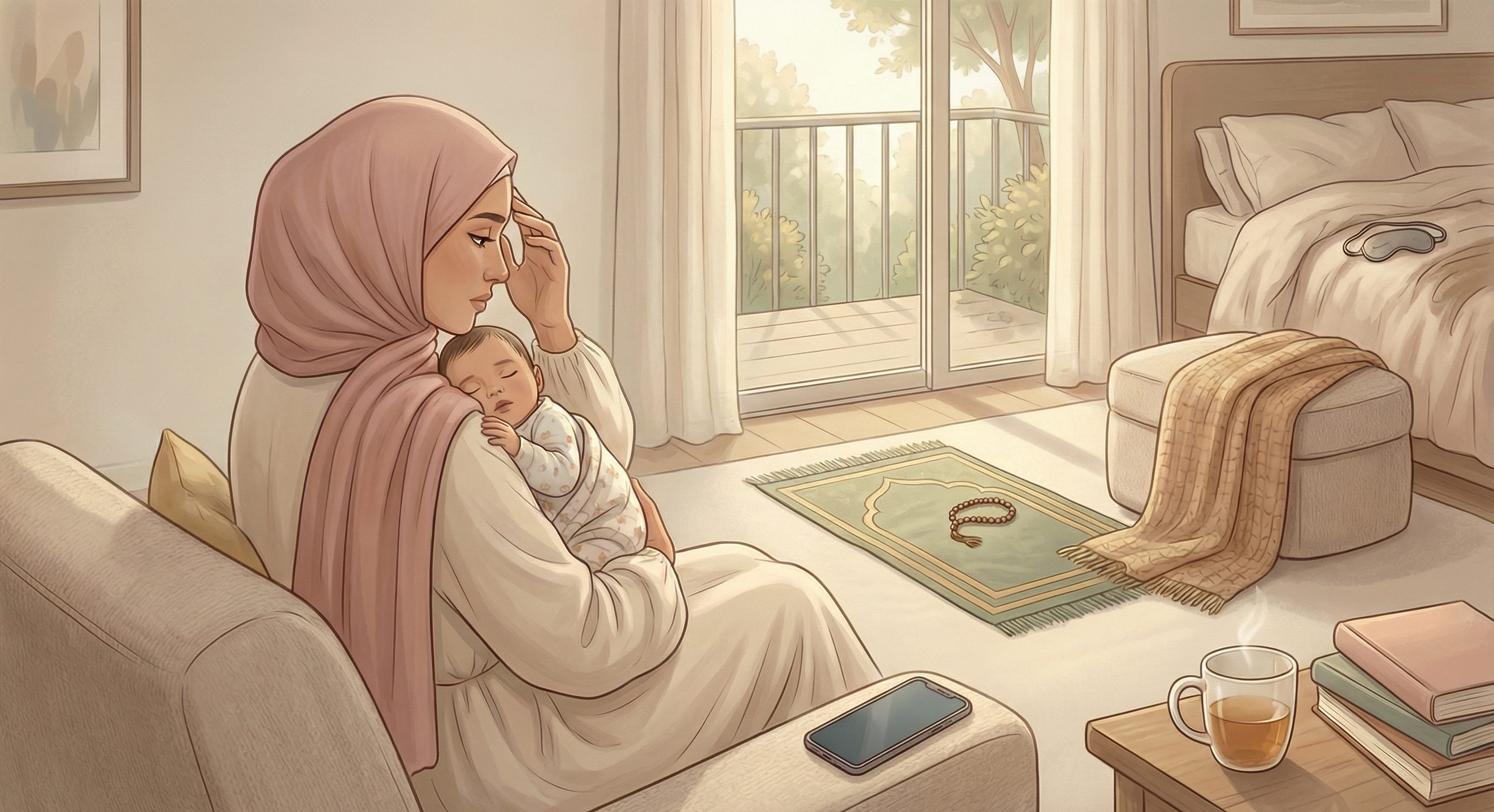
The phone rings while you are bouncing the baby with one leg.
You see the name and your first feeling is not happiness.
It is a tightness.
Your stomach drops like you are about to be asked to do something you do not have the strength for. Your scalp prickles. Your jaw sets.
This is someone you love. Someone who used to feel easy.
You answer anyway, because you miss people. Because you are not rude. Because part of you still wants normal.
“Assalaamu Alaikum waRahmatullah,” she says, bright.
You respond with the correct warmth. Your voice behaves. You even smile.
But inside, you are counting seconds like you are holding your breath.
She asks about the baby, about sleep, about you. She laughs. She tells you something small from her day. Harmless.
And a wave of irritation rises in you so fast you almost feel shocked by it.
Not at her exactly.
More at the pressure of being present. The effort of tracking words while your body is already doing three other things. The demand of sounding okay. The noise.
You do not snap. You do not show it. You keep your tone soft. You make the right little sounds at the right times.
But your insides are not soft.
When you finally hang up, you sit with a strange aftertaste.
Why did that drain me.
Why was I annoyed at kindness.
What kind of person am I becoming.
The part you do not want to admit out loud
This is the part that makes you feel guilty.
You were not yelled at.
You were not insulted.
You were not treated unfairly.
Someone loved you and your body reacted like it was under pressure.
So your mind starts building a story that hurts you.
I am becoming harsh.
I am ungrateful.
This is my new personality now.
Listen to me, sister.
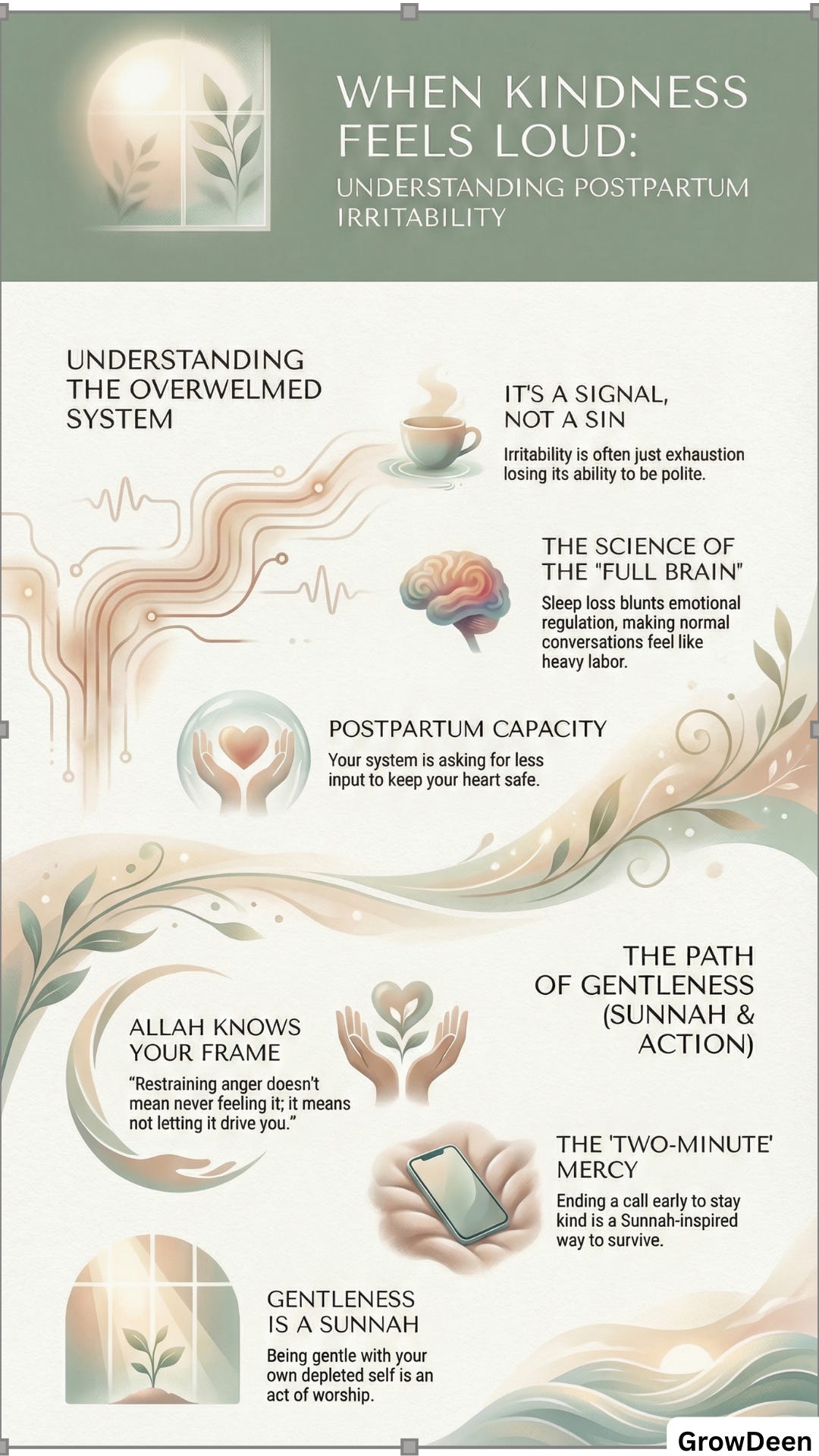
A tired nervous system will turn the volume up on everything. Even love. Even laughter. Even small talk.
Not because love is wrong.
Because you are maxed out.
When your brain is full, even talking becomes work
A normal conversation asks for more than we like to admit.
Track the story. Respond kindly. Ask back. Sound interested. Stay emotionally available.
And postpartum already has you multitasking in your bones.
Feeding math. Sleep math. Safety scanning. Household bits. A baby’s needs that interrupt the middle of a thought.
So the call lands on an already full system.
Sleep loss is associated with worse mood and more negative emotional states, it can blunt positive mood, and it can affect emotion regulation, that small pause that helps you stay steady. [1]
Poor sleep quality is also associated with increased irritability. [2]
So when you feel irritated, it is not automatically a spiritual failure.
It is often a body signal.
Too much input. Not enough recovery.
Postpartum irritability has a name, and that can reduce shame
Some mothers notice anger or irritability postpartum in a way that surprises them. You will even see it described as postpartum rage, meaning increased anger or frustration or losing temper more easily after having a baby. [3]
Sometimes irritability shows up as part of postpartum depression or anxiety for some women, because these conditions do not always look like crying all day. They can look like agitation, snapping internally, feeling overwhelmed, withdrawing, feeling unlike yourself. [4] [5] [6]
I am not diagnosing you.
I am doing something gentler.
I am taking away the loneliness of thinking you are the only one.
And I am giving you permission to treat this as a health and capacity issue, not a moral identity.
If you want support for these quiet postpartum moments that feel hard to explain, you can subscribe for free. You will get gentle guidance and practical scripts that help you protect your heart without cutting yourself off from people.
A small shift that changes the whole story
Try this thought the next time irritation rises.
This is not who I am. This is my system asking for less.
Irritation is often a cover.
It is what exhaustion looks like when it is tired of being polite.
Sometimes it is fear.
Sometimes it is grief.
Sometimes it is your brain begging for quiet.
So instead of arguing with the feeling, treat it like a smoke alarm.
It is telling you something.
Usually, you need less input.
That is not selfishness.
That is how you stay kind.
Al Latif makes room for your small capacity
This moment can come with religious fear, because irritation feels ugly.
But Allah knows the frame you are working with.
Allah praises those who restrain anger and pardon people. (Qur’an 3:134) [8]
Restrain anger does not mean never feel it.
It means when it arrives, you do not let it drive you.
Allah also tells His servants to say what is best. (Qur’an 17:53) [9]
Sometimes “best” is not a long, lovely reply.
Sometimes “best” is ending the conversation early before your tongue becomes sharp.
The Prophet ﷺ said, “Do not get angry.” [10]
And he ﷺ said the strong one is the one who controls himself while in anger. [11]
Postpartum strength can look plain.
You did not lash out.
You did not embarrass someone with your fatigue.
You protected your tongue.
That counts.
And the Prophet ﷺ said, “Allah is Gentle and loves gentleness in all matters.” [12]
So gentleness toward yourself, especially when you are depleted, is not indulgence.
It is a sunnah shaped way to survive.
One boundary that keeps love intact
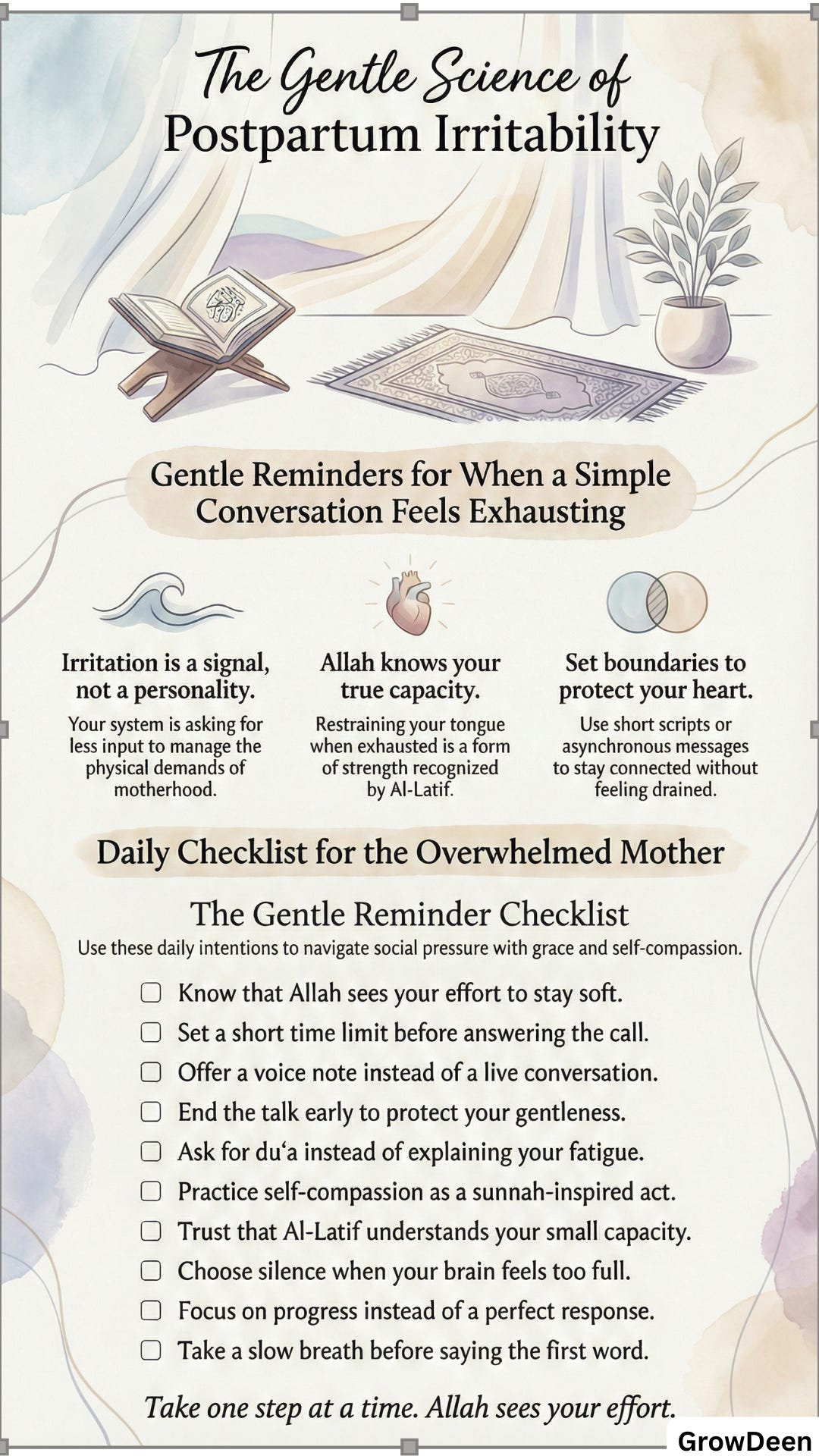
Pick one boundary that lets you stay connected without drowning.
Before the next call, decide your limit in advance. Quietly. No drama.
Then borrow one short line. Just one.
I am low on energy but I wanted to answer. I can only talk for two minutes.
I cannot talk today, but your message helped. Please keep me in your du‘a.
Can we do voice notes instead of calls for a while. I can reply when I am able.
That last one is a mercy.
Asynchronous connection is still connection.
If the irritability feels bigger than tiredness, if you are scared of your reactions, or you feel persistently overwhelmed, bring it to a clinician. ACOG’s guideline emphasizes screening and diagnosis for perinatal mental health conditions during pregnancy and postpartum, including depression and anxiety. [6]
If you ever have thoughts of harming yourself or you feel unsafe, seek urgent help immediately through local emergency services or crisis resources. [4] [5]
For tonight, I want to leave you with one dignified truth.
Feeling irritated does not mean you are becoming a bad person.
It means your life is asking more than your body can comfortably give.
And you are still trying to answer with gentleness.
That effort is seen.
Allah, help this mother hold her tongue when her body is overwhelmed. Bring gentleness back to her, forgive what slips from her in tiredness, and send her people who understand her small capacity right now. Ameen.
Reflection and Action Gifts
If you’ve reached this part of the page, it tells me something meaningful about you.
You weren’t just skimming words or passing time. You stayed because something here mattered to you.
Because you’re hoping, quietly, that life can feel a little lighter, a little clearer, a little more grounded than it does right now.
That’s why we prepared these Reflection and Action Gifts for you. Not as content. Not as decoration.
But as tools we intentionally created with care, time, and dua, so what you just read doesn’t stay on the page, but gently finds its way into your daily life. These resources were made slowly and thoughtfully, with parents like you in mind.
You’re welcome to save them, print them, revisit them, or place them somewhere you’ll see often.
You can use them quietly on your own, or share them with your family if that feels right.
Our only hope is that they bring you comfort, clarity, and small moments of steadiness in the middle of real life.
May Allah place barakah in your effort, accept your intention, and make what you’re trying to do easier than it feels right now.
📥Download your Reflection and Action Gifts
This gift pack includes👇:
Gentle Understanding Card
Gentle Reminders Card
Everyday Reflections Card
Dua Card
If these resources support you even in a small way, I’d love to continue walking alongside you.
When you subscribe, you’ll receive future reflections and practical resources like these, completely free, delivered gently to your inbox as they’re created.
And if you know another parent or mother who might need this right now, please feel free to share or restack this so the benefit can reach them too.
You’re not meant to carry this alone.
Subscribe for free if you want more calm, practical support for postpartum moments like this, and gentle scripts that protect your relationships without draining you.
What kind of conversation drains you the most right now.
References
[1] Tomaso, C.C., Johnson, A.B., & Nelson, T.D. (2021). The effect of sleep deprivation and restriction on mood, emotion, and emotion regulation: Three meta-analyses. Sleep Medicine Reviews (PMC full text). https://pmc.ncbi.nlm.nih.gov/articles/PMC8193556/
[2] Whiting, C., et al. (2023). Associations between sleep quality and irritability. Journal of Sleep Research (PMC full text). https://pmc.ncbi.nlm.nih.gov/articles/PMC10978035/
[3] Cleveland Clinic. Postpartum Rage: Symptoms, Diagnosis & Treatment. https://my.clevelandclinic.org/health/diseases/24768-postpartum-rage
[4] National Institute of Mental Health (NIMH). Perinatal Depression. https://www.nimh.nih.gov/health/publications/perinatal-depression
[5] Mayo Clinic. Postpartum depression: Symptoms and causes. https://www.mayoclinic.org/diseases-conditions/postpartum-depression/symptoms-causes/syc-20376617
[6] American College of Obstetricians and Gynecologists (ACOG). Screening and Diagnosis of Mental Health Conditions During Pregnancy and Postpartum (Clinical Practice Guideline, 2023). https://www.acog.org/clinical/clinical-guidance/clinical-practice-guideline/articles/2023/06/screening-and-diagnosis-of-mental-health-conditions-during-pregnancy-and-postpartum
[7] ACOG (PubMed record). ACOG Clinical Practice Guideline No. 4: Screening and Diagnosis of Mental Health Conditions During Pregnancy and Postpartum (2023). https://pubmed.ncbi.nlm.nih.gov/37486660/
[8] Qur’an 3:134 — restraining anger. https://quran.com/3/134
[9] Qur’an 17:53 — “say that which is best.” https://quran.com/17/53
[10] Sahih al-Bukhari. “Do not get angry.” https://sunnah.com/bukhari:6116
[11] Sahih al-Bukhari. “The strong one is the one who controls himself while in anger.” https://sunnah.com/bukhari:6114
[12] Sahih Muslim. “Allah is Gentle and loves gentleness in all matters.” https://sunnah.com/muslim:2593