
Parents, Never Put This on a Child’s Burn
What Parents Need to Know in the First Moments After a Burn

Free gift for you! A practical companion resource is waiting for you near the end of this article to help you remember, apply, and benefit from what you read. Don’t forget to download!
Fast, calm first aid for burns and scalds begins with cooling the burn under cool running water for 20 minutes, knowing when urgent medical help is needed, and avoiding the common mistakes that make burns worse.
A burn can change the whole mood of a day in less than a second.
A cup of tea tips.
A bath is hotter than expected.
Steam rises from cooking.
A child reaches for something bright and warm before an adult can stop them.
And then suddenly everything narrows. The crying. The fear. The scramble. The adult heart trying not to panic while also needing to move quickly.
That is why this topic has to stay plain.
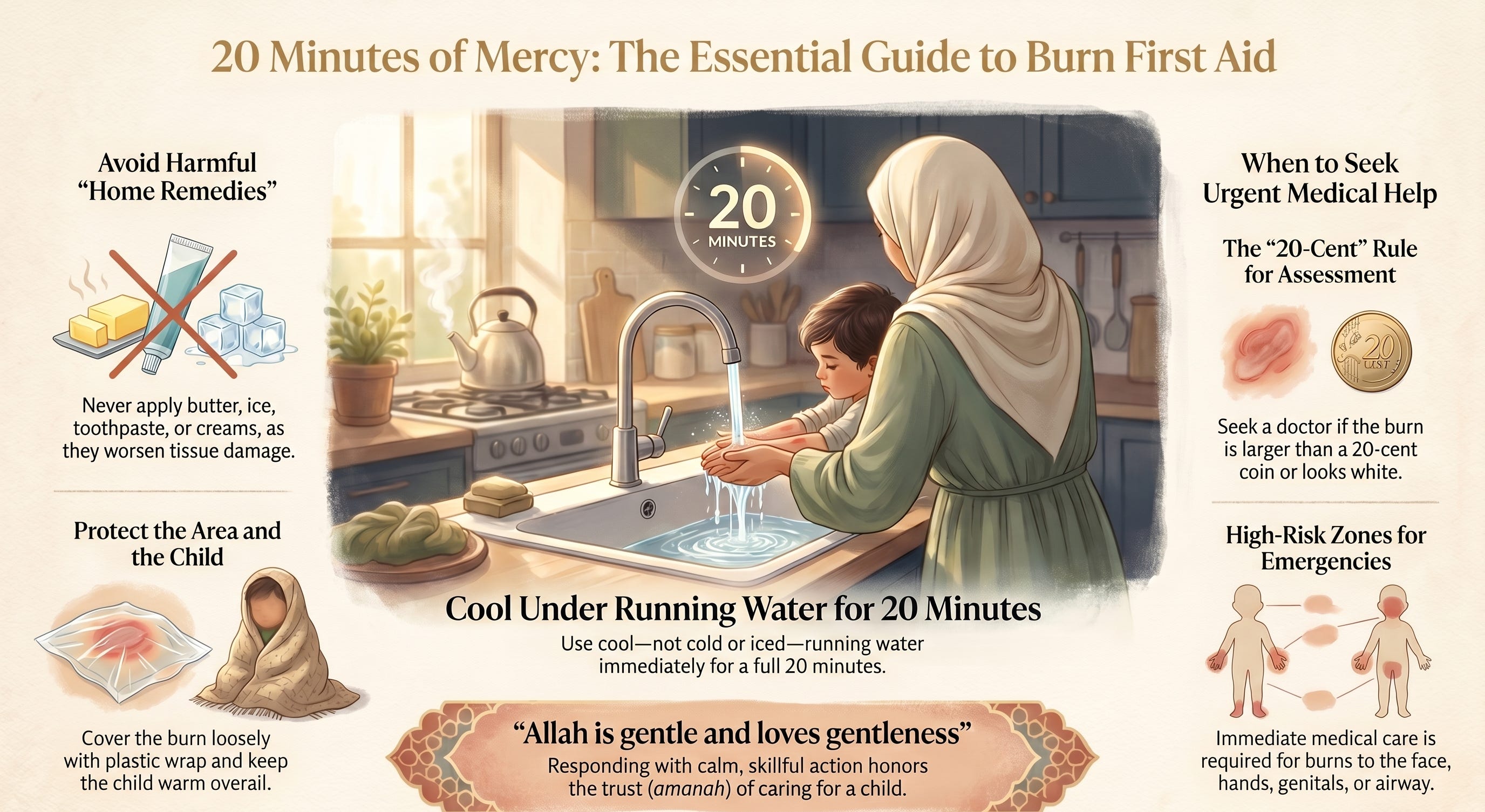
When a child is burned, the best immediate first aid for a thermal burn is cool running water for 20 minutes. [1][3][8][9]
The first step feels simple because it is supposed to
There is mercy in how clear this guidance is.
Cool running water.
Twenty minutes.
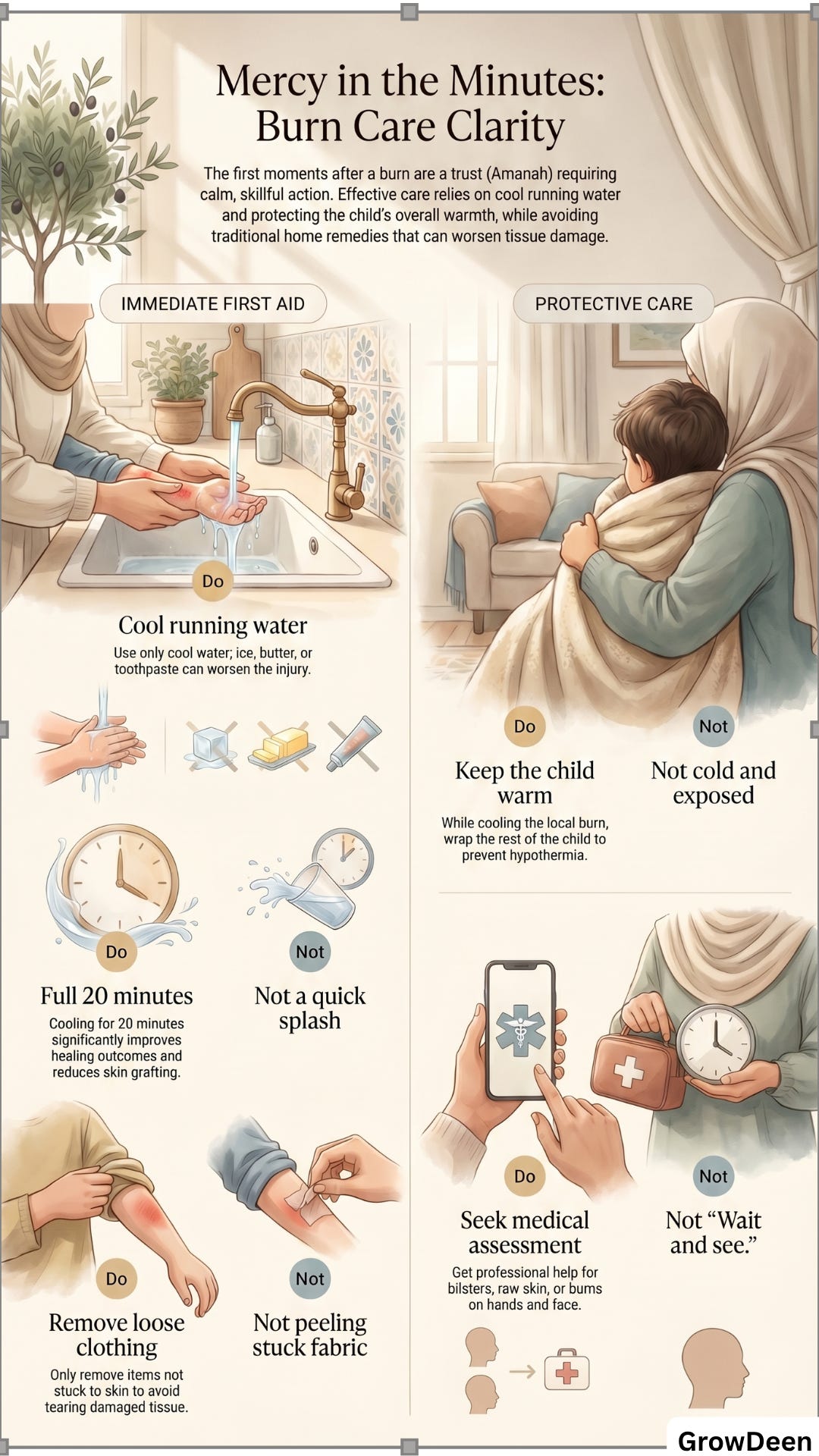
That first step matters more than many people realize. Cooling the burned area as soon as possible for a total of 20 minutes can make a real difference, and cooling may still be useful in shorter intervals for up to three hours after the injury. [1][3][9] Stronger evidence supports this too. A systematic review and meta-analysis found that 20 minutes of cool running water first aid within three hours of a thermal burn was associated with better outcomes, including less need for skin grafting and improved healing. [3]
In those first moments, clarity matters more than cleverness.
Not “What do people usually put on burns?”
Not “What did someone once tell me?”
Not “What home remedy might help?”
Just cool running water. That is where you begin.
Cool is healing here. Cold is not
This part matters because many people still confuse “cool the burn” with “make it as cold as possible.”
But the word is cool.
Not iced.
Not freezing.
Not a bag of ice pressed onto damaged skin.
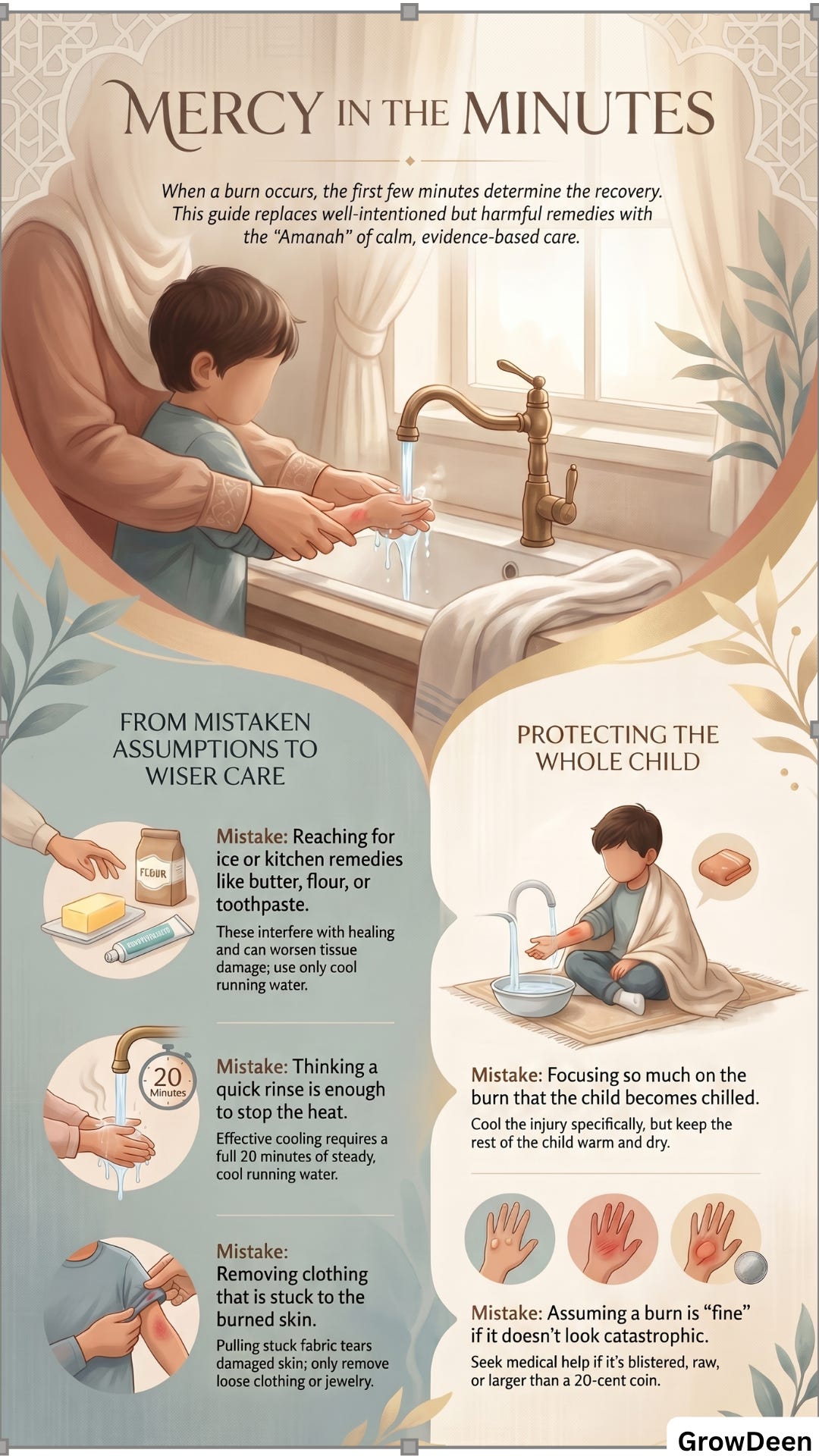
Ice and iced water can worsen tissue damage and add cold injury to skin that is already injured. [1][8] And the same goes for butter, oil, flour, creams, ointments, powders, toothpaste, or lotions. They do not help the burn heal. They interfere with proper assessment and can make the injury worse. [1][8]
This is one of the hardest things for families when panic is high. People want to do something. Anything. Something visible. Something immediate. Something that feels like treatment.
But the best first aid is not dramatic.
It is just correct.
And being correct in those first minutes can preserve far more than people realize.
Before you cool, stop the burn from continuing
There is a small but important sequence here.
First, move the child away from the source of injury if possible. [1] Stop the burning process first, then cool the injury. Clothing or jewellery near the burn should be removed only if it is not stuck to the skin. [1] Clothing that has stuck should not be pulled off, because that can tear damaged skin and make the injury worse.
That is one of those moments where gentleness matters a great deal.
Not rushed pulling.
Not panicked stripping away of fabric.
Just careful action.
And once cooling is underway or finished, the burn should be covered loosely with a light, non-stick covering such as plastic wrap or a clean plastic bag, especially while seeking medical care. [1] Common pediatric burn guidance supports that too. After cooling, a clean non-fluffy, non-adherent covering helps protect the area and reduce contamination while the child is assessed. [1][8]
There is something almost tender about the sequence when it is done properly.
Stop the harm.
Cool the injury.
Cover it lightly.
Protect the child.
The child needs cooling, but the child also needs warmth
This balance is easy to miss.
Burn first aid is not only “cool the burn.”
It is also “keep the child warm.”
Children lose heat quickly. That is why it is wise to keep the child warm overall, even while the burn itself is being cooled. Large or prolonged cooling in a small child can contribute to hypothermia, which is why the guidance warns not to cool a large burn for more than 20 minutes. [1][8]
So yes, cool the injury.
But do not forget the rest of the child.
The injury is local.
The child is whole.
That sounds obvious when written down. In an emergency, it is the sort of thing people forget.
Some burns should never be “wait and see”
There are burns that need urgent medical help straight away.
Call an ambulance if the burn is severe, involves the face, hands, genitals, or airway, or covers a large part of the body. [1] Airway-burn warning signs also matter enormously: coughing, wheezing, breathing difficulty, voice change, or soot around the mouth or nostrils. [1] These are high-risk features and they should never be shrugged off.
WHO and Mayo-type emergency guidance classify major burns and inhalation-related burns as emergencies needing immediate medical care. [1]
There is also a helpful middle category for parents who are trying to decide whether a burn has moved beyond simple home care.
If the burn is at least the size of a 20-cent piece, looks deep or white, is blistered or raw, or causes severe pain or pain not relieved by simple medicine, it should be seen by a doctor or hospital even if an ambulance is not called. [1][4]
That kind of threshold matters because many burns begin looking deceptively manageable.
And uncertainty itself is a reason to get help.
A child’s burn does not need to be catastrophic before it deserves proper medical assessment.
Most childhood scalds happen in ordinary homes, not dramatic disasters
Scalds deserve special emphasis because they are among the most common burns in children.
Registry data from Australia and New Zealand found that scalds make up a major share of pediatric burn injuries, especially in younger children, and prevention research shows that many of these happen in the home from hot drinks, hot water, and cooking situations. [5][10] Another prevention review found that home-based changes, including safer hot-water practices, safer handling of hot liquids, and better household awareness, can reduce the risk of childhood scalds. [7][10]
That means first aid matters.
But prevention matters too.
Do not carry hot drinks while holding a child.
Turn pot handles inward.
Do not leave bowls of soup, noodles, or tea near table edges.
Control tap water temperature where possible.
These are not glamorous safety habits. But pediatric burns happen most often in domestic settings, not cinematic emergencies. [1][5][6][7][10]
And honestly, that may be part of why the topic matters so much. The most painful injuries often grow out of moments that looked completely normal five seconds earlier.
If this kind of careful, grounded writing helps you feel steadier in the real work of caring for children, subscribe for free so the next article and companion resources arrive quietly in your inbox.
Allah’s mercy is in calm, skillful response
From an Islamic perspective, responding well in those first minutes is part of amanah.
A child’s body is a trust. Allah says, “Indeed, Allah commands you to render trusts to whom they are due.” [11]
A burn is painful and frightening, and the adult beside the child becomes the difference between chaos and useful action. Allah also says, “And do not kill yourselves. Indeed, Allah is ever Merciful to you.” [12]
The scholars explain that this includes avoiding preventable harm and not dealing carelessly with danger. That means first aid is not outside spiritual responsibility. Knowing how to respond is part of it.
The Prophet ﷺ said, “Each of you is a shepherd, and each of you is responsible for his flock.” [13]
That responsibility includes knowing what to do in the first moments after a child is burned. Not guessing. Not panicking. Not reaching for kitchen remedies because someone once said they help. It means learning the right steps before the emergency comes.
And there is mercy in the method. The Prophet ﷺ said, “Allah is gentle and loves gentleness in all matters.” [14]
Gentleness here does not mean hesitation. It means calm, careful action. Moving the child away from danger. Cooling the injury properly. Speaking reassuringly. Seeking help promptly when the injury is serious.
And the Prophet ﷺ also said, “There should be neither harming nor reciprocating harm.” [15]
That principle fits burns first aid directly. Do not add harm by using ice. Do not add harm by peeling stuck clothing. Do not add harm by delaying help for a major burn.
And intention gives all of this its weight. “Actions are only by intentions.” [16]
A parent who learns first aid, refreshes emergency skills, prepares for accidents, and responds to a child’s injury with skill and care is not only being practical. They are honoring a trust for Allah’s sake.
In the end, the first minutes are not the time for creativity
They are the time for steadiness.
Cool the area under cool running water for 20 minutes.
Remove loose clothing and jewellery nearby if it can be done safely.
Cover the burn lightly.
Keep the child warm.
Get urgent medical help for severe burns, burns to the face, airway, hands or genitals, burns covering a large area, or burns you are unsure about.
And do not use remedies that feel traditional but make the injury worse. [1][2][3][4][8][9]
Those first minutes matter.
A great deal can be preserved in them.
GIFTS FOR YOU, DEAR READER
If you’ve reached this part of the page, that tells me something meaningful about you.
You stayed with this.
You did not just skim it and move on.
And usually that means something here felt close to real life. Maybe it named a fear you have carried quietly. Maybe it gave shape to a situation you hope never happens, but know you should still be ready for. Maybe it simply reminded you how much of caregiving is made up of knowledge that feels small until the day it matters urgently.
That effort matters.
Your willingness to read carefully, reflect honestly, and prepare before a crisis arrives is not small. It says something beautiful about the kind of care you are trying to offer.
I did not want this article to remain only words on a page.
I wanted it to stay with you a little longer than that.
To move with you into the kitchen.
Into bath time.
Into those ordinary household moments where a burn can happen quickly and where calm, remembered knowledge can change what happens next.
So we prepared a small companion pack for you.
Not as decoration.
Not as pressure.
But as a few thoughtful resources designed to help this stay close to daily life. Something you can save, revisit, print, reflect on, or keep nearby when you want the heart of this guidance in a form that is easier to carry into the day.
The hope is simple.
Not just that you read.
But that what you read becomes easier to remember, easier to apply, and easier to return to when you need it.
These companion resources were made slowly, thoughtfully, with care and sincere du’a. They were prepared because some kinds of guidance are too important to leave as a passing impression. They deserve something steadier. Something that helps bridge the gap between knowing and doing.
So please do download the companion pack.
And if it supports you, subscribe for free so future articles and companion resources arrive directly in your inbox. That way, the next time something is published for a real moment of care, urgency, and trust, it reaches you without extra effort from you.
And if someone comes to mind while you are reading, a parent, grandparent, teacher, caregiver, or anyone responsible for children around hot liquids, baths, and kitchens, share it with them too.
May Allah place barakah in your effort, accept your intention, and make the care you give more skillful, more merciful, and more rewarded than it feels in the moment.
What is one burn or scald situation you think families underestimate most in everyday life?
Subscribe for free if you’d like future articles and companion resources that help Islamic wisdom and practical care stay close to real life.
References
[1] Burgess, J., Watt, K.A., Kimble, R.M., & Cameron, C. (2018). Knowledge of childhood burn risks and burn first aid: Cool runnings
[2] Davies, M., Maguire, S., Okolie, C., Watkins, W., & Kemp, A.M. (2013). How much do parents know about first aid for burns?
[3] Griffin, B., Cabilan, C.J., Ayoub, B., Xu, H.G., Palmieri, T., Kimble, R., & Singer, Y. (2022). The effect of 20 minutes of cool running water first aid within three hours of thermal burn injury on patient outcomes: A systematic review and meta-analysis
[4] Kassira, W., & Namias, N. (2008). Outpatient management of pediatric burns
[5] Riedlinger, D.I., Jennings, P.A., Edgar, D.W., Harvey, J.G., Cleland, M.H.J., Wood, F.M., & Cameron, P.A. (2015). Scald burns in children aged 14 and younger in Australia and New Zealand – An analysis based on the Burn Registry of Australia and New Zealand (BRANZ)
[6] Thompson, R., Budziszewski, R., Nanassy, A.D., Meyer, L.K., Glat, P., & Burkey, B. (2021). Evaluating an urban pediatric hospital’s scald burn prevention program
[7] Turner, C., Spinks, A., McClure, R., & Nixon, J. (2004). Community-based interventions for the prevention of burns and scalds in children
[8] Varley, A., Sarginson, J., & Young, A. (2016). Evidence-based first aid advice for paediatric burns in the United Kingdom
[9] Wood, F.M., Phillips, M., Jovic, T., Cassidy, J.T., Cameron, P., Edgar, D.W., & Steering Committee of the Burn Registry of Australia and New Zealand (BRANZ). (2016). Water first aid is beneficial in humans post-burn: Evidence from a bi-national cohort study
[10] Zou, K., Wynn, P.M., Miller, P., Hindmarch, P., Majsak-Newman, G., Young, B., Hayes, M., & Kendrick, D. (2015). Preventing childhood scalds within the home: Overview of systematic reviews and a systematic review of primary studies
[11] Qur’an, Surah An-Nisa 4:58
[12] Qur’an, Surah An-Nisa 4:29
[13] Sahih al-Bukhari 7138
[14] Sahih Muslim 2593
[15] Sunan Ibn Majah 2340
[16] Sahih al-Bukhari 1, Sahih Muslim 1907