
Newborn Nappies Can Answer More Questions Than You Think
What Your Baby’s Nappy Is Quietly Telling You

Observing your baby’s pee and poo in the first year can quietly tell you a lot about hydration, digestion, feeding, and when it may be time to seek medical advice.
You open the nappy and pause.
Maybe the colour looks different today. Maybe there is less than yesterday. Maybe there is more. Maybe you are staring at mustard yellow poo like it is a medical mystery.
And in a way, for a new parent, it is.
Baby pee and poo can feel oddly emotional. One nappy reassures you. The next one makes you wonder if something is wrong.
That does not make you anxious in a bad way.
It makes you attentive.
And in the first year, that attentiveness matters more than people realise.
The nappy tells little stories every day
A baby’s nappies can tell small stories about health.
Hydration. Digestion. Feeding. Sometimes even illness.
That does not mean every change is a problem. Doctors often remind parents that there is a wide range of normal in infancy. [1] [3]
Still, patterns matter.
Noticing what is usual for your baby makes it easier to recognise when something shifts enough to deserve attention.
This kind of watching is part of loving care.
Nothing dramatic.
Just daily noticing.
Allah’s care can show up in small observations
Islam does not separate careful attention to the body from a life of worship.
The Prophet ﷺ said that the body has rights over us. [6]
That hadith lands differently once you become a parent.
Because suddenly, someone else’s little body has rights in your hands too.
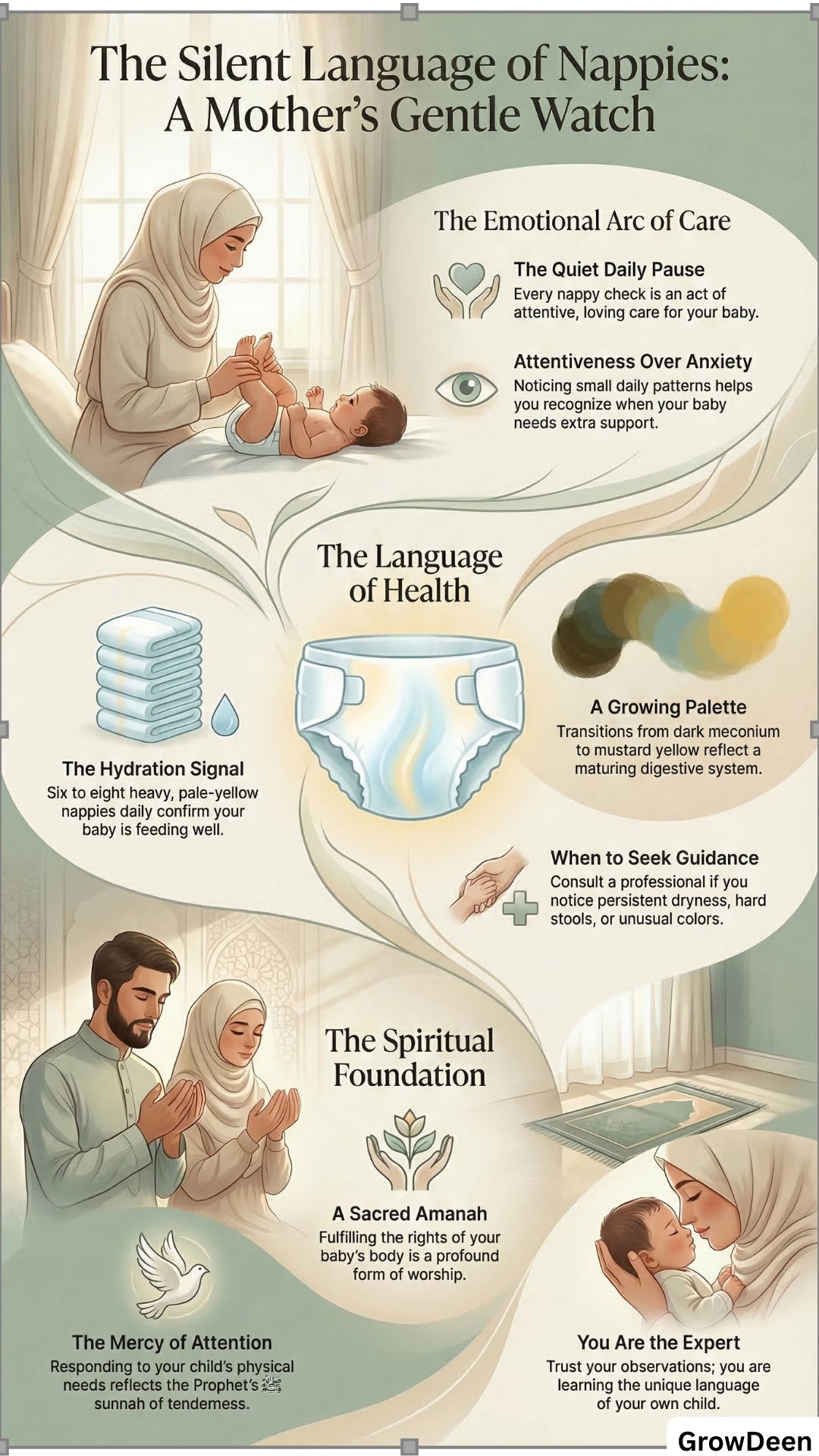
A nappy check may feel ordinary. But when you are paying attention to your baby’s hydration, digestion, comfort, and wellbeing, that is part of fulfilling amanah.
And when something seems off, responding early is not overreacting.
It is care.
What baby pee usually looks like when things are going well
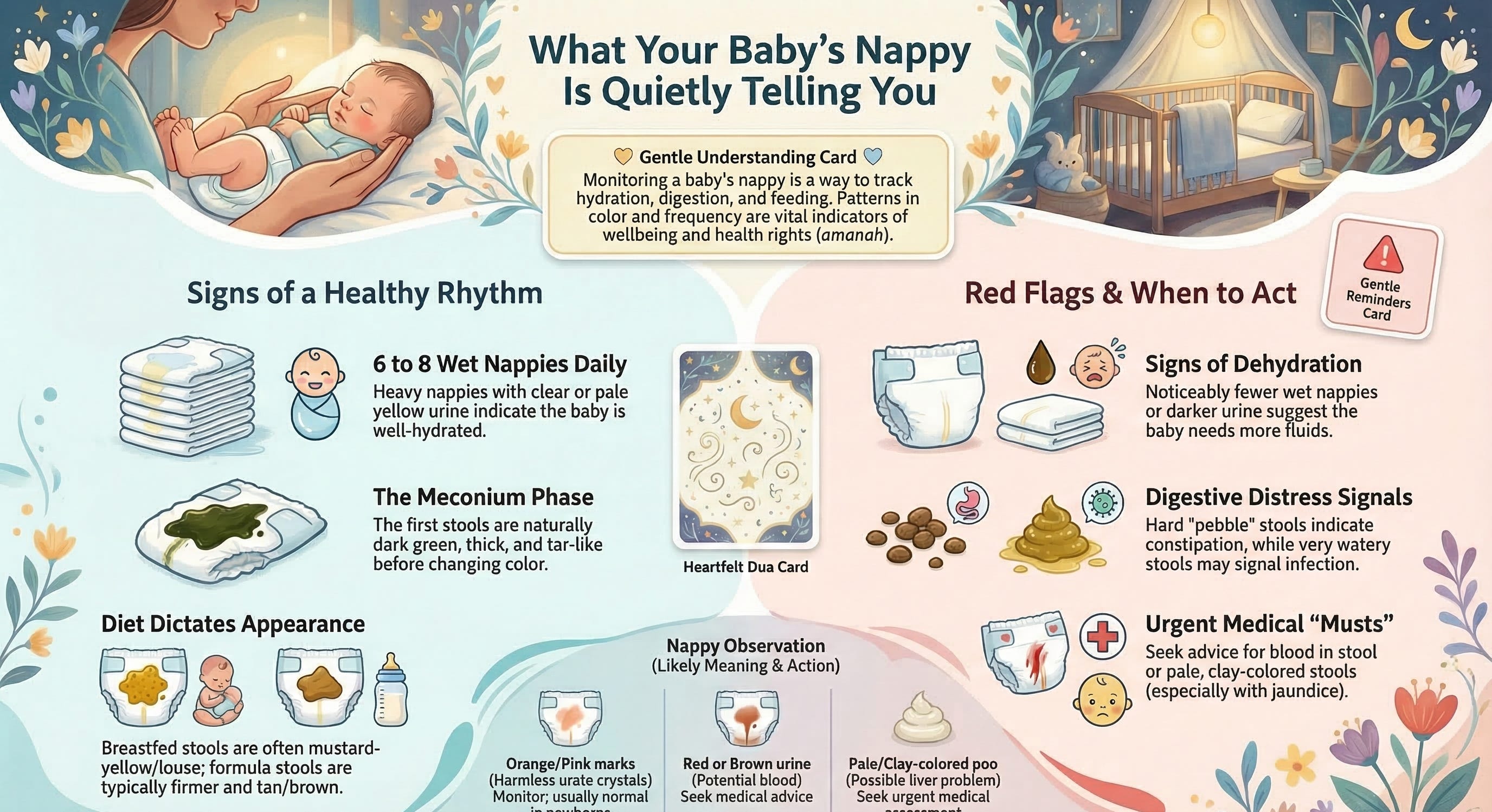
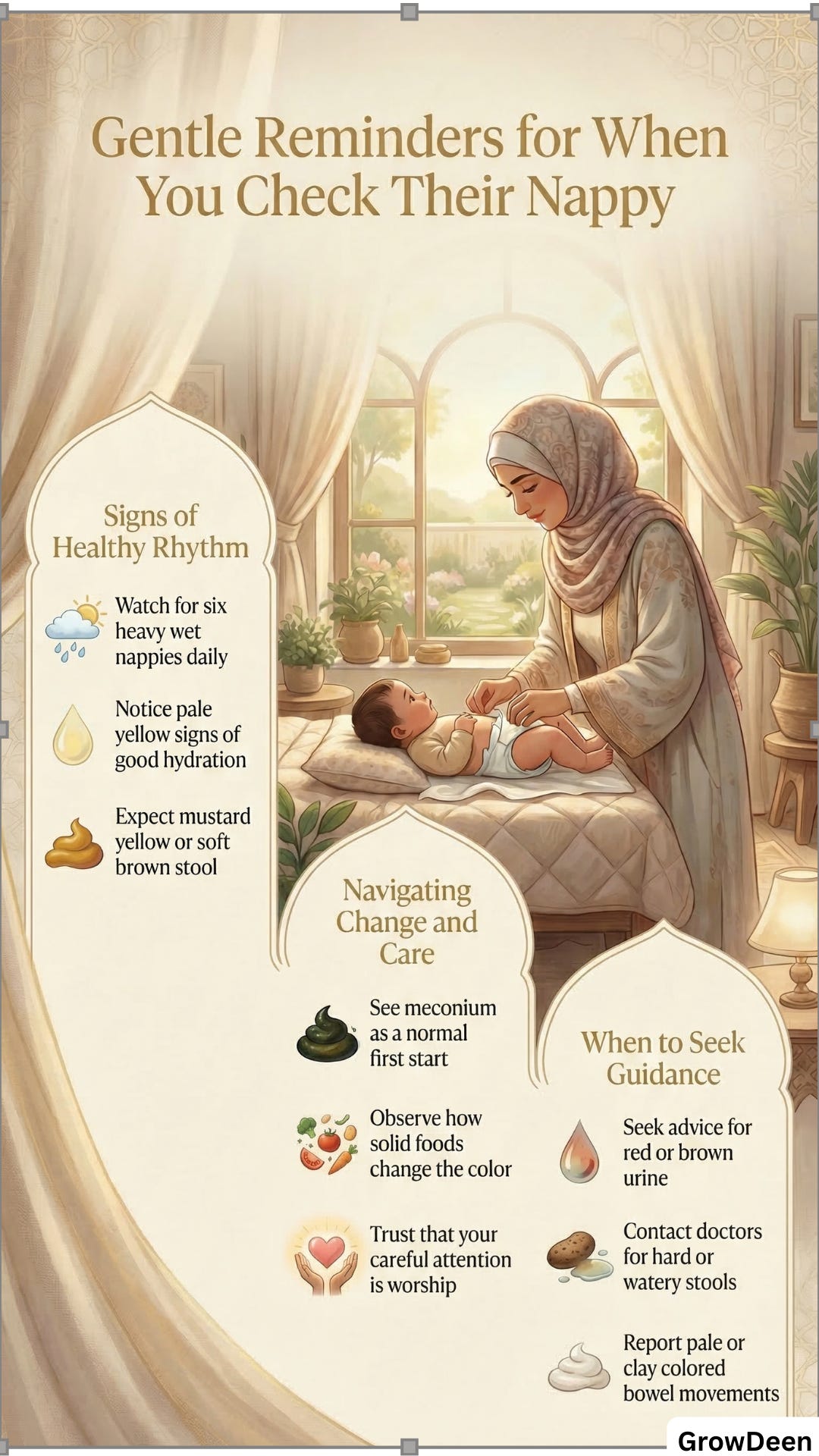
Young babies usually wet nappies many times a day. In the early months, six to eight wet nappies a day or more is common when feeding is going well. [1] [4]
A heavy nappy with clear or pale yellow urine is usually reassuring. It often suggests the baby is getting enough milk or fluids. [4]
That is why wet nappies matter so much in the early months.
They are one of the simplest clues that feeding may be going well.
Sometimes parents notice orange or pinkish marks in a disposable nappy and feel instantly alarmed. In many newborns, these can be harmless urate crystals or a reaction between urine and the nappy material. [1]
Even so, if urine looks truly red or brown, or if you think you may be seeing blood, that needs medical advice. [2] [4]
A helpful internal line here is this:
Not every strange nappy is danger. But some nappies deserve a closer look.
When fewer wet nappies deserve more attention
Darker urine or fewer wet nappies can suggest that a baby is not getting enough fluids or may be mildly dehydrated. [1] [4]
That does not automatically mean something serious is happening. Sometimes feeding has just been a little off. Sometimes a baby is unwell. Sometimes you simply need guidance.
But babies can change quickly.
So if wet nappies drop noticeably, or your baby seems unwell alongside that, it is worth monitoring feeding closely and speaking with a healthcare professional if concerns continue. [1] [4]
The Qur’an says, “Do not throw yourselves into destruction with your own hands.” [7]
This is one of those places where that wisdom becomes practical.
Pay attention. Do not panic. Act when needed.
The first poo always looks surprising
A baby’s very first stool is called meconium.
It is usually very dark green or almost black, thick, sticky, and tar like. It can look strange if you have never seen it before, but it is a normal part of newborn life. It is simply the material that collected in the baby’s intestines during pregnancy being passed after birth. [1]
For the first few days, stools may stay dark green before changing as feeding becomes established and digestion adjusts. [1] [3]
Then things start to vary a lot.
And that variation is where many parents begin second guessing themselves.
Some babies poo several times a day.
Some only a few times a week.
Many babies poo during or right after a feed because feeding stimulates the bowel. [3]
A lot of this is normal.
Food changes the nappy more than parents expect
Breastfed babies often have stools that are soft, loose, and yellow or mustard like. Sometimes they look green. Sometimes you see little curds that look like undigested milk fat. The smell may be mild and can vary. [1] [3]
Formula fed babies often have firmer stools, with colours that range more toward grey yellow or brown. [3]
Then solids arrive and everything changes again.
The poo usually becomes firmer, stronger smelling, and more varied in colour. Parents may also see bits of undigested food like banana fibres, tomato skin, or corn. [3]
It can look messy and confusing.
But it is often just digestion growing up a little.
The Qur’an says, “Then let man look at his food.” [9]
For a baby, food becomes growth, energy, hydration, and yes, sometimes a very informative nappy.
If support like this would help you feel steadier through the baby months, subscribe for free so the next article arrives in your inbox when you need it.
When poo stops looking normal enough to ignore
Two common concerns are constipation and diarrhoea.
Constipation means stools become hard, dry, and difficult to pass. They may look like little pebbles or marbles and can clearly make a baby uncomfortable. This can happen in some formula fed babies, especially if formula is not mixed correctly, and sometimes when solids begin. [5]
Diarrhoea is the opposite pattern. Stools become very loose or watery and happen more often than usual. If that comes with vomiting, infection may be part of the picture. Babies can become dehydrated quickly, so medical advice matters. [2]
Blood in the stool also deserves medical attention. It may appear bright red with mucus, or darker brown to black depending on the cause. [2]
Another important sign is pale or clay coloured stool, especially if a baby also has jaundice. That needs urgent assessment because it can point to a liver problem. [3]
This is where the Prophet’s mercy toward children becomes very real in practice. He was tender with children, and caring for a child’s wellbeing with gentleness and urgency when needed is part of that mercy. [8] [10]
Most days, nappy care is not dramatic.
It is just part of feeding, soothing, and carrying your baby through the day.
But sometimes those quiet observations are exactly what help keep a child safe.
So if you find yourself studying nappies more than you ever imagined, you are not being silly.
You are learning your baby.
GIFTS FOR YOU, DEAR PARENT
If you’ve reached this part of the page, it tells me something meaningful about you.
You weren’t just skimming or passing time. You stayed because something here felt relevant to your real life.
Because you care.
Because you want to do things with more awareness.
Because you’re trying, even when it feels overwhelming.
That is not small.
So I didn’t want this article to remain just words on a page. I wanted it to gently step into your daily life in practical ways. That’s why we prepared these Life Gifts for you.
Not as extras.
Not as decorations.
But as simple tools to help you hold onto what mattered most in what you just read.
Here’s what you’ll find inside:
Gentle Understanding Card
A clear and simplified summary of the core concept from this article, so you can revisit the main idea anytime without rereading everything.
Heartfelt Dua Card
A carefully chosen dua connected to this stage of life, because we know that real strength and ease ultimately come from Allah’s help.
Gentle Actions Card
Practical examples to help you translate knowledge into action, so what you learned becomes part of your daily rhythm.
Gentle Reminders Card
Short, steady reminders drawn from the key points, designed to be printed or saved and placed somewhere you’ll see often.
These were designed slowly and thoughtfully, with time, care, and sincere dua. We created them because we genuinely want to walk alongside you, not just through one article, but through every stage of this lifelong journey.
If these gifts support you even in a small way, I would love for you to continue receiving them.
Subscribe so that each new Gift arrives directly in your inbox whenever we release the next stage. That way, you won’t miss the tools designed to support you right where you are.
May Allah place barakah in your effort, accept your intention, and make this path easier and more rewarding than it feels right now.
Please share it with a family/friend who may benefit from this knowledge.
What is one moment with your child that feels hardest lately, and what kind of support would make it feel lighter?
If you want gentle, benefit focused support for the newborn and baby months, subscribe for free so the next article and the next set of Gifts arrive quietly in your inbox.
References
[1] Darlow, B. (2016). The newborn infant: Stabilisation and examination. In Practical Pediatrics (7th ed.). Elsevier.
[2] Forster, E., & Scaini-Clarke, L. (2022). Recognising and responding to the sick child. In Paediatric Nursing in Australia and New Zealand (3rd ed.). Cambridge University Press.
[3] Hardikar, W., Bannister, L., & Gibb, S. (2020). Gastroenterology. In Paediatric Handbook (10th ed.). John Wiley & Sons.
[4] The Royal Children’s Hospital. (2025). Clinical Practice Guidelines: Urinary Tract Infection.
[5] The Royal Children’s Hospital. (2020). Clinical Practice Guidelines: Constipation.
[6] Hadith: Sahih al-Bukhari 5199.
[7] Qur’an, Surah Al-Baqarah 2:195.
[8] Hadith: Sahih Muslim 2318.
[9] Qur’an, Surah Abasa 80:24.
[10] Hadith: Sahih al-Bukhari 5997 and Sahih Muslim 2318.
Also: Sahih Muslim 2318