
Motherhood Changed Me Faster Than I Expected
I Miss The Old Me And I Do Not Know If That Is Grief Or Growth

Three months postpartum, the question “Who am I becoming?” is often the sign of a real inner transition, and you can meet it with gentleness, intention, and a few steady threads that keep you rooted.
You are folding baby clothes that barely look real.
Socks the size of your thumb. A onesie that could fit inside your purse.
The baby is finally asleep, or finally quiet, and your hands keep moving because sitting still feels too loud.
Your phone is nearby. You scroll without meaning to.
Someone you know posts a promotion. A trip. A new house. A “busy week” that looks clean and adult.
You feel happy for them. You really do.
But there is another feeling, quieter than jealousy.
A distance.
Like you are watching life from a different room.
You remember what you used to care about. How you used to plan. How you used to imagine yourself.
And now your mind does not go there first.
It goes to: Did the baby eat enough. What time is the next nap. Did I read anything today. Is my husband okay. Why do I feel so changed.
Then a thought slips in, almost like a question asked by someone you cannot see.
Who am I becoming.
Not who am I now, like a quiz.
Who am I becoming slowly, long term, inside this new life.
And it scares you a little, because you cannot tell what is growth and what is loss.
You are not losing your mind, your life is rearranging you
This is not just about hobbies or sleep or “finding time for yourself.”
It is about orientation.
Your inner furniture is moving around without asking permission.
Things that used to feel urgent feel far.
Sometimes you miss that urgency.
Sometimes you feel relieved it is gone.
Sometimes you feel both at the same time and it makes your chest feel tight.
Postpartum is a real transition. ACOG describes it as a period of adapting to multiple physical, social, and psychological changes. [1]
So part of what you are feeling is not a flaw.
It is development.
And development can be disorienting.
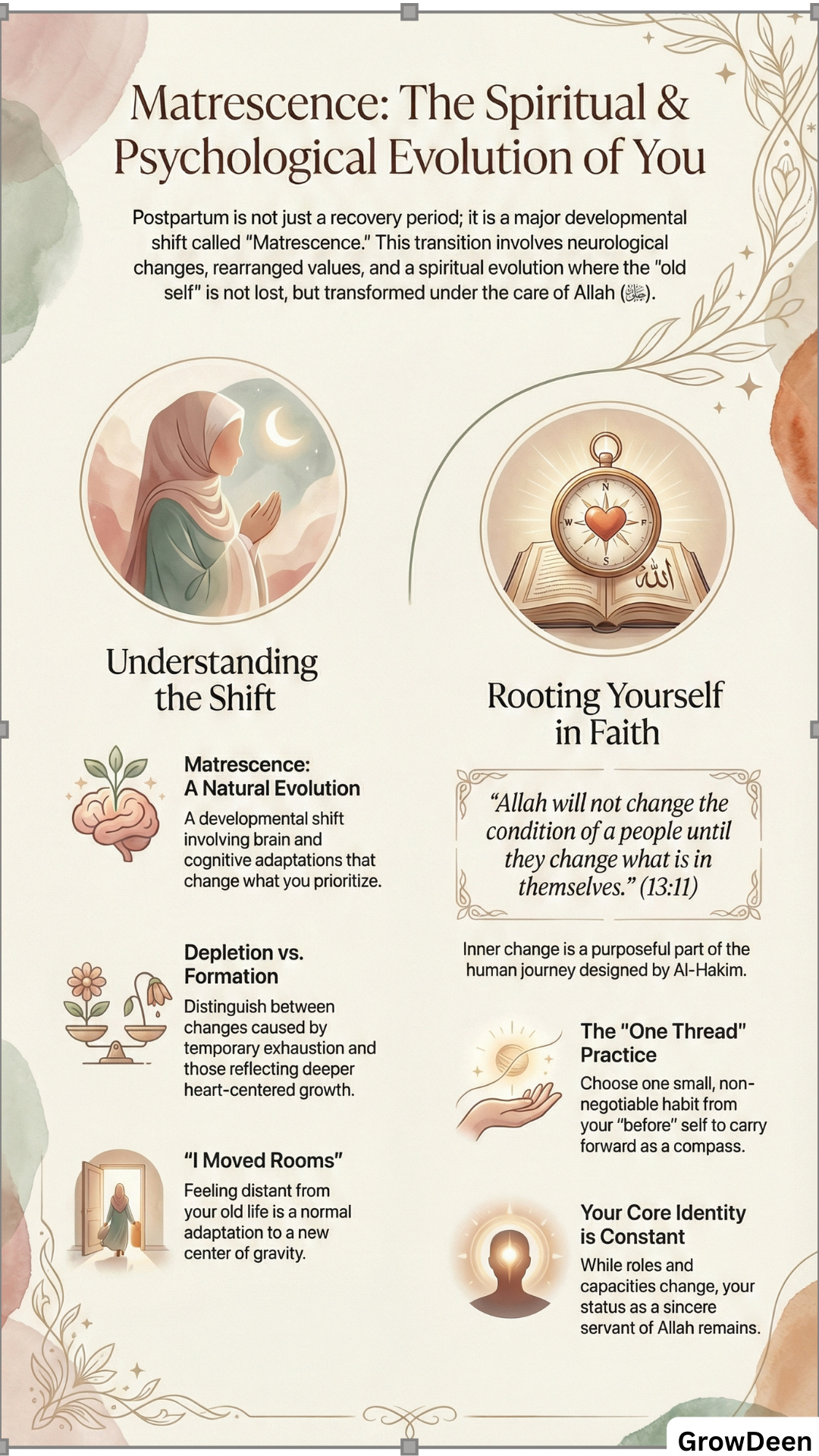
Matrescence is a real thing, even if you never heard the word
There is a word people use now that makes this less lonely.
Matrescence.
A way of describing the psychological, social, cultural, even existential changes of becoming a mother. Not as an illness. As a developmental shift. [2]
Some research also describes the peripartum period as involving long lasting brain and cognitive adaptations, with postpartum bringing a new level of responsibility and cognitive load that changes what you notice and what you prioritize. [3]
So when you look at your old goals and feel like you cannot grab them the same way, it might not be because you stopped being you.
It might be because you are carrying a different weight.
And your mind keeps reorganizing around what matters most right now.
The scary part is not change, it is not knowing what kind of change it is
Here is where the fear gets personal.
You are not only asking, will I still be fun.
You are asking, will I still be me, the servant of Allah I recognize.
Because values shifting can feel spiritual.
You do not want motherhood to harden you.
You do not want isolation to tighten you.
If you are doing this in the West with limited support, that matters. Constant self reliance reshapes people. Isolation reshapes people. It can steal softness, not because you are doomed, but because you are carrying too much alone.
There is research showing that first time mothers build new forms of shared identity and belonging over time, and that social connection matters. [5] Qualitative work also shows how stressful the transition can be, and how support, or lack of it, shapes coping. [6]
So if you feel like you moved rooms, you probably did.
You moved into a room where the baby is the center of gravity.
It is normal to wonder what else gets pulled toward that center.
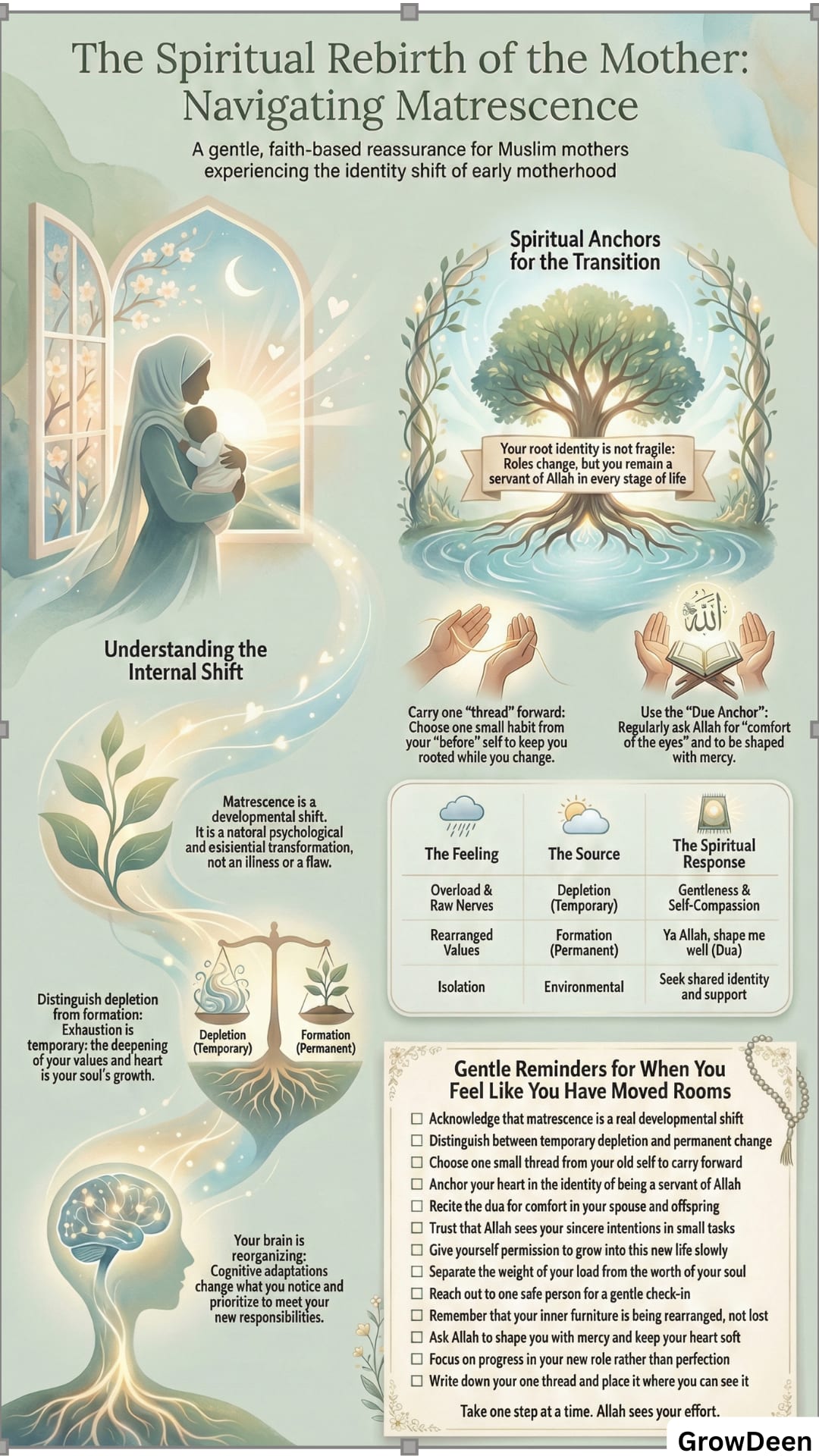
The question gets clearer when you separate depletion from formation
This is the part that can save you from spiraling.
Not every version of you that shows up postpartum is the real permanent version.
Some of what feels like change is depletion.
Broken sleep. Overload. Raw nerves. A body healing. A mind interrupted every few minutes.
That version of you is not your destiny. She is your exhausted version.
Some of what feels like change is formation.
Values getting deeper. Priorities shifting. Your heart learning a new seriousness. Your sense of time changing. Your view of the dunya getting quieter.
And these two get mixed together in real life.
That is why you cannot tell what is growth and what is loss.
A small reframe helps.
Instead of asking, Who am I becoming, like it is a threat, ask it like a dua.
Ya Allah, shape me well.
If you want gentle writing that helps you untangle moments like this without shame, you can subscribe for free. It is for the days you are trying to find your footing while holding a whole new life.
Al Hakim can grow you without breaking you
Islam does not ask you to freeze yourself in one version forever.
Allah says, “Indeed, Allah will not change the condition of a people until they change what is in themselves.” (Qur’an 13:11) [7]
Inner change is part of life on purpose.
And Allah says, “And Allah created you, then He will take you.” (Qur’an 16:70) [8]
Life is stages.
Bodies change.
Capacities change.
Roles change.
This is not new to Allah.
What steadies you is remembering that in every stage, you are still His servant. That root identity is not fragile.
The Prophet ﷺ said, “Actions are only by intentions.” [9]
So even when your days look small, your intention can keep you facing the right direction.
You can be clumsy in your new role and still sincere.
And Allah gives us a dua that fits a mother’s heart.
“Our Lord, grant us from our spouses and our offspring comfort to our eyes, and make us an example for the righteous.” (Qur’an 25:74) [10]
That dua admits something quietly.
Building a family shapes you.
So you ask Allah to shape you with mercy.
One thread you choose not to lose
Here is the formative move.
Instead of treating this identity shift like a private panic, treat it like a real transition that needs gentleness and support.
Then ask a smaller question than “who am I becoming.”
What do I want to carry forward from who I was, on purpose.
Not everything.
Just one thread.
Something small you choose not to lose.
Maybe it is reading a few lines most days, even if it is not a full session.
Maybe it is taking care of salah as best you can, not perfectly, but faithfully.
Maybe it is staying kind in your home, even when the world feels loud.
Maybe it is keeping one friendship alive, the one that does not demand performance.
Choose one thread.
Write it down.
Not as a pressure. As a compass.
And if this identity confusion comes with persistent depression or anxiety symptoms, especially hopelessness, panic, or feeling unsafe, reach out to your healthcare provider and urgent supports. Perinatal mental health conditions are common and treatable, and you deserve help. [4]
Allah, I feel myself changing. Some of it scares me. Some of it feels like growth. Do not let me lose the parts of me that You love. Shape me into a mother with mercy, and a woman with steadiness. And make this new life a path back to You. Ameen.
Reflection and Action Gifts
If you’ve reached this part of the page, it tells me something meaningful about you.
You weren’t just skimming words or passing time. You stayed because something here mattered to you.
Because you’re hoping, quietly, that life can feel a little lighter, a little clearer, a little more grounded than it does right now.
That’s why we prepared these Reflection and Action Gifts for you. Not as decorations.
But as tools we intentionally created with care, time, and dua, so what you just read doesn’t stay on the page, but gently finds its way into your daily life. These resources were made slowly and thoughtfully, with parents like you in mind.
You’re welcome to save them, print them, revisit them, or place them somewhere you’ll see often.
You can use them quietly on your own, or share them with your family if that feels right.
Our only hope is that they bring you comfort, clarity, and small moments of steadiness in the middle of real life.
May Allah place barakah in your effort, accept your intention, and make what you’re trying to do easier than it feels right now.
📥Download your Reflection and Action Gifts
This gift pack includes👇:
Gentle Understanding Card
Gentle Reminders Card
Everyday Reflections Card
Dua Card
If these resources support you even in a small way, I’d love to continue walking alongside you.
At the very end, if you want more writing that meets you in these quiet postpartum identity moments, you can subscribe for free.
References
[1] ACOG — Optimizing Postpartum Care (Committee Opinion, 2018) (postpartum as ongoing adaptation across physical, social, psychological changes).
[2] Athan, A.M. et al. (2024). A critical need for the concept of matrescence in perinatal psychiatry. Frontiers in Psychiatry.
[3] Orchard, E.R. et al. (2023). Matrescence: lifetime impact of motherhood on cognition and the brain. Trends in Cognitive Sciences.
[4] National Institute of Mental Health (NIMH) — Perinatal Depression.
[5] Seppälä, T. et al. (2022). Development of first‐time mothers’ sense of shared identity (longitudinal qualitative study). Journal of Community & Applied Social Psychology.
[6] McLeish, J. & Redshaw, M. (2021). First-time mothers’ experiences of postnatal social support (qualitative study). BMC Pregnancy and Childbirth (PMC).
[7] Qur’an 13:11 https://quran.com/13/11
[8] Qur’an 16:70 https://quran.com/16/70
[9] Sahih al-Bukhari 1 — “Actions are only by intentions…” https://sunnah.com/bukhari:1
[10] Qur’an 25:74 https://quran.com/25/74