
Most Parents Don’t Realize How Fast Ordinary Moments Can Scald a Child
What Parents Need to Notice About Scald Risks at Home

Free gift for you! A practical companion resource is waiting for you near the end of this article to help you remember, apply, and benefit from what you read. Don’t forget to download!
Most childhood scalds happen at home and can often be prevented by safer hot-water habits, careful kitchen routines, and close supervision around hot drinks, baths, and cooking areas.
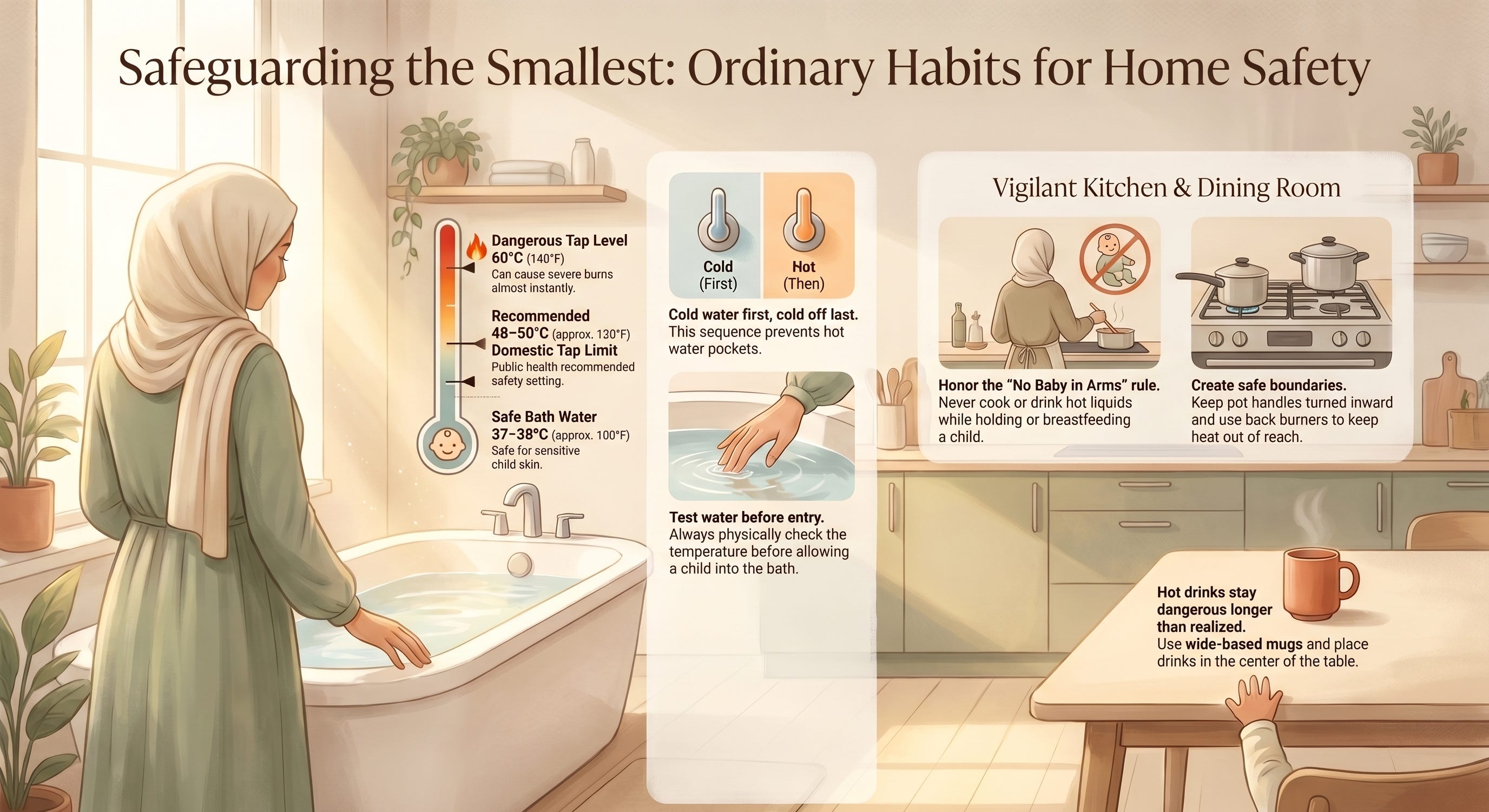
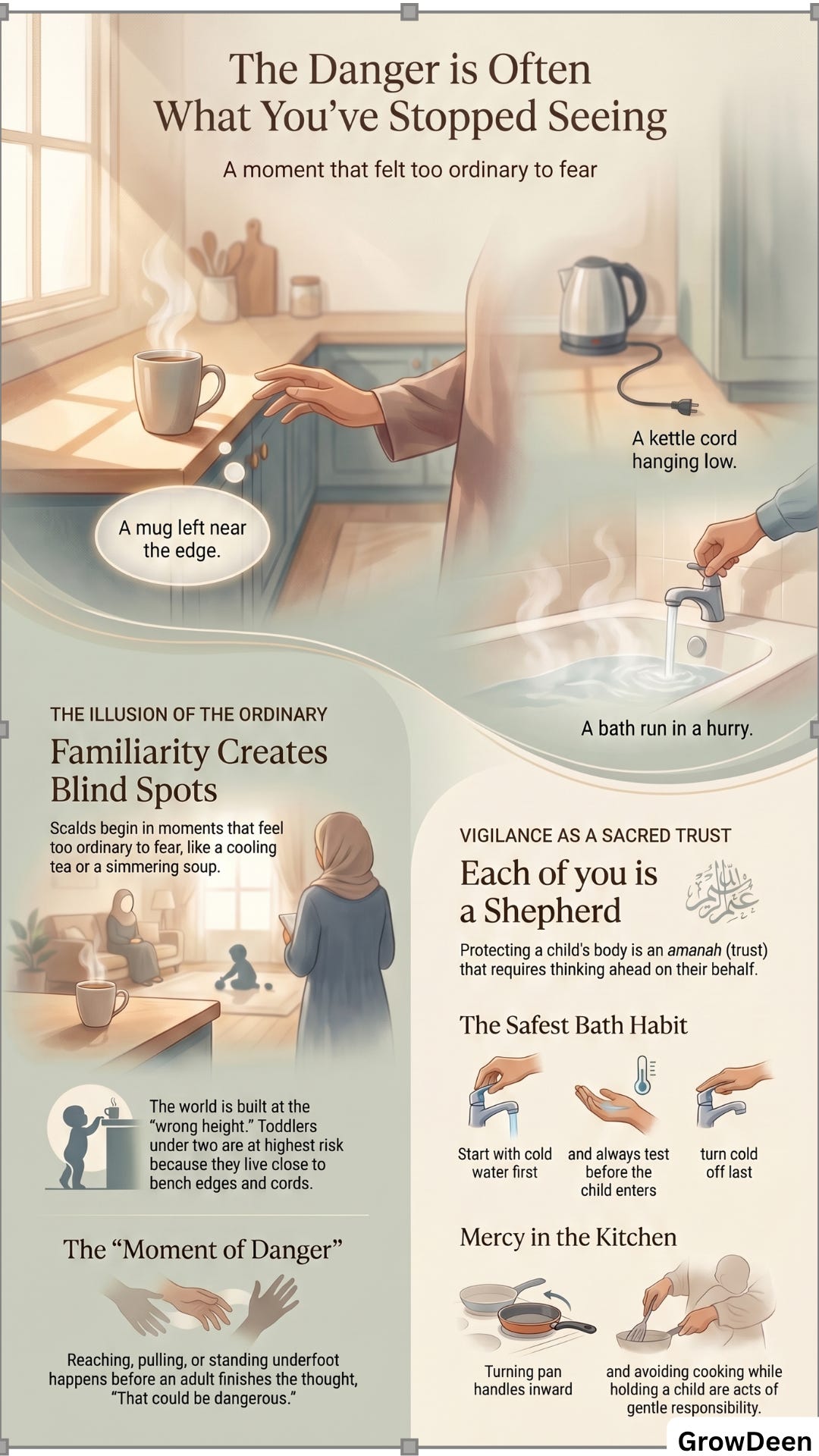
Scalds are the kind of injury that can begin in a moment that felt too ordinary to fear.
A mug left too close to the edge.
A kettle cord hanging lower than you noticed.
A bath run in a hurry.
Soup that looks ready, calm, harmless, even though it is still carrying more heat than a small child’s skin can bear.
That is part of why scald prevention matters so much in family life. It is not usually about rare disasters. It is about familiar rooms, familiar routines, familiar objects, and a child moving toward them before an adult has finished the thought, “That could be dangerous.” [1][5][6][10][11][12][13][14][15]
The youngest children are the ones who pay first
Young children, especially those under two, are at the greatest risk of scald injuries. [5][6][10][11]
That age pattern matters because toddlers do not need to do very much to be badly hurt. Reaching. Pulling. Grabbing. Climbing. Standing underfoot at the wrong moment. That is often enough.
Scald injuries are among the most common burn injuries in young children, and hot drinks remain one of the major causes. [5][6][10] Recent pediatric guidance keeps pointing back to the same household causes: hot drinks, hot foods, bath water, and cooking liquids. [11][12][13][14][15]
And really, that makes sense. Young children live close to benches, table edges, cords, handles, low taps, and adult routines. The world is built at exactly the wrong height for them.
Not all “hot” is the same, and that matters more than people think
One of the most useful distinctions families can hold onto is this: the safe temperature for bath water is not the same as the upper safe limit for water coming out of a household tap.
A safe bath temperature for babies and children is around 37–38°C. But water delivered from household taps should not come out at a dangerously high temperature. At around 60°C, a severe burn can happen extremely quickly. Around 50°C is lower risk, though still far too hot for an actual bath. [3][9]
That is why public-health and child-burn prevention guidance keeps pointing families toward keeping domestic hot-water delivery around 48–50°C or about 120°F where possible. [11][13][14]
This can sound technical until you picture the real-life moment.
A child turns the tap.
An adult assumes the bath is almost ready.
A hand goes straight into hot water before anyone has mixed it properly.
That is how fast the difference between those temperatures begins to matter.
The safest bath starts before the child enters the room
Bathroom scald prevention begins before the bath is even filled.
Cold water first.
Cold off last.
Test the water before the child gets in. [3][5][10][11][12][13][14]
Those habits matter because children are not only burned by baths that are overall too hot. They are also burned by baths with hot and cold pockets, by hot water coming directly from the tap, or by being left in a bathroom where they can turn on the hot water themselves. [3][5][10]
This is why supervision in the bathroom has to stay firm. A young child should never be left alone there. And they should not be left in the care of an older child who may not understand how quickly hot water can injure them.
The same logic applies to tap locks, door-closing habits, and anti-scald or thermostatic temperature-control devices where they are available. These are not luxuries. They are ways of building safety into the room before a mistake happens. [1][2][3] Evidence from randomized and cost-effectiveness studies supports thermostatic mixer valves as a meaningful way to reduce bath-water scald risk in homes with young children. [1][2]
The kitchen asks for a different kind of vigilance
In many homes, the kitchen and dining area are even more dangerous than the bathroom.
Not because they look dangerous.
Because they are full of routines adults perform half on instinct.
A kettle boiling.
Pasta draining.
Tea cooling.
A pan simmering.
A child weaving through legs while someone is trying to finish one more task before sitting down.
The safer habits are simple, but they matter deeply. Supervise children carefully in the kitchen. Do not leave hot pots or kettles unattended. Turn pan handles inward. Use back burners first. Consider stove guards. Create a real boundary around cooking spaces. [5][6][7][10][11][12][13][14][15]
Children’s hospitals and burn-prevention groups keep returning to these same habits because they work. They make the kitchen harder for a child to get badly hurt in.
And one line deserves to stay especially firm in spirit: do not cook while holding or breastfeeding a baby or young child. [10][11][12][13][14][15]
It is one of those things adults normalize because they are trying to get through the day. But if hot food or liquid spills, the child receives the injury first and worst. Planning cooking around sleep, safe containment, or another adult’s help is not overcautious. It is wise.
Hot drinks stay dangerous long after adults stop thinking about them
Hot drinks need their own warning because adults underestimate them all the time.
Tea and coffee do not have to be boiling to cause serious injury. They stay hot enough to scald for longer than many people realize. [5][6][11][12][13][14][15]
That is why the practical advice matters so much.
Use mugs with wide bases.
Keep drinks at the center of the table or back of the bench.
Never drink something hot while holding a child.
Use placemats instead of tablecloths that can be tugged down. [10][11][12][13][14][15]
It sounds almost too domestic to matter.
And that is exactly why it matters.
Some of the worst injuries begin in moments everyone would have described as ordinary five seconds earlier.
The room should not depend only on your memory to stay safe
The source material rightly includes appliance safety too.
Kettle cords should not hang down.
Short cords are better.
Free-standing stoves should be stabilized with anti-tip devices. [10][11][12][13][14][15]
These are small environmental changes, but that is often how prevention works best. Not by hoping a child will understand danger, but by making the danger harder to reach.
And first aid still belongs in a prevention article, because families who know what to do will limit harm if prevention fails.
If a fresh scald happens, cool it under cool running water for 20 minutes. [3][8][9] Ice, butter, creams, oils, or powders should not be applied, because they can worsen tissue injury or interfere with treatment. [3][8][9][11][13][14]
Sometimes prevention fails anyway. That is part of life. But even then, steadiness and correct first aid can preserve a great deal.
If writing like this helps you feel steadier in the real work of caring for children, subscribe for free so the next article and companion resources arrive quietly in your inbox.
Allah’s care in these ordinary acts of caution
From an Islamic perspective, scald prevention sits naturally under amanah.
A child’s body is not something to handle carelessly. Allah says, “Indeed, Allah commands you to render trusts to whom they are due.” [16]
A young child in a kitchen or bathroom is completely dependent on the adults around them to think ahead. And Allah says, “And do not throw yourselves with your own hands into destruction.” [17]
It is a broad warning, but it fits this subject well. Preventable harm is still harm.
The Prophet ﷺ said, “Each of you is a shepherd, and each of you is responsible for his flock.” [18]
That responsibility shows up in very simple things. Turning the pan handle in. Moving the tea farther back. Testing the bath water. Shutting the bathroom door. Waiting to cook until your hands are free.
And the Prophet ﷺ said, “Allah is gentle and loves gentleness in all matters.” [19]
Gentleness here is not softness without caution. It is carefulness. It is not rushing with boiling water while a child wraps around your legs. It is not placing your convenience above their safety.
And intention gives those ordinary acts their weight. “Actions are only by intentions.” [20]
A parent who arranges the home more safely, learns first aid, and changes routines around hot liquids out of sincere care for the child is not just being practical. They are honoring a trust for Allah’s sake.
In the end, scald prevention is built from habits that look small until they matter
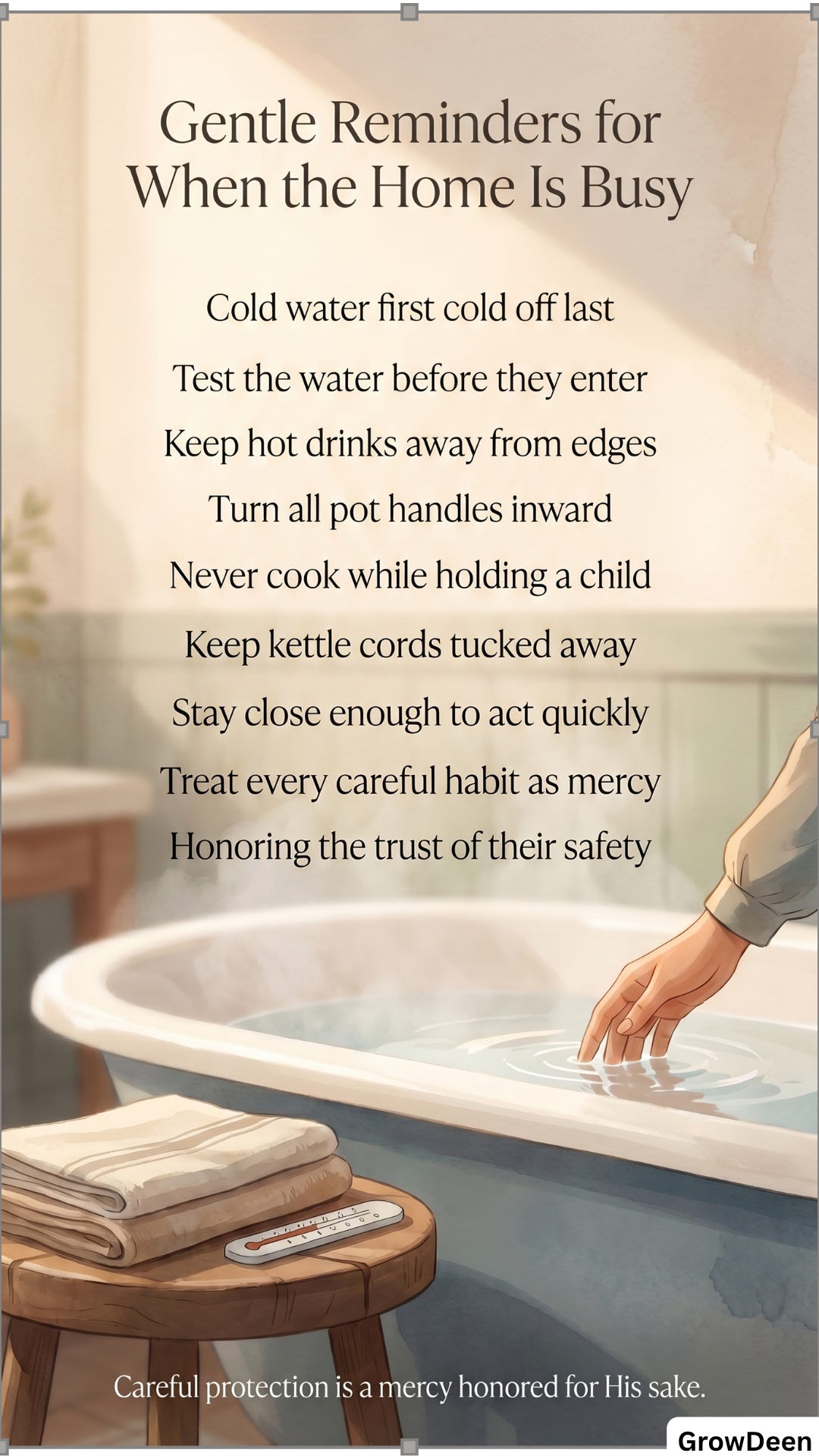
Cold water first.
Test the bath.
Keep hot drinks away from edges.
Do not cook while holding a child.
Turn handles inward.
Keep cords short.
Keep children out of cooking spaces.
These are not dramatic solutions.
They are the kind that save skin, pain, and grief precisely because they are repeated so often. [1][2][3][5][6][8][9][10][11][12][13][14][15]
That is the deeper truth here. Prevention usually does not look heroic. It looks like steady habits in familiar rooms.
GIFTS FOR YOU, DEAR READER
If you’ve reached this part of the page, that tells me something meaningful about you.
You stayed with this.
You did not just skim it and move on.
And usually that means something here felt close to real life. Maybe it made you think about your own kitchen. Maybe it brought to mind a child who moves faster than your heart can keep up with. Maybe it simply reminded you how much caregiving lives in small acts of prevention that no one else ever sees.
That effort matters.
Your willingness to read carefully, reflect honestly, and take ordinary household risks seriously is not small. It says something beautiful about the kind of care you are trying to give.
I did not want this article to remain only words on a page.
I wanted it to stay with you a little longer than that.
To move with you into the kitchen.
Into bath time.
Into snack prep and evening routines.
Into the ordinary domestic places where a scald can begin quickly and where the right habits can quietly stop it before it starts.
So we prepared a small companion pack for you.
Not as decoration.
Not as pressure.
But as a few thoughtful resources designed to help this stay close to daily life. Something you can save, revisit, print, reflect on, or keep nearby when you want the heart of this guidance in a form that is easier to carry into the day.
The hope is simple.
Not just that you read.
But that what you read becomes easier to remember, easier to apply, and easier to return to when you need it.
These companion resources were made slowly, thoughtfully, with care and sincere du’a. They were prepared because some kinds of guidance are too important to leave as a passing impression. They deserve something steadier. Something that helps bridge the gap between knowing and doing.
So please do download the companion pack.
And if it supports you, subscribe for free so future articles and companion resources arrive directly in your inbox. That way, the next time something is published for a real stage of care, responsibility, and protection, it reaches you without extra effort from you.
And if someone comes to mind while you are reading, a parent, grandparent, teacher, caregiver, or anyone responsible for children around kitchens, bathrooms, hot drinks, and cooking areas, share it with them too.
May Allah place barakah in your effort, accept your intention, and make the care you give more protective, more merciful, and more rewarded than it feels in the moment.
What is one ordinary scald risk in family life that you think people stop noticing because it feels too familiar?
Subscribe for free if you’d like future articles and companion resources that help Islamic wisdom and practical care stay close to real life.
References
[1] Burgess, J., Watt, K.A., Kimble, R.M., & Cameron, C. (2018). Knowledge of childhood burn risks and burn first aid: Cool runnings
[2] Davies, M., Maguire, S., Okolie, C., Watkins, W., & Kemp, A.M. (2013). How much do parents know about first aid for burns?
[3] Griffin, B., Cabilan, C.J., Ayoub, B., Xu, H.G., Palmieri, T., Kimble, R., & Singer, Y. (2022). The effect of 20 minutes of cool running water first aid within three hours of thermal burn injury on patient outcomes: A systematic review and meta-analysis
[4] Kassira, W., & Namias, N. (2008). Outpatient management of pediatric burns
[5] Riedlinger, D.I., Jennings, P.A., Edgar, D.W., Harvey, J.G., Cleland, M.H.J., Wood, F.M., & Cameron, P.A. (2015). Scald burns in children aged 14 and younger in Australia and New Zealand – An analysis based on the Burn Registry of Australia and New Zealand (BRANZ)
[6] Thompson, R., Budziszewski, R., Nanassy, A.D., Meyer, L.K., Glat, P., & Burkey, B. (2021). Evaluating an urban pediatric hospital’s scald burn prevention program
[7] Turner, C., Spinks, A., McClure, R., & Nixon, J. (2004). Community-based interventions for the prevention of burns and scalds in children
[8] Varley, A., Sarginson, J., & Young, A. (2016). Evidence-based first aid advice for paediatric burns in the United Kingdom
[9] Wood, F.M., Phillips, M., Jovic, T., Cassidy, J.T., Cameron, P., Edgar, D.W., & Steering Committee of the Burn Registry of Australia and New Zealand (BRANZ). (2016). Water first aid is beneficial in humans post-burn: Evidence from a bi-national cohort study
[10] Zou, K., Wynn, P.M., Miller, P., Hindmarch, P., Majsak-Newman, G., Young, B., Hayes, M., & Kendrick, D. (2015). Preventing childhood scalds within the home: Overview of systematic reviews and a systematic review of primary studies
[11] American Academy of Pediatrics / HealthyChildren.org. Recent guidance noting that scald injuries are the leading cause of burns in young children and commonly come from hot liquids, beverages, and bathing water
[12] NHS. Burns and scalds – Prevention
[13] American Burn Association. Pediatric Scalds: A Burning Issue
[14] Children’s Hospital of Philadelphia, AboutKidsHealth
[15] Qur’an, Surah An-Nisa 4:58
[16] Qur’an, Surah Al-Baqarah 2:195
[17] Sahih al-Bukhari 7138
[18] Sahih Muslim 2593
[19] Sahih al-Bukhari 1, Sahih Muslim 1907