
Keeping Your Home Language Alive Without Turning It Into A Fight

Raising a bilingual or multilingual child is slow, faithful parenting that protects learning, identity, and family bonds through steady, warm opportunities to hear and use the heritage language over time.
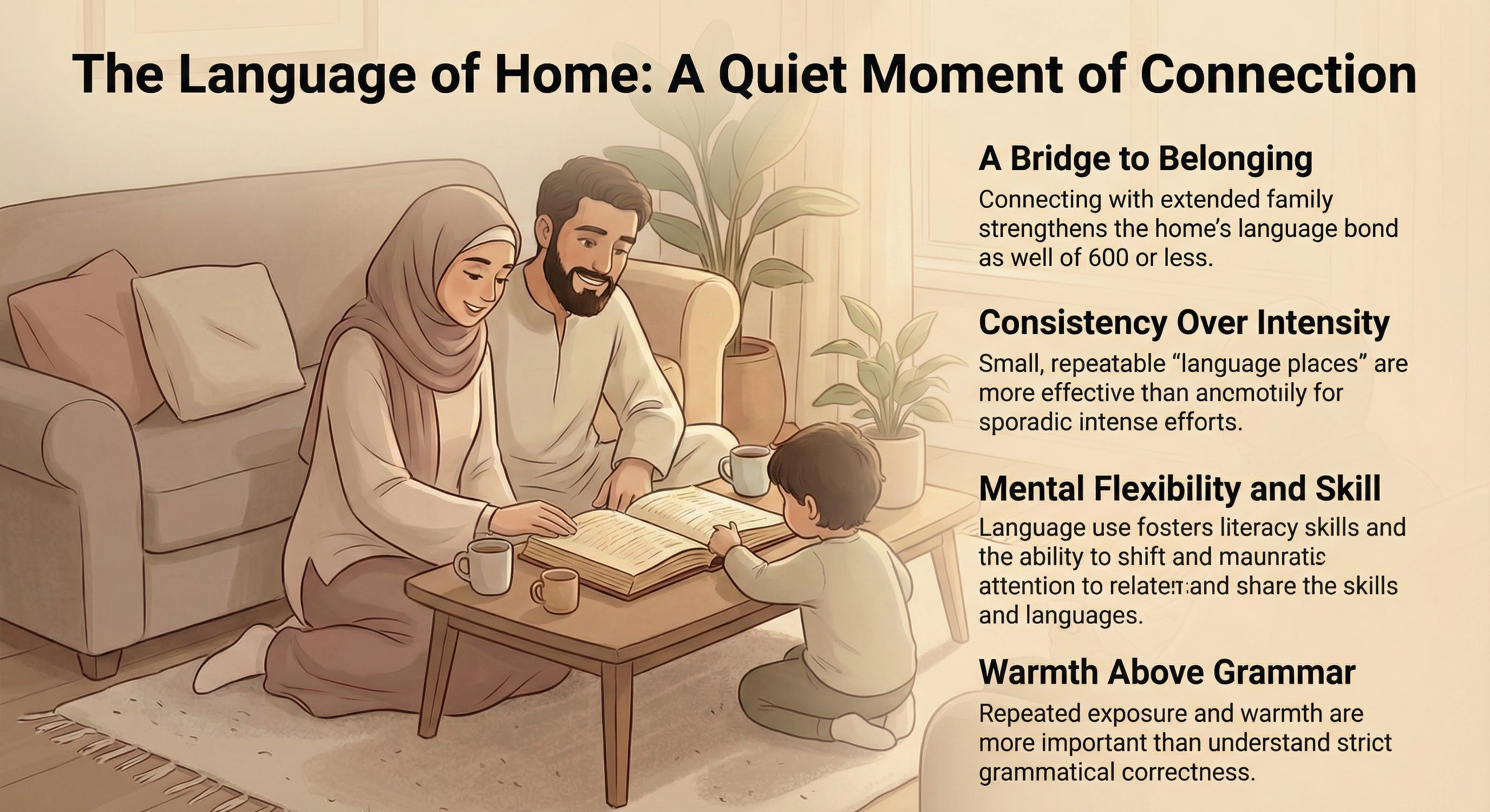
You hear it at the doorway before you even see them.
Your child’s voice, bubbling with school energy. Shoes half off. Backpack sliding down one shoulder. Words coming fast.
You answer in your language without thinking. The language that tastes like home. The one your mother used when she was tired. The one you still reach for when you want to sound gentle.
Your child looks right at you and replies in English.
It is not disrespect.
It is not rejection.
It is ease.
Still, something in your chest drops. You smile, you keep going, you keep the conversation warm.
But later, when the house finally quiets, you feel it.
That small fear.
If I do not hold this, will it disappear.
The long work no one claps for
Some families switch languages like switching rooms. It is natural. It is playful. It is just how life sounds.
Other families feel like they are pushing a stroller uphill in the rain. Everything outside is one dominant language, and the heritage language becomes something you have to protect on purpose.
Either way, bilingualism is not a cute phase. It is long work.
When a child uses two languages, they are bilingual. When they use more than two, they are multilingual. The labels are simple. The lived reality is layered, and the benefits often spill outward into learning, family closeness, and even the wider community’s ability to understand each other. [3] [7]
This is why your effort matters, even when it feels invisible.
What a second language gives a child
Parents often ask for a clear reason to keep going.
Here are some of the reasons that tend to show up in research and real life.
Regular, long term use of more than one language has been linked with stronger language and literacy skills. [3] [4] [10] It is not magic. It is exposure and practice over time.
Many families also notice something about thinking itself. Children get repeated practice shifting attention as they move between languages and settings. That kind of mental flexibility has been connected to aspects of attention and executive function. [4] [6]
And later, the practical benefits are real. Languages can open doors for study, work, and travel. It becomes an actual skill in the world, not just a nice extra. [7] [12]
But if I am honest, the most tender benefits are not on a resume.
They are in a living room.
Belonging is not an “extra”
A heritage language often carries belonging. When a child can speak to extended family in the language of home, relationships deepen. Stories land the way they were meant to land. Jokes make sense. Comfort feels direct. [5] [8]
Children often feel a stronger sense of identity when they can understand family stories without everything being translated. They can enjoy songs, books, films, and small cultural moments without feeling like a visitor in their own roots. [8] [11]
This is why it hurts when your child starts answering in English.
Because it is not only about words.
It is
about closeness.
Allah’s wisdom in the languages we carry
In many Muslim homes, there is an added layer.
Even if your child’s heritage language is Bengali, Somali, Turkish, Urdu, Malay, or something else, many families want some Arabic in the home too, because it is the language of Qur’an.
Allah describes the Qur’an as being revealed in a clear Arabic language. [17]
That does not mean every child needs fluency right away. It means that keeping language connected to deen can be part of nurturing faith with gentleness.
It can look like Qur’an recitation in the home.
It can look like simple duas.
It can look like Arabic phrases used with love, not pressure.
A child does not only learn language through lessons. They learn it through the sound of home.
The part no one tells you clearly enough
A lot of parents quietly worry about one thing.
If I keep using the heritage language, will my child’s English suffer.
This fear is common, and it is one of the reasons families stop.
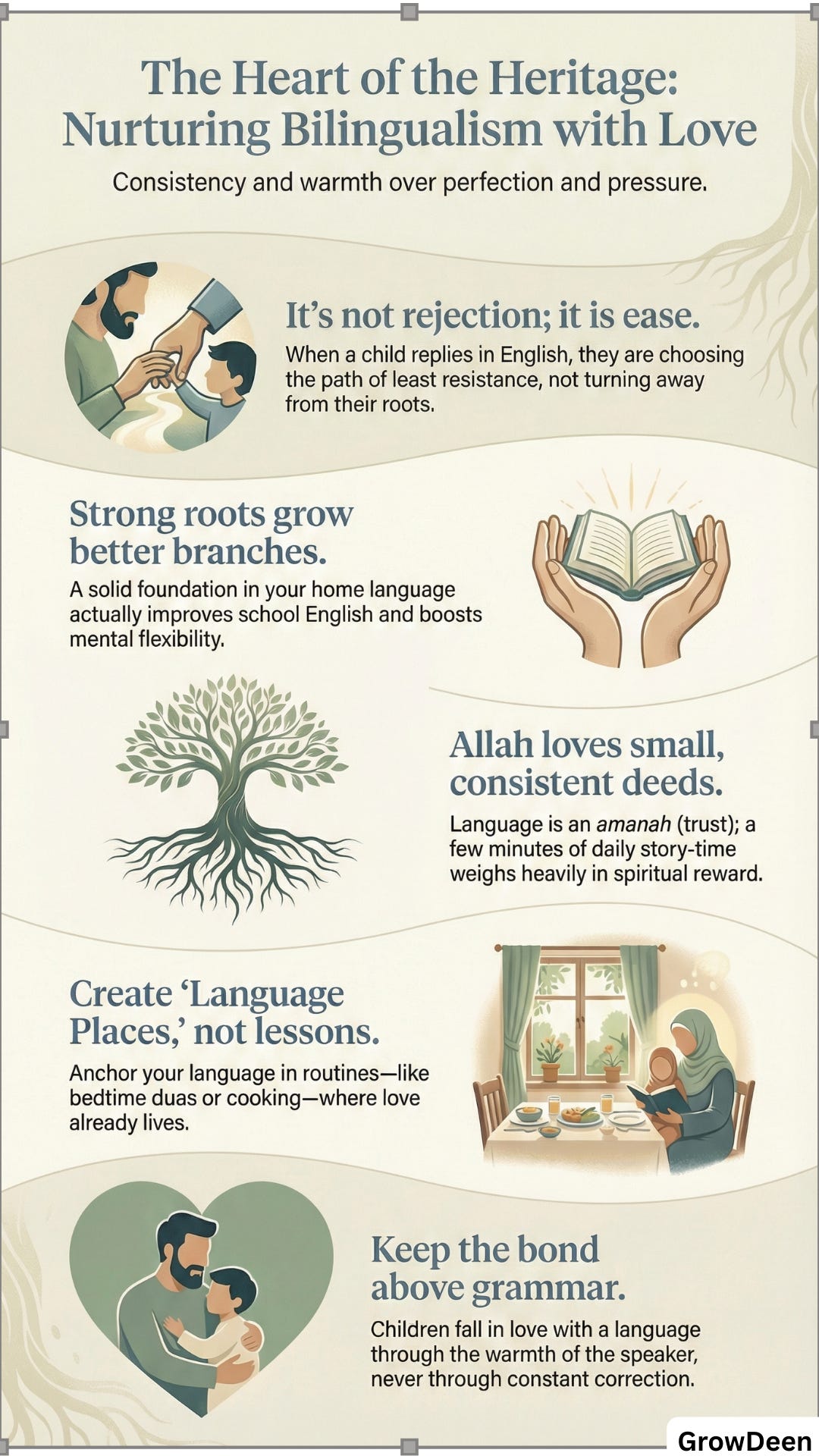
But a strong foundation in the first language can support learning the second. Children from homes with limited English often do better with English at school when the home language remains strong, because that first language base helps them build the next one. [9] [13]
So the work is not perfection.
It is staying.
Consistency, not intensity.
Also, children rarely fall in love with a language through correction. They fall in love with it through warmth and repeated exposure in real life. [7] [11]
A quick note, dear parent. If you want support like this across different stages, you can subscribe for free. These pieces are written to meet you in real life, not in an ideal life.
Small ways to keep it alive without making it heavy
Most families drift in one of two directions.
They either correct constantly, and the child starts avoiding the language.
Or they stop completely, and the language fades quietly.
There is a middle way.
Keep the heritage language present in ordinary life. Not as a separate project. As part of the day.
Try building small, repeatable “language places” in the home.
Bedtime story in the heritage language.
A cooking routine with the same familiar words.
A weekly call with grandparents.
A funny phrase that always makes your child laugh.
If your child answers in English, you can keep it warm.
I understood you. Say it again in our home words.
Try that in our language with me.
I love hearing your stories in our language. It feels close.
Then continue the conversation. Keep the bond above the grammar.
It also helps when the child hears the language beyond just you. Community playgroups. Weekend schools. Older cousins. Family friends. More voices makes it feel normal. [7]
Sometimes it helps to speak to teachers too, so they understand that maintaining the home language matters and is not “confusing” your child. [1] [2]
The questions parents ask when they are tired
Sometimes you just want someone to answer your worries plainly.
Children can usually understand differences between languages early. They often learn that one language belongs at home and another belongs at school, and they can switch depending on who they are with. [14] [15]
Language mixing is common too. A child might start in one language and finish in another. This is often part of normal bilingual development, and children learn over time how to separate languages based on context. [12] [15]
Speech timelines vary for many reasons. Being exposed to more than one language does not automatically mean a child will talk later or less. Many children become strong speakers across their languages as they grow. [10] [15]
If your child is quieter in the heritage language, it does not mean they do not understand. Sometimes comprehension grows first, and confidence catches up later.
That is a very normal pattern.
A quiet Islamic intention to carry with you
If you are teaching your child language, you are not only teaching words.
You are giving them keys.
Keys to family.
Keys to identity.
Keys to stories.
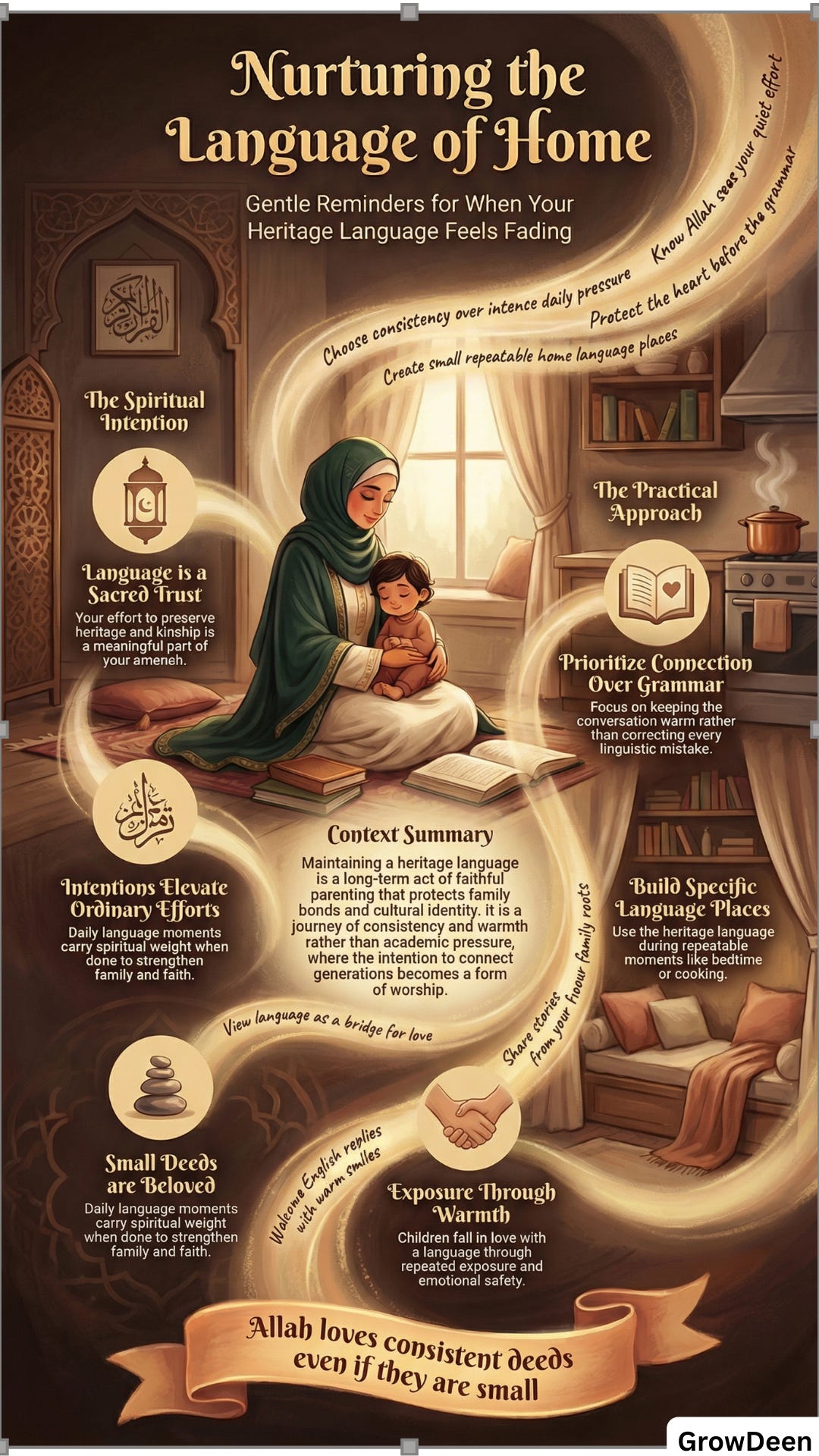
In Islam, intention changes the weight of ordinary effort. The Prophet ﷺ taught that actions are judged by intentions. [18]
So if your intention is to strengthen kinship, preserve heritage, and help your child feel rooted and confident, then those daily language moments become part of your amanah.
And on the slow days, remember this too.
Allah loves consistent deeds, even if they are small. [20]
A few minutes of story time.
A warm correction without shame.
A short voice note to grandparents.
A shared dua.
It all counts.
Ending
If you are in the middle of this, breathe.
Your child is not lost.
Your language is not gone.
This is not an all or nothing story. It is slow shaping, little returns, gentle repetition.
Keep the language alive in the places where love already lives.
And trust that steady effort, done with a clean intention, is never wasted with Allah.
Gifts for You, Dear Parent
If you’ve reached this part of the page, it tells me something meaningful about you.
You weren’t just skimming or passing time. You stayed because something here felt relevant to your real life.
Because you care.
Because you want to do things with more awareness.
Because you’re trying, even when it feels overwhelming.
That is not small.
So I didn’t want this article to remain just words on a page. I wanted it to gently step into your daily life in practical ways. That’s why we prepared these Life Gifts for you.
Not as extras.
Not as decorations.
But as simple tools to help you hold onto what mattered most in what you just read.
Here’s what you’ll find inside:
Gentle Understanding Card
A clear and simplified summary of the core concept from this article, so you can revisit the main idea anytime without rereading everything.
Heartfelt Dua Card
A carefully chosen dua connected to this stage of life, because we know that real strength and ease ultimately come from Allah’s help.
Gentle Actions Card
Practical examples to help you translate knowledge into action, so what you learned becomes part of your daily rhythm.
Gentle Reminders Card
Short, steady reminders drawn from the key points, designed to be printed or saved and placed somewhere you’ll see often.
These were designed slowly and thoughtfully, with time, care, and sincere dua. We created them because we genuinely want to walk alongside you, not just through one article, but through every stage of this lifelong journey.
If these gifts support you even in a small way, I would love for you to continue receiving them.
Subscribe so that each new Gift arrives directly in your inbox whenever we release the next stage. That way, you won’t miss the tools designed to support you right where you are.
May Allah place barakah in your effort, accept your intention, and make this path easier and more rewarding than it feels right now.
Please share it with a family/friend who may benefit from this knowledge.
In the comments, what is one small habit you want to protect this month so your heritage language stays connected to love, not pressure?
References
[3] Baker, C., & Wright, W.E. (2021). Foundations of bilingual education and bilingualism (7th edn). Multilingual Matters.
[4] Barac, R., & Bialystok, E. (2011). Cognitive development of bilingual children. Language Teaching, 44(1), 36 to 54.
[5] Barron-Hauwaert, S. (2010). Bilingual siblings: Language use in families. Multilingual Matters.
[6] Bialystok, E. (2015). Bilingualism and the development of executive function: The role of attention. Child Development Perspective, 9(2), 117 to 121.
[7] Cunningham, U. (2020). Growing up with two languages: A practical guide for multilingual families and those who support them (4th edn). Routledge.
[8] De Houwer, A. (2009). Bilingual first language acquisition. Multilingual Matters.
[9] Meisel, J. (2019). Bilingual children: A guide for parents. Cambridge University Press.
[10] Yip, V., & Matthews, S. (2007). The bilingual child: Early development and language contact. Cambridge University Press.
[11] King, K., & Mackey, A. (2007). The bilingual edge: Why, when, and how to teach your child a second language. Harper Perennial.
[12] Festman, J., Poarch, G., & Dewaele, J.-M. (2017). Raising multilingual children. Multilingual Matters.
[13] Qi, R. (2022). The bilingual acquisition of Chinese Children. The Commercial Press.
[14] Guo, Q., & Qi, R. (2024). A study of bilingual acquisition of wh-questions of a Mandarin-English bilingual preschool child from China to Australia. Education Sciences, 14(9), Article 978.
[15] Zurer Pearson, B. (2008). Raising a bilingual child: A step-by-step guide for parents. Living Language.
[16] Di Biase, B., & Qi, R. (2015). Why speaking two languages is advantageous for the speaker. China Language Strategies, 2(1), 23 to 29.
[17] Qur’an: Surah Ash-Shu‘ara, 26:195.
[18] Sahih al-Bukhari, Hadith 1; Sahih Muslim, Hadith 1907.
[19] Sahih al-Bukhari, Hadith 5986; Sahih Muslim, Hadith 2557.
[20] Sahih al-Bukhari, Hadith 6465; Sahih Muslim, Hadith 782.