
Dear Parents, If You Don’t Feel That Instant Bond, Read This Gently
Bonding Is Not A Spark, It Is A Thread You Keep Weaving

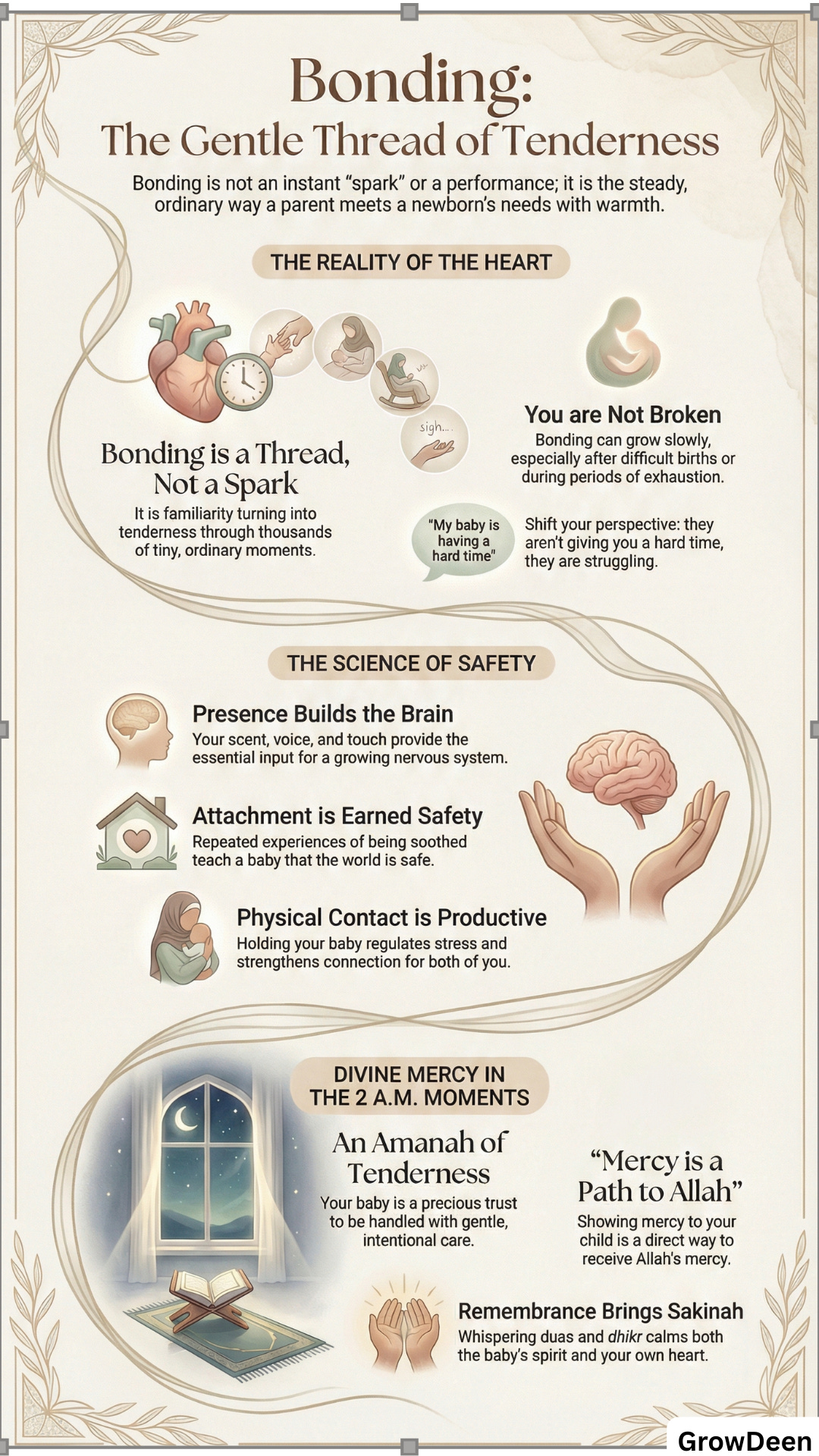
Bonding in the first three months is not a magical moment you either “get” or miss, it is the steady, ordinary way you keep meeting your newborn with warmth until your baby learns, deep in their body, that they are safe.

It is 2:17 a.m.
The house is dark. Your hair is still damp from a rushed shower you barely remember taking. Your baby is on your chest, warm and small and fussy, and you are doing that slow sway in the hallway because the rocking chair suddenly feels too still.
You look down at their tiny face and you feel… something.
Love, yes. Responsibility, definitely.
But maybe not the big rush people talk about.
And then the thought slips in, quietly, like a guilt you did not invite.
What if I am not bonding properly.
Let me sit with you there for a moment.
The kind of love that starts before you feel it
Bonding is not a performance. It is not something you “do right” and earn a gold star for.
It is more like familiarity turning into tenderness.
You learn your baby’s sounds. You notice the way they scrunch their forehead right before they cry. You start to predict what helps and what makes things worse. That is bonding growing.
People also use bonding and attachment like they are the same thing, but they are not quite. Bonding is your relationship forming with your baby. Attachment is what your baby builds over time through repeated experiences of being cared for, soothed, fed, held, and protected. Those experiences teach a baby, without words, that someone comes. That the world is not empty. That they matter. [2] [4] [5]
Your baby is learning safety, not rules
In these first months, your baby is not learning through explanations.
They learn through your presence.
Your voice. Your scent. Your hands. The way you pick them up. The way you look at them when they cry. The way you soften your face when they are overwhelmed.
That steady responsiveness becomes a kind of emotional home base. It is part of what helps them settle, and later, explore the world with more confidence. [7]
This is also part of early brain development. The back and forth between a caregiver and baby, the pauses, the eye contact, the gentle “I see you,” it all becomes input to a growing nervous system. Researchers have even found links between early mother infant interaction patterns and differences in infant brain regions. [6]
That can sound heavy, but I want you to hear it the gentle way.
Your ordinary care matters more than you think.
Physical closeness is not an extra
Sometimes bonding looks like nothing special at all.
Just you holding your baby with your chin resting on their head.
Just your hand on their back.
Just skin to skin in the early days, or a baby tucked against you in a carrier while you wash dishes and whisper little duas under your breath.
Physical contact supports babies and caregivers in real ways. It can help regulate stress, support calm, and strengthen connection. [1]
So if you feel like you are doing “nothing” all day except feeding, holding, rocking, pacing, and trying to pee quickly, please know this.
You are not doing nothing.
You are building a relationship.
Ar Rahman’s Mercy in the 2 a.m. moments
In an Islamic home, bonding carries another layer.
Your baby is an amanah, yes, but not in a cold, scary way.
In a tender way.
Like something precious you handle with care.
The Prophet ﷺ taught us that mercy is not a personality trait for a few soft people. It is a path to Allah’s mercy.
Those who are merciful will be shown mercy by the Most Merciful. [8]
So when you respond to your baby’s cries with gentleness, even when you are exhausted, even when you are confused, even when you are trying not to cry too, that mercy is not wasted.
And when you fill your home with remembrance, even quietly, even imperfectly, Allah tells us something about hearts like yours.
Truly, in the remembrance of Allah do hearts find rest. [9]
Sometimes you are not only calming your baby.
You are being calmed too.
Simple ways to bond that do not require extra energy
Bonding does not need a big plan.
It fits inside things you are already doing.
When you change a nappy, slow your hands down for ten seconds and speak gently.
When your baby makes a sound, answer it like it matters. A smile. A soft response. A little echo back. Those tiny exchanges are early conversation, and they support the beginnings of communication. [3]
When your baby looks at you, meet their gaze for a moment. Not intensely. Just warmly.
When they cry, respond. Even if you do not solve it immediately. A baby learns safety through the pattern of someone trying.
If you want one small self talk line for the hard moments, try this.
My baby is not giving me a hard time. My baby is having a hard time.
Then breathe.
Then do the next gentle thing.
If you would like, you can subscribe for free so these kinds of calm reminders meet you again in the months ahead, right when you need them. No pressure. Just support you can return to on a tired day.
If you do not feel bonded yet, you are not broken
Some parents feel an instant flood of attachment.
Some parents feel numb, anxious, disconnected, or strangely blank.
Especially if the birth was difficult, sleep is shattered, hormones are swinging, or you are carrying sadness you have not even had time to name.
Bonding can grow slowly.
A baby does not demand fireworks. A baby needs steadiness.
If it feels slow for you, do not panic. Keep showing up in small ways. Keep holding. Keep responding. Keep learning your baby’s preferences. Over time, familiarity becomes warmth.
And if you feel worried about your relationship with your baby, or you feel emotionally unwell, please reach out for help. Support is not a sign of weakness. It can be part of protecting an amanah, including your own heart.
More than one safe person is a mercy too
Babies can bond with more than one caregiver. [2] [4]
Parents, grandparents, older siblings, trusted carers.
Across cultures, babies often have multiple attachment figures, and context matters. [4]
Sometimes having another safe person is not only good for your baby.
It is good for you.
Because rest makes you softer.
And when you return with a calmer nervous system, your baby feels that immediately.
Ending, gently
If the first three months feel messy and foggy, you are not failing.
You are in the early stitching.
A relationship is forming in thousands of tiny moments you will not remember later, but your baby’s body will.
May Allah place sakinah in your home, and make your arms a place of safety for your child.
Rabbana hab lana min azwajina wa dhurriyyatina qurrata a yun, waj alna lil muttaqina imama. [9]
Gifts For You, Dear Parent
If you have reached this part of the page, it tells me something meaningful about you.
You were not only scrolling or passing time. You stayed because something here touched a real part of your life.
Because you care.
Because you want to move through motherhood and parenthood with more awareness.
Because you are trying, even on the days that feel like too much.
That is not small.
So I did not want this to remain only words on a screen. I wanted it to gently step into your real days in practical ways. That is why we prepared these Life Gifts for you.
Not as extras.
Not as decoration.
But as simple tools to help you hold onto what mattered most in what you just read.
Here is what you will find inside.
Gentle Understanding Card
A simple, clear reminder of the heart of this article, so you can come back to the main idea in seconds without rereading everything.
Heartfelt Dua Card
A carefully chosen dua for this season of early parenthood, because real strength and ease ultimately come from Allah’s help.
Gentle Actions Card
Small, realistic examples that help you turn knowledge into action, so what you learned can actually fit into your daily rhythm.
Gentle Reminders Card
Short, steady reminders pulled from the core points, designed to be saved or printed and placed somewhere you will see often.
These were made slowly and thoughtfully, with care, time, and sincere dua. They were created because we genuinely want to walk alongside you, not only through one article, but through every stage of this lifelong journey.
If these gifts support you even a little, I would love for you to keep receiving them.
Subscribe so each new Gift arrives directly in your inbox whenever we release the next stage, so you do not miss the tools made to support you right where you are.
May Allah place barakah in your efforts, accept your intention, and make this path easier and more rewarding than it feels right now.
Please share this with a family member or friend who might feel lighter after reading it.
What is one moment with your child that feels hardest lately, and what kind of support would make it feel lighter.
In the comments, what is one small moment this week where you felt close to your baby, even if the day was hard.
References
[1] Bigelow, A.E., and Rankin Williams, L. (2020). To have and to hold: Effects of physical contact on infants and their caregivers. Infant Behavior and Development, 61, 101494.
[2] Bornstein, M.H. (2019). Parenting infants. In Handbook of Parenting, Vol. 1: Children and Parenting (3rd ed.). Routledge.
[3] Conway, L.J., Levickis, P.A., Mensah, F., Smith, J.A., Wake, M., and Reilly, S. (2018). The role of joint engagement in the development of language in a community derived sample of slow to talk children. Journal of Child Language, 45(6), 1275–1293.
[4] Keller, H. (2016). Attachment: A pancultural need but a cultural construct. Current Opinion in Psychology, 8, 59–63.
[5] Kohlhoff, J., Lieneman, C., Cibralic, S., Traynor, N., and McNeil, C.B. (2022). Attachment based parenting interventions and evidence of changes in toddler attachment patterns: An overview. Clinical Child and Family Psychology Review, 25, 737–753.
[6] Sethna, V., Pote, I., Wang, S., and colleagues (2017). Mother infant interactions and regional brain volumes in infancy: An MRI study. Brain Structure and Function, 222, 2379–2388.
[7] Winston, R., and Chicot, R. (2016). The importance of early bonding on the long term mental health and resilience of children. London Journal of Primary Care, 8(1), 12–14.
[8] Sunan al Tirmidhi 1924. Those who are merciful will be shown mercy by the Most Merciful.
[9] Qur’an 13:28. Truly, in the remembrance of Allah do hearts find rest.