
Colic Nights Feel Endless, Here Is How To Get Through Safely
Colic Is Not Your Fault, But Safety Still Matters Most

Colic is heartbreaking, but you can get through it safely by ruling out illness, using gentle soothing that protects baby and parent, and reaching for support before exhaustion turns into danger.

It is evening again.
You can feel your body brace before the crying even starts, because you know the pattern now. The clock moves toward that hour, and your chest tightens as if your nervous system is trying to protect you from what is coming.
You pick your baby up.
You feed.
You change.
You rock.
You whisper.
And still, the crying climbs higher, like nothing you do can reach them.
If you are living this, I want to say something very gently.
This is one of the hardest newborn experiences a parent can go through.
Not because you do not love your baby enough.
Because colic can make you feel powerless in the exact place you most want to help.
Al Latif holds the parents who feel helpless
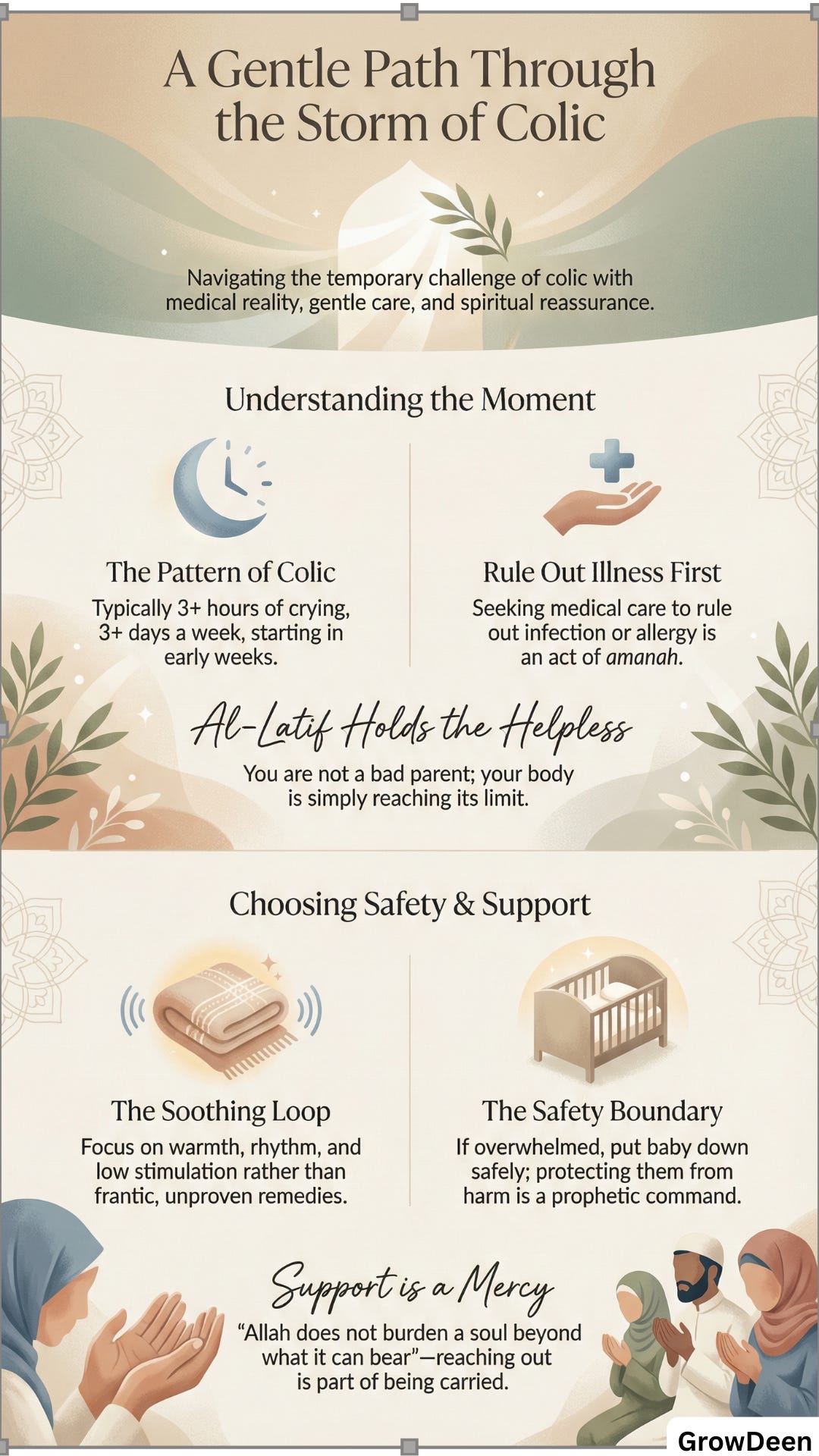
Colic is often described as prolonged crying and fussing in an otherwise well baby, with no clear illness or injury to explain it.
The classic description is that it lasts at least 3 hours a day, happens on at least 3 days in a week, and shows up in these early weeks when babies are still brand new to the world.
Some babies cry loudly, especially in the evenings. They might pull their legs up, strain, squirm, go red in the face. They can look like they are in pain, even when pain is not the clear cause.
Research on infant crying patterns shows that fussing and crying is most intense in the early weeks for many babies, and colic fits into that picture for a portion of infants [1]. Reviews also describe colic as most common in the first weeks, and likely caused by more than one factor, not one simple reason [2] [3].
So if you are searching for one neat answer, you may not find it.
But you can still find a safe way through.
The first step is not fixing it, it is ruling out illness
When the crying is extreme, getting your baby checked is not overreacting.
It is wise.
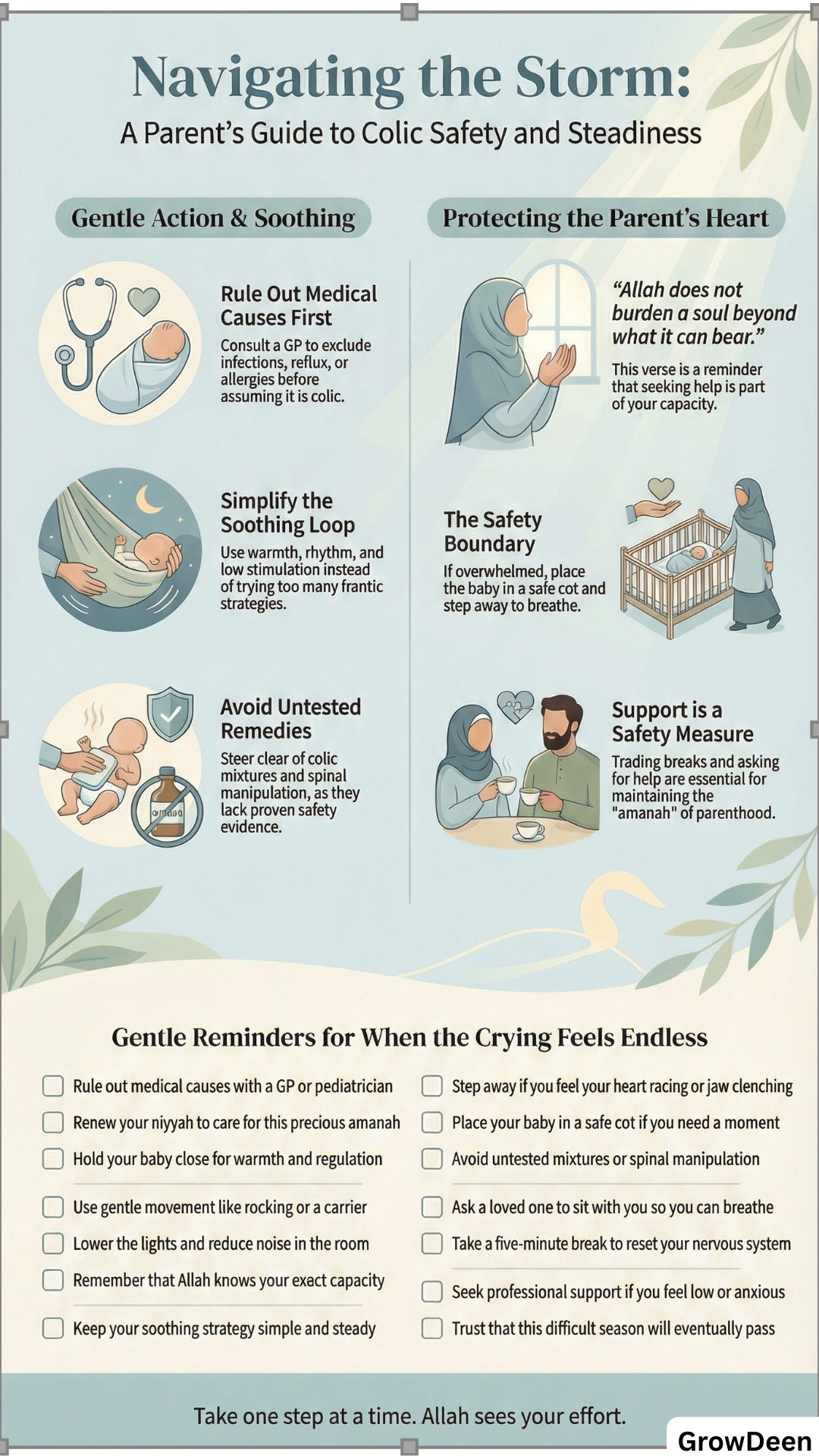
A GP or paediatrician can assess your baby and rule out medical causes of excessive crying. In practice, clinicians may consider things like reflux disease, infections such as ear infections or urinary tract infections, hernias, or allergy in a small subset of infants [2] [3] [4].
Please seek medical care promptly if your baby seems unusually listless or pale, feeds poorly or is not gaining weight, has a fever, or has ongoing vomiting or diarrhoea.
And if your baby feels off to you, even if you cannot explain why, that feeling matters. You do not need perfect words to ask for help.
This is part of amanah.
When the crying is not stopping, what can you do in the moment
If your baby has been checked and you are in that long stretch of crying, the goal shifts.
Not perfection.
Not silence.
Comfort and safety.
Start simple. One small loop. Too many strategies at once can make you feel frantic.
Hold your baby close.
Warmth, pressure, and your steady presence are not extras. They are regulation.
Add gentle movement.
Rocking, walking, a carrier or sling. Many babies respond to warmth plus rhythm.
Lower stimulation.
Dim the lights. Reduce noise. Slow your movements. Sometimes the world is simply too much.
Some parents find a warm bath helps. Some find a soft voice or steady humming helps. Some babies calm with sucking, through breastfeeding, a dummy, or later their fingers.
If you try white noise or similar background sound, keep it gentle and safe.
You are not trying to control your baby.
You are trying to carry them through something they cannot navigate alone.
As-Sabur helps you stay steady when you feel like you cannot
Colic is not only hard because of the baby.
It is hard because of what it does to you.
The sound can get under your skin. Your heart races. Your jaw clenches. You feel panic, anger, hopelessness, sometimes all in the same minute.
That does not mean you are a bad parent.
It means your body is reaching its limit.
There is research showing that when crying becomes excessive, parents often need something specific. A plan. Clear support. Someone who takes them seriously [5]. Being heard helps because it steadies you.
And steadiness is safety.
Allah tells us, “Allah does not burden a soul beyond what it can bear.” [6] That verse is not a command to suffer silently. It is a reminder that Allah knows your capacity, and that reaching for help is part of being carried through.
If you need something tiny to say to yourself in the moment, try this.
My baby is struggling.
I am allowed to struggle too.
We will get through this safely.
The safety boundary that must never be crossed
Never shake a baby.
Shaking can cause bleeding in the brain and may lead to permanent brain damage.
If you feel out of control, put your baby in a safe place like a cot.
Step away.
Breathe.
Call someone.
Call a parenting helpline.
Do whatever you need to do to return to calm.
In our deen, protection from harm is not a small matter. The Prophet ﷺ taught, “There should be neither harming nor reciprocating harm.” [7]
Sometimes living that hadith looks like one brave act.
Putting your baby down safely and walking into the next room for one minute.
Not because you are cold.
Because you are protecting your baby from a moment you do not want to have.
The things that look tempting when you are desperate
When parents are exhausted, anything that promises relief can look like mercy.
But several approaches either do not have solid evidence, have poor evidence, or carry risk.
Over the counter colic mixtures are not recommended. They do not have a strong scientific basis, are not consistently proven to help, and may not be thoroughly tested in very young babies [3].
Pain relieving agents have been studied in infantile colic, but evidence does not support a quick simple fix, and safety matters deeply at this age [8].
Reflux medications are sometimes tried, but reviews note there is no good evidence that reflux medication reliably reduces crying and fussing in colic [3].
Complementary and alternative medicines have not been shown to be effective, and safety concerns remain [9].
Spinal manipulation is not recommended for infants and may be harmful. An independent review of chiropractic spinal manipulation in children under 12 raised safety concerns and did not support it as a treatment approach for babies [10].
Diet changes for a breastfeeding mother are unlikely to reduce crying unless a baby has a diagnosed allergy. Food allergy can play a role for a small subset of infants, but it is controversial and usually comes with other signs beyond crying alone [4].
If your clinician advises eliminating foods, do it with guidance. If you remove major food groups, you may need supplements.
If your baby is formula fed, changing formula without a diagnosis is unlikely to help and can become expensive [4].
One area you might hear about is probiotics. Reviews and meta analyses continue to examine whether probiotics reduce crying time and in which groups they seem most helpful [11]. If you are considering probiotics, ask your GP, lactation consultant, or child and family health nurse first.
Support is not a luxury, it is part of colic care
If your baby has colic, your wellbeing is not a side note.
It is a safety measure.
Sometimes you only get five minutes. Five minutes counts.
A shower while someone holds the baby.
A cup of tea in silence.
A short walk outside.
If you have a partner or co parent, trade breaks like a serious plan, because it is.
And if you do not, ask someone to come sit with you. Not to solve colic, but to keep you steady.
There is trial evidence that programs aiming to prevent early sleep and crying problems also looked at effects on postnatal depression risk [12]. You do not need to wait until you are drowning to reach out.
If you are feeling persistently low, anxious, numb, or unable to cope, please speak to your GP or nurse. Early support is mercy.
Somewhere in the middle of colic, parents often start thinking, I should be able to handle this.
No.
Colic is hard.
You are allowed to need help.
If you would like more gentle, Islamically grounded support for newborn safety moments, you are welcome to subscribe for free so you have calm guidance waiting for you before the next hard evening arrives.
Gifts for You, Dear Parent
If you’ve reached this part of the page, it tells me something meaningful about you.
You weren’t just skimming or passing time. You stayed because something here felt relevant to your real life.
Because you care.
Because you want to do things with more awareness.
Because you’re trying, even when it feels overwhelming.
That is not small.
So I didn’t want this article to remain just words on a page. I wanted it to gently step into your daily life in practical ways. That’s why we prepared these Life Gifts for you.
Not as extras.
Not as decorations.
But as simple tools to help you hold onto what mattered most in what you just read.
Here’s what you’ll find inside:
Gentle Understanding Card
A clear and simplified summary of the core concept from this article, so you can revisit the main idea anytime without rereading everything.
Heartfelt Dua Card
A carefully chosen dua connected to this stage of life, because we know that real strength and ease ultimately come from Allah’s help.
Gentle Actions Card
Practical examples to help you translate knowledge into action, so what you learned becomes part of your daily rhythm.
Gentle Reminders Card
Short, steady reminders drawn from the key points, designed to be printed or saved and placed somewhere you’ll see often.
These were designed slowly and thoughtfully, with time, care, and sincere dua. We created them because we genuinely want to walk alongside you, not just through one article, but through every stage of this lifelong journey.
If these gifts support you even in a small way, I would love for you to continue receiving them.
Subscribe so that each new Gift arrives directly in your inbox whenever we release the next stage. That way, you won’t miss the tools designed to support you right where you are.
May Allah place barakah in your effort, accept your intention, and make this path easier and more rewarding than it feels right now.
Please share it with a family or friend who may benefit from this knowledge.
What part of colic feels hardest for you right now, the evenings, the helplessness, the exhaustion, or feeling alone in it?
References
[1] Wolke, D., Bilgin, A., & Samara, M. (2017). Fussing and crying durations and prevalence of colic in infants. The Journal of Pediatrics, 185, 55 to 61.e4. https://doi.org/10.1016/j.jpeds.2017.02.020
[2] Daelemans, S., Peeters, L., Hauser, B., & Vandenplas, Y. (2018). Recent advances in understanding and managing infantile colic. F1000Research, 7. https://doi.org/10.12688/f1000research.14940.1
[3] Hjern, A., Lindblom, K., Reuter, A., & Silfverdal, S. A. (2020). A systematic review of prevention and treatment of infantile colic. Acta Paediatrica, 109(9), 1733 to 1744. https://doi.org/10.1111/apa.15247
[4] Nocerino, R., Pezzella, V., Cosenza, L., Amoroso, A., Di Scala, C., Amato, F., Iacono, G., & Canani, R. B. (2015). The controversial role of food allergy in infantile colic: Evidence and clinical management. Nutrients, 7(3), 2015 to 2025. https://doi.org/10.3390/nu7032015
[5] Harskamp Van Ginkel, M. W., Klazema, W., Hoogsteder, M. H., Chinapaw, M. J., & van Houtum, L. (2023). The need of having a plan in excessive infant crying: Parents’ experiences of healthcare support. Acta Paediatrica, 112(3), 434 to 441. https://doi.org/10.1111/apa.16618
[6] Qur’an 2:286. https://quran.com/2/286
[7] Sunan Ibn Majah 2340. There should be neither harming nor reciprocating harm. https://sunnah.com/ibnmajah:2340
[8] Biagioli, E., Tarasco, V., Lingua, C., Moja, L., & Savino, F. (2016). Pain relieving agents for infantile colic. Cochrane Database of Systematic Reviews, Issue 9, CD009999. https://doi.org/10.1002/14651858.CD009999.pub2
[9] Cabanillas Barea, S., Jiménez del Barrio, S., Carrasco Uribarren, A., Ortega Martínez, A., Pérez Guillén, S., & Ceballos Laita, L. (2023). Complementary and alternative medicines were not effective for infantile colic. Acta Paediatrica, 112(7), 1378 to 1388. https://doi.org/10.1111/apa.16807
[10] Safer Care Victoria. (2019). Chiropractic spinal manipulation of children under 12: Independent review. Victorian Government.
[11] Vaz, S. R., Tofoli, M. H., Avelino, M. A., & da Costa, P. S. (2024). Probiotics for infantile colic: Meta analysis and systematic review. Acta Paediatrica, 113(2), 170 to 182. https://doi.org/10.1111/apa.17036
[12] Hiscock, H., Cook, F., Bayer, J., Le, H. N. D., Mensah, F., Cann, W., Symon, B., & St James Roberts, I. (2014). Preventing early infant sleep and crying problems, and post natal depression: A randomized trial. Pediatrics, 133(2), 346 to 354. https://doi.org/10.1542/peds.2013-1886