
A Small Part Of Newborn Care That Can Feel Big At First
That Tiny Belly Button Can Feel More Worrying Than It Should

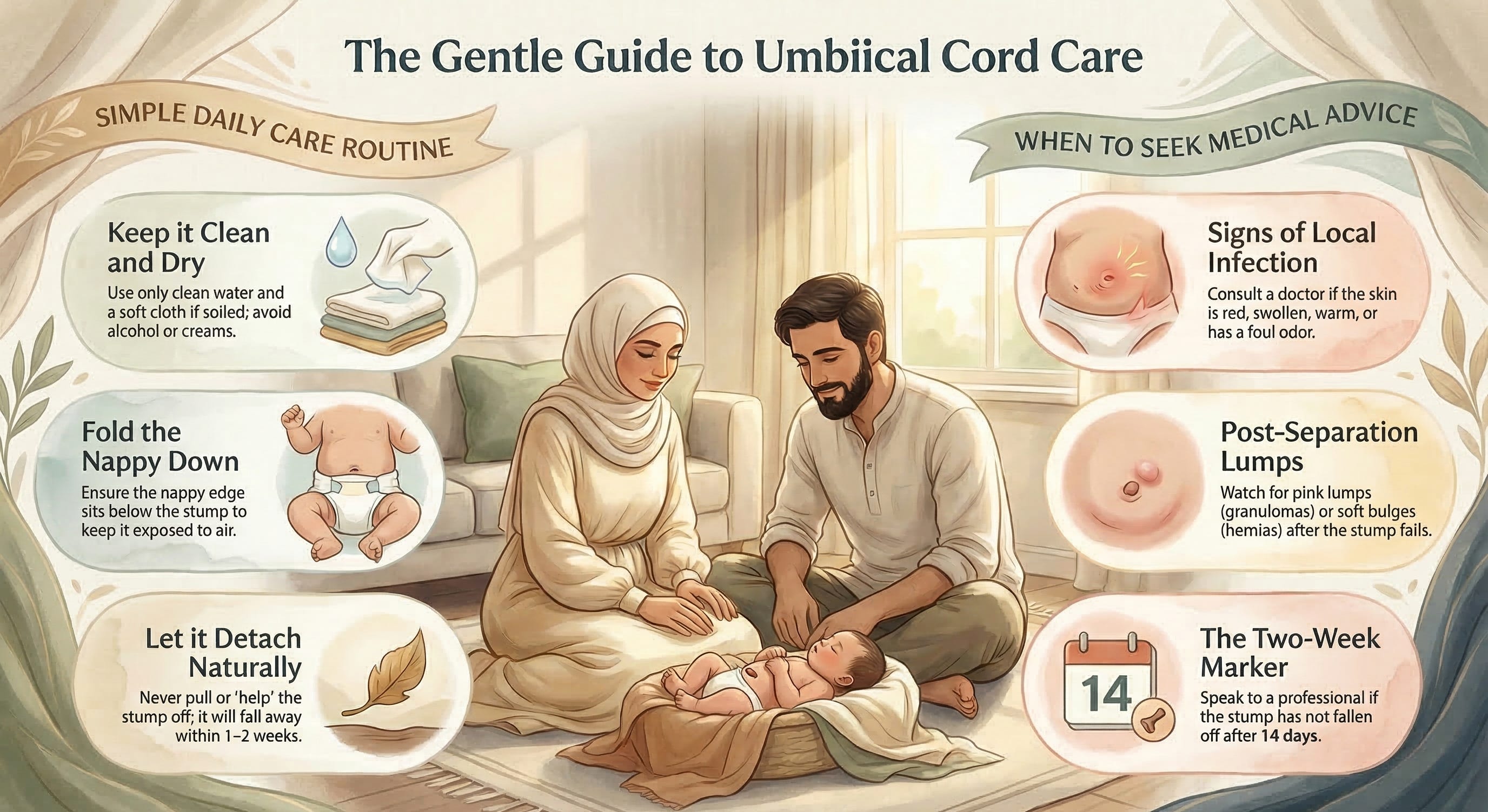
A newborn’s umbilical stump usually heals best when it is kept clean, dry, and undisturbed, allowing it to dry up and fall off naturally while parents watch gently for signs that need medical attention.
It happens in one of those quiet newborn moments.
You are changing the nappy, still moving a little carefully because everything about this baby feels new, and then your eyes land on that small dark stump at the belly.
It can look odd at first.
A little dry. A little fragile. A little unfamiliar.
And even if nobody says it out loud, a lot of parents feel the same thought rise in their chest.
Am I supposed to do something with this?
If that is you, you are not overreacting. The umbilical stump makes many loving, attentive parents nervous in the beginning.
That little stump is supposed to change
Before birth, the umbilical cord was part of the lifeline between mother and baby, carrying oxygen and nutrients through the placenta during pregnancy. After birth, the cord is clamped and cut, leaving behind the short stump attached to the baby’s abdomen. [1] [4]
Then the body begins a very ordinary, very remarkable bit of healing.
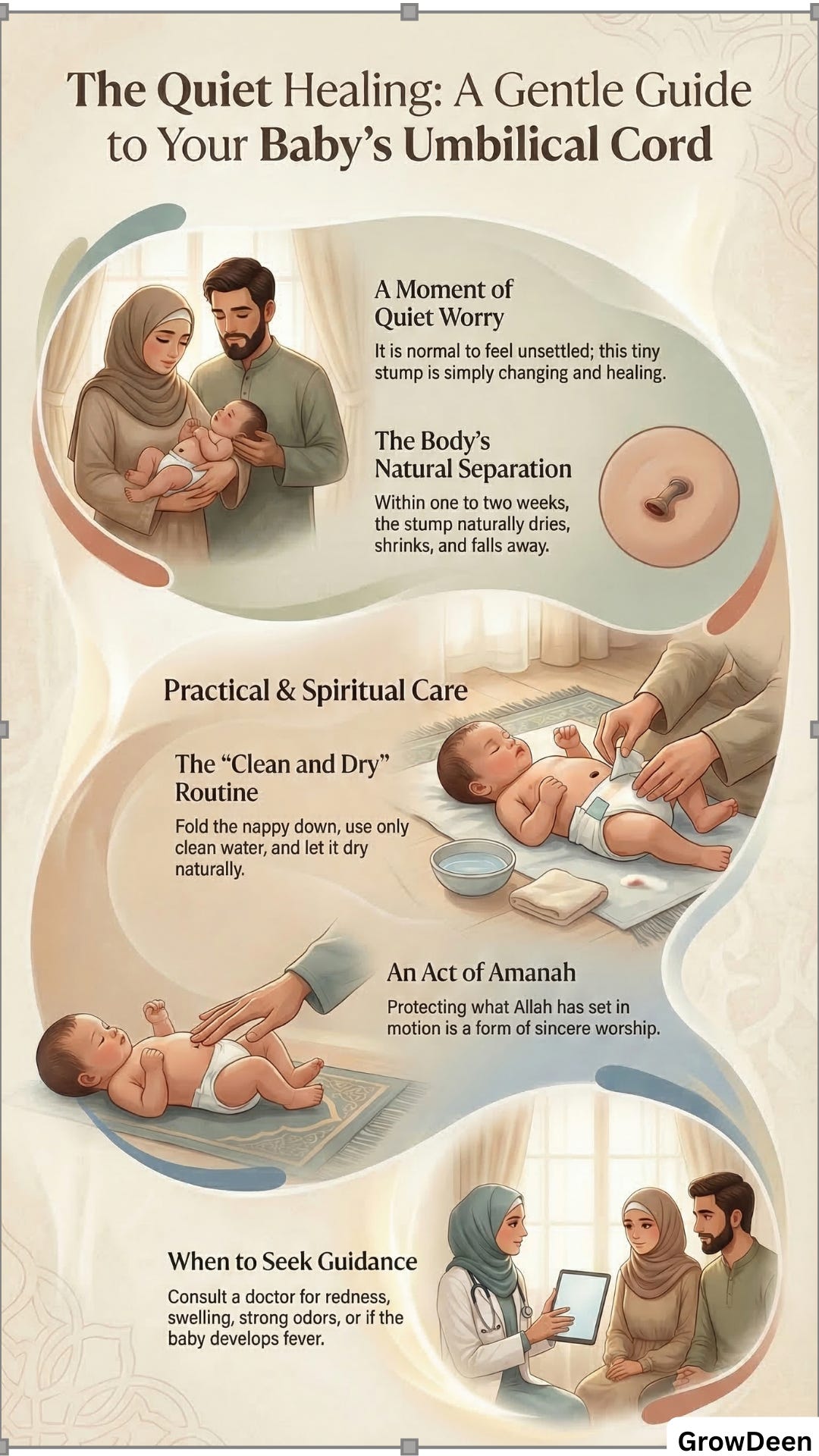
Over the next days, the stump dries out. It darkens, shrinks, hardens, and eventually falls away. For most babies, this happens within one to two weeks, though a little variation is normal. [1] [2]
When it finally separates, what remains is the belly button.
Sometimes just knowing that this odd looking thing is meant to dry, darken, and drop off naturally brings a parent a lot of relief.
Allah’s wisdom can be seen in even this small healing
There is something quietly moving in this part of newborn care.
A baby who was once physically connected to the mother is now living outside the womb, and even the body is showing that transition in front of your eyes.
The Qur’an reminds us of the careful stages through which Allah forms a human being. “We created man from an extract of clay. Then We placed him as a drop in a secure place. Then We made the drop into a clinging form…” [9]
This little stump is part of that story.
Not in a sentimental way only. In a real way.
It is a sign that your baby’s body is healing exactly as it was created to heal.
And for a Muslim parent, even this kind of simple care can be part of amanah. You are not being asked to force the process. You are being asked to protect it gently.
Some things that look strange are still normal
While the stump is drying, parents may notice a small amount of fluid around the belly button. It may look clear, slightly sticky, brownish, or a little yellow. Sometimes it leaves a faint mark on the nappy or clothing. A mild smell can happen too. In many cases, this is part of normal healing as the tissue dries and the skin closes. [2] [3]
That matters because the appearance can be unsettling if you are seeing it for the first time.
A parent often imagines healing should look neat.
Newborn healing does not always look neat.
Sometimes it looks a little messy before it looks finished.
The best care is usually very simple
Umbilical care is not complicated.
The main goal is to keep the area clean and dry and then leave it mostly alone so healing can happen naturally.
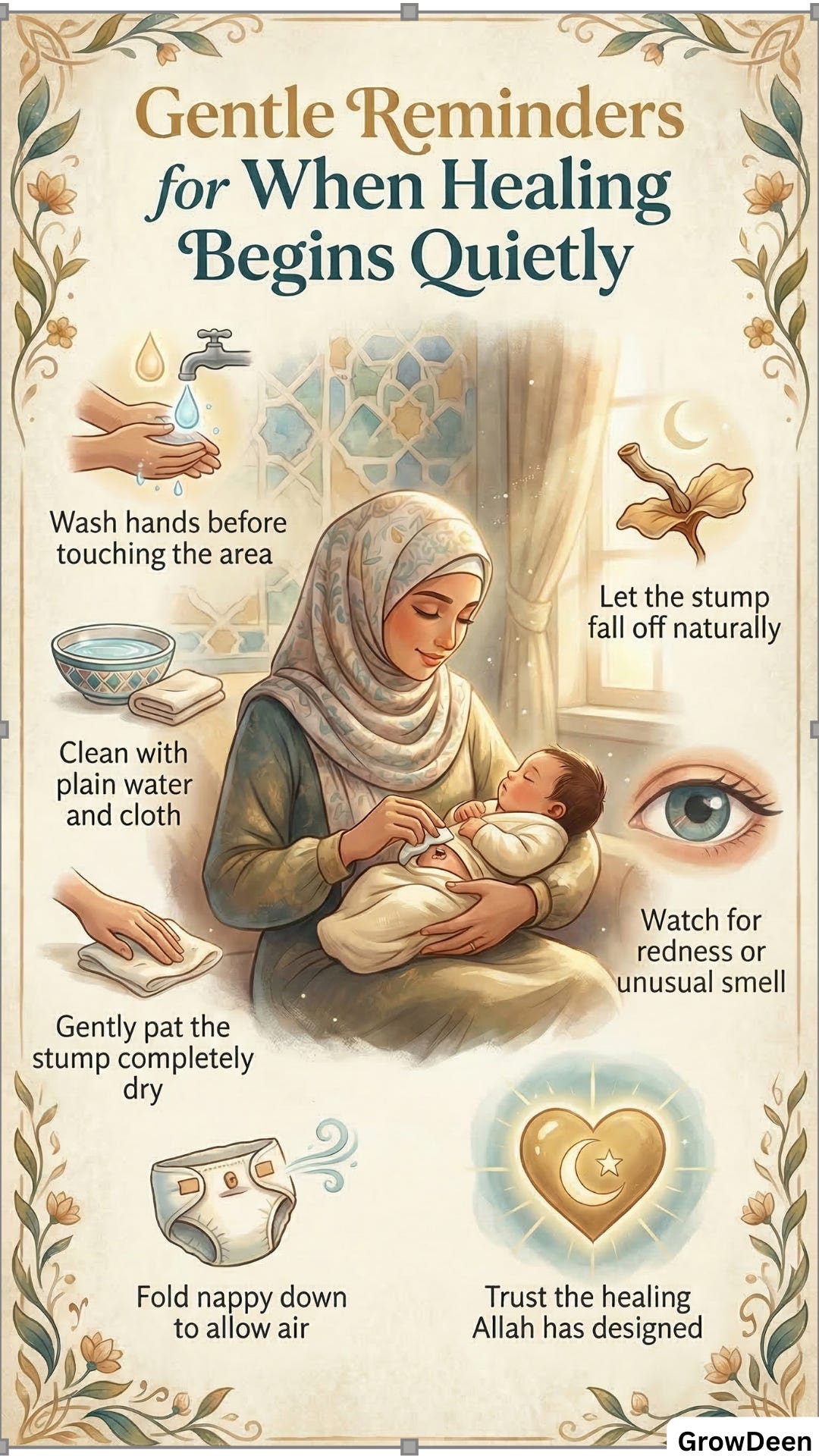
If the stump gets dirty from urine or stool, or if you are cleaning around it during bath time, wash your hands first. Then use a soft cloth or cotton ball with clean water to gently wipe around the area. If needed, a small amount of mild baby cleanser can be used. Afterward, pat it dry gently with a soft cloth. [1] [5] [6]
That is usually enough.
Dry cord care is widely recommended because letting the stump dry naturally supports normal healing. [1] [6]
A helpful practical habit is to fold the top of the nappy downward if it comes up over the stump. That helps keep air reaching the area instead of trapping moisture. Tight coverings and dressings are best avoided. [1] [2]
And one important rule belongs here very clearly.
Do not pull the stump off.
Even if it looks loose. Even if it seems almost ready. Let it detach in its own time.
When your concern deserves to be taken seriously
Most umbilical stumps heal quietly. But sometimes the body gives signs that something is not going as it should.
It is worth contacting your GP, paediatrician, or child health nurse if the stump has not fallen off after about two weeks, or if the skin around it looks red, swollen, warm, or noticeably irritated. A strong unpleasant smell deserves attention too. [1] [2]
Medical advice should also be sought if sticky fluid keeps coming out several days after the stump falls off, if the belly button becomes hot, swollen, or painful, or if your baby seems unusually sleepy, lethargic, unwell, or develops a fever. [1] [2] [5]
These are not the moments for a parent to minimize what they are seeing.
The Prophet ﷺ said, “There should be neither harming nor reciprocating harm.” [10]
Sometimes preventing harm looks like asking early instead of waiting in silence.
If this kind of calm, grounded support helps you in the newborn season, subscribe for free so the next article meets you in your inbox when you need it.
Sometimes the stump falls off, but the area still needs a little watching
After the stump falls away, some babies develop a small pink or red lump in the belly button called an umbilical granuloma. It may look moist and can sometimes leak a small amount of clear or yellow fluid. Many improve on their own, but it is still wise to have a doctor or child health nurse look at it because some cases need simple treatment. [2] [7]
Another thing parents may notice is a soft bulge near the belly button, especially when the baby cries or strains. This can be an umbilical hernia. In many infants it is harmless and painless, and it often closes on its own as the child grows, usually by three to five years. Still, it should be examined so the diagnosis is clear and the progress can be monitored. [8]
So again, the pattern is simple.
Do not panic.
Do not ignore.
Watch gently and ask when needed.
Gentleness is one of the most important parts of this care
Newborn care is full of tiny acts that seem ordinary from the outside.
Cleaning around a stump.
Folding a nappy down.
Checking for redness.
Pausing to see if something looks different today.
But these small acts matter.
And they matter not only medically. They matter spiritually too. The Prophet ﷺ said, “Allah is gentle and loves gentleness in all matters.” [12]
That hadith fits newborn life so beautifully.
Because this stage does not respond well to force.
It responds to steadiness.
To tenderness.
To the kind of attention that does not rush healing and does not neglect it either.
And when you feel unsure, remember that Allah does not ask you to do more than you can carry. “And do not throw yourselves into destruction with your own hands.” [11] There is wisdom in protecting health through even the smallest daily routines.
So if that tiny belly button has been making you nervous, breathe.
You do not need to become an expert overnight.
You need a clean routine, a watchful eye, and a gentle heart.
GIFTS FOR YOU, DEAR PARENT
If you’ve reached this part of the page, it tells me something meaningful about you.
You weren’t just skimming or passing time. You stayed because something here felt relevant to your real life.
Because you care.
Because you want to do things with more awareness.
Because you’re trying, even when it feels overwhelming.
That is not small.
So I didn’t want this article to remain just words on a page. I wanted it to gently step into your daily life in practical ways. That’s why we prepared these Life Gifts for you.
Not as extras.
Not as decorations.
But as simple tools to help you hold onto what mattered most in what you just read.
Here’s what you’ll find inside:
Gentle Understanding Card
A clear and simplified summary of the core concept from this article, so you can revisit the main idea anytime without rereading everything.
Heartfelt Dua Card
A carefully chosen dua connected to this stage of life, because we know that real strength and ease ultimately come from Allah’s help.
Gentle Actions Card
Practical examples to help you translate knowledge into action, so what you learned becomes part of your daily rhythm.
Gentle Reminders Card
Short, steady reminders drawn from the key points, designed to be printed or saved and placed somewhere you’ll see often.
These were designed slowly and thoughtfully, with time, care, and sincere dua. We created them because we genuinely want to walk alongside you, not just through one article, but through every stage of this lifelong journey.
If these gifts support you even in a small way, I would love for you to continue receiving them.
Subscribe so that each new Gift arrives directly in your inbox whenever we release the next stage. That way, you won’t miss the tools designed to support you right where you are.
May Allah place barakah in your effort, accept your intention, and make this path easier and more rewarding than it feels right now.
Please share it with a family or friend who may benefit from this knowledge.
What is one moment with your child that feels hardest lately, and what kind of support would make it feel lighter?
If you want gentle, benefit focused support for the newborn months, subscribe for free so the next article and the next set of Gifts arrive quietly in your inbox.
What part of newborn care has felt most unfamiliar or worrying for you lately?
References
[1] World Health Organization. Care of the Umbilical Cord: A Review of the Evidence. WHO Guidelines for Newborn Care.
[2] American Academy of Pediatrics. Caring for Your Baby and Young Child: Birth to Age 5. AAP Publications.
[3] Royal Children’s Hospital Melbourne. Umbilical Cord Care.
[4] Mayo Clinic. Umbilical Cord Care for Newborns.
[5] Centers for Disease Control and Prevention (CDC). Newborn Umbilical Cord Care and Infection Prevention.
[6] UNICEF. Essential Newborn Care Guidelines.
[7] Cleveland Clinic. Umbilical Granuloma: Symptoms and Treatment.
[8] Johns Hopkins Medicine. Umbilical Hernia in Children.
[9] Qur’an. Surah Al-Mu’minun 23:12–14.
[10] Sunan Ibn Majah 2340.
[11] Qur’an. Surah Al-Baqarah 2:195.
[12] Sahih Muslim 2593.