
The Optimal 6 Days of In 2026

The month of Ramadan may end, but the door of worship does not close with it. One of the most beautiful ways to carry the spirit of Ramadan forward is to fast six days in Shawwal. The Prophet ﷺ taught that the one who fasts Ramadan and then follows it with six days of Shawwal receives a reward like fasting the whole year.[1]
That is an extraordinary gift. A few more days of sincere worship, added after Ramadan, become a sign of consistency, gratitude, and a heart that still wants nearness to Allah.
What Is Shawwal?
Shawwal is the tenth month of the Islamic calendar. It begins immediately after Ramadan, and its first day is Eid al Fitr, a day on which fasting is not allowed.[2] From the second day of Shawwal onward, the six recommended fasts may be observed at any time before the month ends.[1]
These six days are not obligatory. They are a voluntary act of worship, but one of tremendous virtue. For many believers, they serve as the first test of whether the habits of Ramadan will continue after Eid.
The Hadith About the 6 Days of Shawwal
The clearest proof for this practice is the hadith of Abu Ayyub al Ansari رضي الله عنه. The Messenger of Allah ﷺ said:
“Whoever fasts Ramadan and then follows it with six days of Shawwal, it is as if he fasted for a lifetime.”[1]
Another narration explains the meaning behind this reward. Thawban رضي الله عنه reported that the Prophet ﷺ said that fasting Ramadan is like fasting ten months, and fasting six days afterward is like fasting two more months, making a full year in reward.[3]
This matches the Qur’anic principle that a good deed is rewarded tenfold.[4] In that sense, thirty days of Ramadan become like three hundred days in reward, and six more days become like sixty. Together, that reaches the reward of a full year.
Do the 6 Days Have to Be Consecutive?
No. A person may fast the six days consecutively or spread them throughout the month of Shawwal.[1] What matters is that the six fasts are completed within Shawwal itself.
Some people prefer to begin right after Eid so they can complete them early. Others spread them out because of work, family duties, travel, or physical energy. Both approaches are acceptable, inshaAllah.
When Can You Start?
You may begin from the second day of Shawwal, because fasting on Eid itself is prohibited.[2] After that, any six days in Shawwal may be chosen.
Many people love to start early because it helps preserve the momentum of Ramadan. But there is flexibility in the Sunnah, and that mercy should not be overlooked. The goal is not to create hardship. The goal is to continue worship with sincerity and steadiness.
How These Fasts Connect With Other Sunnah Fasts
In some years, certain days in Shawwal may overlap with other recommended voluntary fasts, such as the White Days or a Monday or Thursday. In those cases, many scholars mention that a person may hope for the reward of more than one voluntary intention on the same day, as long as the fasts are all voluntary in nature.[5][6]
That is why some people become especially excited when a cluster of Shawwal days also matches the White Days and Monday or Thursday fasting. It feels like a rare opening of mercy, where one act of worship may carry several layers of reward by the permission of Allah.
At the same time, it is important to remember that this discussion applies to voluntary fasts. An obligatory make up fast for Ramadan is a separate matter and should not be treated lightly.[4]
What About Missed Ramadan Fasts?
This is one of the most common questions, especially for women who missed days in Ramadan due to menstruation, pregnancy, breastfeeding, illness, or other valid reasons.
The Qur’an makes clear that missed Ramadan fasts are to be made up on other days.[4] Also, Aisha رضي الله عنها said that she would sometimes delay making up missed Ramadan fasts until Sha’ban.[7] Because of this, scholars discussed whether a person must complete missed Ramadan fasts before observing the six days of Shawwal.
There is a well known difference of opinion among scholars on this issue. Some preferred completing the obligatory fasts first, while others allowed a person to fast the six days of Shawwal before completing all missed Ramadan fasts, especially since the make up days remain due across the year.[4][7]
Because this is a fiqh issue with scholarly discussion, a person should follow a reliable scholar they trust. But one matter should remain clear: the six days of Shawwal do not replace missed Ramadan fasts. These are two separate acts of worship, and each has its own purpose and ruling.[4]
Who Can Fast These Six Days?
Anyone who is able to fast may take part in this Sunnah. That includes healthy adults, and even older children if they are physically able and their parents supervise them gently.
Those who are sick, elderly, traveling, menstruating, pregnant, or breastfeeding should consider their condition carefully and act with wisdom. Islam does not ask a person to harm themselves. Allah loves worship that is sincere and within one’s capacity.[4]
Spiritual Benefits of Fasting in Shawwal
The reward itself is enough to stir the heart, but the blessings of these fasts go beyond numbers.
Fasting six days after Ramadan is a sign that worship was not only seasonal. It suggests that the servant did not say goodbye to obedience the moment Eid arrived. Instead, they carried something of Ramadan into the days that followed.
It is also a beautiful way to show gratitude. Ramadan is a gift. Being allowed to worship in it is a gift. Reaching Eid is a gift. And continuing in worship after Eid is another gift still.
More than that, fasting has a special station with Allah. In a hadith qudsi, Allah says that fasting is for Him, and He Himself gives its reward.[8] The fasting person has two joys: one when breaking the fast and one when meeting his Lord.[8]
The Prophet ﷺ also said that whoever fasts one day for the sake of Allah, Allah distances his face from the Fire by seventy years.[9] And he ﷺ taught that in Paradise there is a gate called al Rayyan, through which those devoted to fasting will enter.[10]
When these hadith are remembered together, the six days of Shawwal stop looking like “just six extra fasts.” They become a path of hope, protection, gratitude, and closeness to Allah.
Practical Tips for Fasting the 6 Days of Shawwal
The days after Ramadan can quickly become busy. Family visits continue, routines return, and many people feel a drop in energy after the intensity of Ramadan. That is exactly why it helps to plan ahead.
Choose your six days early. Put them in your calendar. Speak to your family about them. If possible, fast with a spouse, sibling, friend, or members of your local community. Shared worship often makes consistency easier.
It also helps to pair fasting with other acts of remembrance. Read Qur’an. Increase dhikr. Make dua before iftar. Let these six days become more than abstaining from food and drink. Let them be six days of keeping the heart awake.
A Beautiful Opportunity in 2026
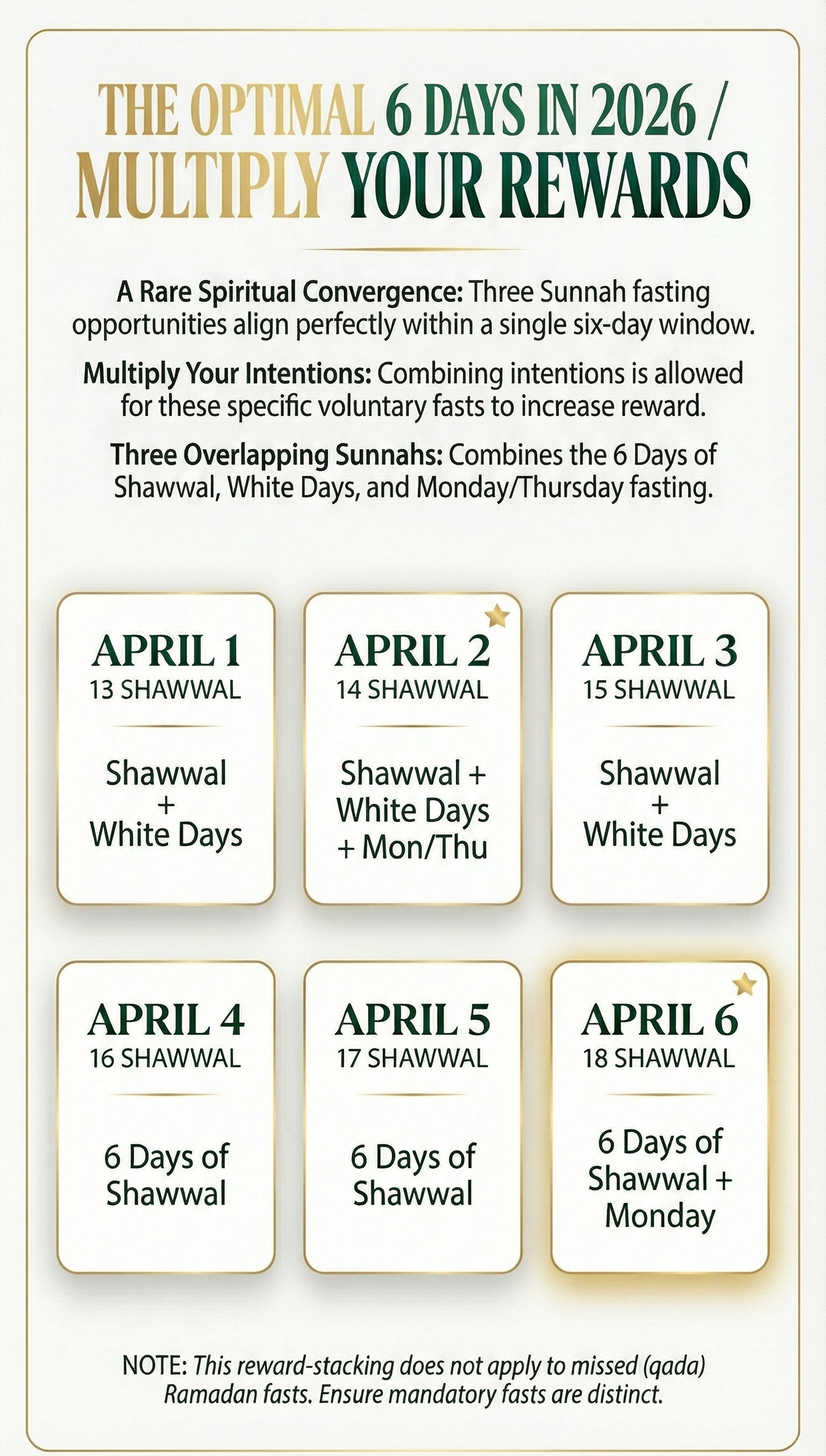
Based on the calendar being followed in this article, one especially meaningful window falls from April 1 to April 6, 2026. In that stretch, the six days of Shawwal can overlap with the White Days and with Monday or Thursday fasting.[5][6]
Here is that schedule in simple form:
Wednesday, April 1
13 Shawwal
6 days of Shawwal + White Days
Thursday, April 2
14 Shawwal
6 days of Shawwal + White Days + Monday/Thursday fasting
Friday, April 3
15 Shawwal
6 days of Shawwal + White Days
Saturday, April 4
16 Shawwal
6 days of Shawwal
Sunday, April 5
17 Shawwal
6 days of Shawwal
Monday, April 6
18 Shawwal
6 days of Shawwal + Monday fasting
As always, local moon sighting and local calendars may differ, so people should confirm dates with their local mosque or trusted Islamic authority.[2]
Frequently Asked Questions
Do I have to fast all six days in a row?
No. You may fast them consecutively or separately throughout Shawwal.[1]
Can I fast them after Shawwal ends?
The specific Sunnah is tied to the month of Shawwal, so the six days should be completed within that month.[1]
Are the 6 days of Shawwal the same as the White Days?
No. The six days of Shawwal are a specific Sunnah connected to the month of Shawwal.[1] The White Days are a separate monthly Sunnah connected to fasting three days each month, and many scholars identify them as the 13th, 14th, and 15th.[5]
Can women fast them after menstruation ends?
Yes. If a woman is unable to fast during menstruation, she resumes when she becomes pure. If time remains in Shawwal, she may complete as many of the six days as she is able.[4]
Can children fast these days?
Yes, if they are physically able and it is done with wisdom, gentleness, and parental care.
Conclusion
Shawwal is not the end of the journey. It is the beginning of what comes after a blessed month. Ramadan trains the heart, but Shawwal reveals whether the heart wants to continue.
The six days of Shawwal are a simple Sunnah, but they carry tremendous reward.[1][3] They teach consistency after intensity. They teach gratitude after blessing. And they remind us that the Lord of Ramadan is also the Lord of Shawwal, Dhul Qa’dah, and every month of the year.
Whoever is able should not let this opportunity pass lightly. Six days may seem small, but with Allah, small acts done sincerely can open doors far greater than we imagine.
References
[1] Sahih Muslim, Book of Fasting, Hadith 1164a – Whoever fasts Ramadan then follows it with six of Shawwal
[2] Sahih al Bukhari, Book of Fasting – Prohibition of fasting on Eid al Fitr and Eid al Adha
[3] Sunan Ibn Majah, Hadith 1715 – Ramadan equals ten months and six days equal two months
[4] Qur’an 2:185 – Missed fasting days are to be made up on other days
[5] Jami’ al Tirmidhi, Hadith 761 – Fasting the 13th, 14th, and 15th of the lunar month
[6] Jami’ al Tirmidhi, Hadith 747 – Deeds are presented on Monday and Thursday, and I love that my deeds be presented while I am fasting
[7] Sahih al Bukhari, Hadith 1950 – Aisha رضي الله عنها delayed making up missed Ramadan fasts until Sha’ban
[8] Sahih al Bukhari, Hadith 1904 – Fasting is for Me and I shall reward for it
[9] Sahih Muslim, Hadith 1153 – Whoever fasts one day for Allah, Allah distances him from the Fire
[10] Sahih al Bukhari, Hadith 1896 – The gate of al Rayyan for those who fast